Distilling Visual Agents from Minimal Interaction: 4B Student Model Achieves Over 90% Performance Gain

Distilling visual agents with just four curated trajectories, a 4B model recovers over 90% of the gap to a 27B teacher.
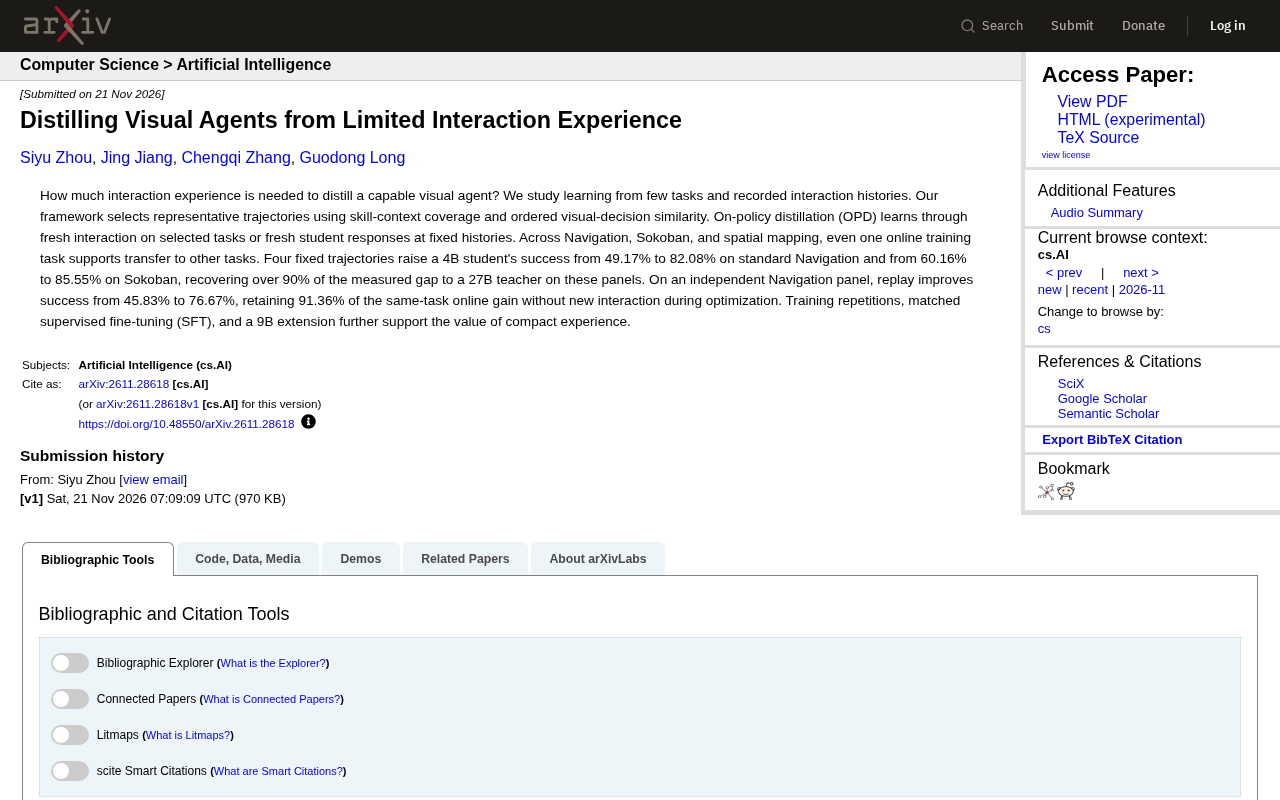
This study proposes a framework for distilling visual agents from extremely limited interaction experience, selecting representative trajectories via skill-context coverage and ordered visual decision similarity, then transferring knowledge through policy distillation (OPD) in both online and replay modes. On navigation and Sokoban tasks, four fixed trajectories raise a 4B student model's success rates from 49.17% to 82.08% and from 60.16% to 85.55%, both recovering over 90% of the measured gap to the 27B teacher. Replay on an independent navigation set lifts success from 45.83% to 76.67%, retaining 91.36% of the online gain. Repetition, matched SFT, and 9B scaling experiments further confirm the value of compact experience.
Visual agents typically rely on large amounts of interaction data for training, but a new study shows that a strong student model can be distilled from just a tiny amount of interaction experience. The research explores learning from a small number of tasks and recorded interaction histories, achieving significant results on tasks such as navigation, Sokoban, and spatial mapping—even enabling transfer with just a single online training task.
Framework Design: Curated Trajectories and Policy Distillation
The research team proposes a framework that selects representative trajectories based on skill-context coverage and ordered visual decision similarity. Policy distillation (On-Policy Distillation, OPD) has two implementations: fresh interaction on selected tasks, or fresh responses from the student model under a fixed history. The core of this approach lies in maximizing knowledge transfer efficiency using limited interaction data.
Policy distillation (On-Policy Distillation, OPD) is a knowledge transfer method in which the student model learns on trajectories generated by its own policy, with the teacher model providing step-by-step supervision signals on these trajectories, rather than directly fitting the teacher model's output distribution on a fixed dataset. Compared with traditional offline distillation, the key advantage of OPD is that the training distribution matches the state distribution the student model encounters during actual deployment, thereby mitigating the "exposure bias" problem—where intermediate states encountered by the student model at inference time do not match the states seen during training. In this study, OPD has two variants: one is fresh interaction on selected tasks, where the student model interacts with the environment in real time and is labeled by the teacher; the other is to have the student model generate new responses for existing trajectories under fixed historical records and then align them, thereby reusing existing experience without touching the environment at all.
Skill-context coverage and ordered visual decision similarity are the two core metrics used in this paper for trajectory selection. The former measures the breadth of coverage of the selected trajectory set in the "skill-context" space—that is, whether the perception–decision patterns required by different tasks are sufficiently represented, avoiding the selection of highly redundant samples; the latter compares the similarity of decision sequences under visual input between trajectories, emphasizing the temporal structure of decisions rather than single-frame state matching. Combined, these two metrics ensure that trajectories selected under a very small sample budget can both cover diverse skill situations and be representative at the decision level, allowing limited interaction experience to carry the greatest knowledge transfer value. This selection mechanism is the prerequisite for "four trajectories being enough to recover most of the performance gap."
Experimental Results: A Few Trajectories Substantially Improve Success Rates
Experiments on navigation, Sokoban, and spatial mapping tasks show that even a single online training task can support transfer to other tasks. Specifically, four fixed trajectories raise the success rate of the 4B student model on the standard navigation task from 49.17% to 82.08%, and on the Sokoban task from 60.16% to 85.55%. These two results recover more than 90% of the measured gap to the 27B teacher model.
In addition, on an independent navigation test set, replay raises the success rate from 45.83% to 76.67%, requiring no new interaction during optimization and retaining 91.36% of the same-task online gain. Training repetition, matched supervised fine-tuning (SFT), and scaling experiments with a 9B model further support the value of compact experience.
Replay in this experiment refers to distillation training using recorded interaction histories without new interaction with the environment. Compared with online OPD, replay eliminates the overhead of environment calls and real-time teacher queries, but its supervision signals come from fixed historical trajectories with limited distribution coverage. Experiments show that replay retains 91.36% of the same-task online gain on an independent navigation test set, indicating that compact experience records themselves already contain most of the transferable decision knowledge. This result has clear implications for practical deployment: in scenarios where interaction costs are high or the environment cannot be accessed repeatedly, a small number of high-quality trajectories can be collected once and reused offline repeatedly.
Significance and Outlook
This study demonstrates the potential of distilling visual agents from limited interaction experience, offering new ideas for reducing training costs and data requirements. Through curated trajectories and policy distillation, small models can achieve performance close to large models, which cannot be ignored for practical deployment and resource-constrained scenarios.
(Note: This article is based on the paper abstract; please refer to the original paper for more details.)
Supervised fine-tuning (SFT) versus policy distillation is key to understanding the conclusions of this paper. SFT typically has the student perform behavior cloning on fixed trajectories generated by the teacher, optimizing the likelihood of teacher actions; whereas OPD has the student receive teacher corrections on its own state distribution. The paper mentions that "matched supervised fine-tuning" is less effective than distillation, suggesting that under extremely few-sample conditions, simply imitating teacher actions can fail due to distribution shift, whereas exposing the student to its own error states and receiving targeted guidance can achieve stronger generalization with less data. This also explains why the 4B student model can recover more than 90% of the measured gap to the 27B teacher.
One-line Summary
Distilling visual agents with just four curated trajectories, a 4B model recovers over 90% of the performance gap to a 27B teacher.
Paragraph Summary
This study proposes a framework for distilling visual agents from extremely limited interaction experience. Its core is selecting representative trajectories via skill-context coverage and ordered visual decision similarity, then achieving knowledge transfer through policy distillation (OPD), supporting both online fresh interaction and replay from fixed histories. On navigation, Sokoban, and spatial mapping tasks, four fixed trajectories raise the 4B student model's navigation success rate from 49.17% to 82.08% and Sokoban from 60.16% to 85.55%, both recovering more than 90% of the measured gap to the 27B teacher. On an independent navigation test set, replay raises the success rate from 45.83% to 76.67%, retaining 91.36% of the online gain. Training repetition, matched SFT, and 9B scaling experiments further validate the value of compact experience, offering new ideas for reducing training costs and data requirements.
Related articles

From 0 to 1: Vibe Coding an AI Knowledge Base — A Practical Retrospective and Tech Stack Breakdown
A retrospective on building the AI knowledge base OilBook from scratch with Vibe Coding: Next.js+Neon stack, Oil Dev Skill workflow, Stripe paywall security, interview-style writing, AI-flavor control, and Vercel deployment.

GLM-5.4 Hands-On: Native Vision Meets a New Vibe Coding Workflow
Hands-on with Zhipu GLM-5.4: native vision tested across a 3D product demo, pure-code video generation, and remote-control Vibe Coding, compared with GPT-6.2 and Gemini Neon.

AI and Humans Claim to Prove the Riemann Hypothesis: Machine-Verified, Yet Nobody Can Understand It
Anthropic mathematician and AI Claude claim to prove the Riemann Hypothesis with 17 million lines of Lean code, machine-verified but unreadable by humans. This article analyzes the event, the zero proportion record from 41.6% to 67.2%, and the gap between machine verification and human understanding.