DIY Controller Upgrade: TMR Stick + Back Paddles Mod Tested — Can It Beat the Official Pro Controller?

LTT's 10-hour DIY mod tests whether TMR sticks can make budget controllers rival $200 flagships.
The Linus Tech Tips team spent over 10 hours modding a drifting DualSense and an Xbox One controller with TMR magnetic sticks, back paddles, trigger stops, and new shells — attempting to replicate Elite 2 and DualSense Edge features at lower cost. TMR sticks delivered notably better feel and reliability, and transparent clickable buttons earned high praise, but difficult desoldering caused multiple board failures. The conclusion: the Xbox mod offers strong value, while the DualSense Edge becomes hard to justify once modding is on the table.
First-party game controllers have long set the industry standard for build quality, yet they've consistently lagged behind on innovative features — many of which were actually pioneered by cheaper third-party alternatives. When aftermarket mod parts begin matching official build quality while offering better functionality, a natural question arises: why spend $200 on an official "Elite" controller?
The Linus Tech Tips team tried to answer that question with a DIY experiment spanning over 10 hours. Armed with a heavily drifting old DualSense and a dusty Xbox One controller pulled from a van, they turned to the modding community in an attempt to transform aging hardware into something that could rival official flagship devices.
The Core Upgrade: Potentiometer Sticks to TMR
The heart of the entire mod is the thumbstick module replacement. Every current first-party controller — even high-end models — ships with potentiometer-based analog sticks by default. These sticks have physical contact strips inside that wear down over time, which is the root cause of "stick drift."
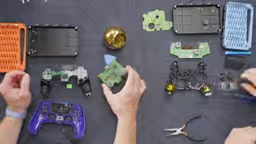
The mod offers two upgrade paths: Hall Effect and the newer TMR (Tunnel Magneto Resistant) sticks. Both replace physical contacts with magnets, dramatically improving reliability and longevity. The video specifically uses GuliKit's TMR sticks, which have the advantages of being more power-efficient, more precise, and more resistant to external interference than Hall Effect solutions — all while using smaller magnets.
Even before installing the TMR sticks, the author could already feel that the "movement was smoother," with noticeably better consistency between diagonal and cardinal directions compared to the stock sticks. It's worth noting that the TMR stick's center return spring can theoretically still degrade over time, though the author says they haven't encountered any noticeable deterioration.
Potentiometer-based analog sticks detect stick position through variable resistance: as the stick moves, internal carbon film tracks make physical contact with metal brush contacts, changing the resistance value, which is then converted into coordinate signals. This design is inexpensive and technically mature, but carbon film wear is a structural flaw — over time, the brush contacts can no longer make stable contact with the tracks, causing the controller to output drifting signal values even at rest. This is the origin of "stick drift," and no potentiometer-based stick from any brand can fundamentally avoid this problem — they just vary in how long they last.
Hall Effect sticks detect position by measuring changes in a magnet's magnetic field near a sensor, with no physical contact whatsoever, theoretically eliminating wear-based drift. TMR (Tunnel Magneto Resistant) is a newer generation of magnetic sensing technology that uses quantum tunneling-induced magnetoresistance changes to detect magnetic fields. It offers higher sensitivity, lower power consumption, and better interference rejection against stray magnetic fields compared to traditional Hall sensors, while also allowing the use of smaller magnets — helping reduce module size.
More Than Just Sticks: A Full Feature Stack
The team's mod list was ambitious: TMR stick replacement, LED backlit buttons, shell replacement, a new back plate with paddles and trigger stops. The DualSense additionally received transparent clickable face buttons and a D-pad, along with a larger battery (rated at 4000mAh, though the author expressed skepticism about that number).
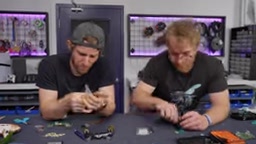
Difficulty varied noticeably between the two platforms. The Xbox controller mod was rated as "more beginner-friendly," but with one hard prerequisite — you must use a specific motherboard revision (model 1708) and flash new firmware that Microsoft doesn't officially support, in order to "upgrade" an Xbox One controller to Series-level compatibility with Microsoft's calibration tools. The PlayStation controller teardown was considerably more involved.
The author admitted that doing any single mod individually has fairly comprehensive written guides, but the real challenge is that "when you're doing all the mods at the same time, sequencing the steps becomes a puzzle" — while following the back paddle guide, he discovered he'd done several steps for the LED buttons in the wrong order.
Paddles are extra buttons located on the back of the controller that can be remapped to any commonly used input (like jump or reload), allowing players to perform more actions without taking their thumbs off the sticks. They're especially useful in FPS and action games. Trigger Stops are physical locks that, when inserted, shorten the trigger travel to its minimum, enabling faster digital inputs (like firing) — commonly used in competitive scenarios sensitive to trigger latency. Both features are core selling points of Microsoft's Xbox Elite series and Sony's DualSense Edge, and represent the primary functional targets this mod aims to replicate. It's worth noting that paddle remapping functionality typically relies on a chip built into the aftermarket back plate and has compatibility requirements with the controller's main board firmware — not all third-party back plates work correctly on every firmware version.
Soldering Hell: Stick Removal Is the Biggest Bottleneck
The most time-consuming part of the entire project was the soldering and desoldering of the stick modules. Because stick modules have many solder joints, removing them requires extensive desoldering work. Many guides simply recommend "destructive removal" of the sticks to save time, but the team initially committed to a non-destructive approach.
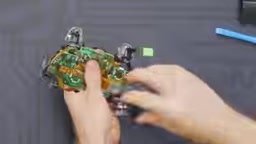
The results were rough. The video uses a "7 hours later" title card to hint at the ordeal: the Xbox controller's solder wick desoldering approach "worked reasonably well," while the hot air station method was merely passable due to inexperience. The PlayStation controller fared worse — one board was ruined by a melted connector, and the second stick proved so difficult to remove that they ultimately resorted to destructive methods anyway. The duo even scrapped an entire board and started over.
A recurring lesson throughout: this is not a project for people who don't enjoy electronics DIY. Springs flying everywhere, misaligned solder joints, parts that might be installed wrong — these situations were constant. The author's takeaway was blunt: "Watch the entire video first, then start working."
Stick modules typically use through-hole soldering, where the module's pins pass through the board's pads and are secured with solder points — usually between 7 and 14 pins. Removal requires completely clearing all solder from each joint before the module can be extracted without damaging the pads. The two common desoldering methods are: Solder Wick (Desoldering Braid), a copper braid that absorbs melted solder through capillary action when heated — relatively controlled but slow; and a Hot Air Station, which can heat multiple joints simultaneously for greater efficiency, but with poor temperature and airflow control, can easily damage nearby plastic parts, connectors, or even chips. For inexperienced users, the risk of collateral damage from a hot air station is far higher than from solder wick — which is exactly what caused the PlayStation board failure in the video.
Results and Whether It's Worth It
After all the effort, both controllers lit up and worked correctly. Paddle remapping, trigger stops, and LED lighting all functioned as intended, and the PlayStation controller's back plate even had a small configurable screen.
In terms of feel, the transparent clickable face buttons were called "world-class" — the one upgrade the author explicitly said he would "definitely do again." The LED lighting on both controllers received a more lukewarm reception — the author already turns off the light bar on his PS5 and doesn't need more lights shining in his face. On the paddle front, the DualSense aftermarket paddles felt soft and "mushy," noticeably worse than the stiffer, more tactile Xbox paddles.
On cost — this is the central argument of the entire project: modding a standard DualSense ends up "not being much cheaper than an actual Edge," but the Xbox mod is both cheaper and simpler, delivering a near-Elite 2 experience at a lower price point. The author was direct: "This makes the Edge completely pointless, and buying a controller plus mods is cheaper than buying an Edge."
That said, the mod doesn't fully replicate every official flagship feature. The Elite 2's adjustable stick tension, the Edge's software tools (behind a paywall), along with the additional stick modules and carrying case included with official products, remain differentiators. But the author's view is that swapping fixed TMR sticks in place of replaceable potentiometer sticks is an entirely worthwhile trade — "these will outlive generation after generation of replacement parts."
Final Thoughts
This experiment is less a tutorial and more a counterargument to big-brand pricing strategy. When drift — a problem that could be avoided with better hardware — instead becomes a reason to force users into repeated controller purchases, the modding community responds with magnetic sticks and modular components as an alternative.
The cost is very real: over 10 hours of soldering, disassembly, and trial and error — not something the average gamer can easily replicate. But for those willing to dive into electronics DIY, a fully custom controller built entirely by hand, packed with features, and priced within reason delivers a kind of satisfaction that no official flagship can match.
Related articles

Chain of Thought Isn't Just for AI: How Humans Can Use CoT to Improve Thinking Quality
Chain of Thought isn't just a prompt trick for large models. Starting from a Hacker News discussion, this article analyzes why CoT works for human thinking too, breaks down actionable ways to transfer it, and highlights the key differences between human CoT and machine CoT.
Cloudflare Teams Up with OpenAI: Closi…
Cloudflare Teams Up with OpenAI: Closing the Loop from Vulnerability Discovery to Defense with AI
Cloudflare uses OpenAI Daybreak to investigate security vulnerabilities and generate reviewable remediation plans, while developers use Codex to boost coding efficiency and quality.

Orca Multi-Agent Orchestration in Practice: A Guide to Parallel Collaboration with Claude and Codex
Orca is Stable AI's free open-source agent workbench supporting 34 agents like Claude Code and Codex in parallel. Learn its Git worktree isolation, multi-model orchestration, and mobile management.