DIY Custom Alarm Clock for His Daughter: One Father's Frustration with Off-the-Shelf Products

A developer built a custom alarm clock for his daughter after finding nothing on Amazon good enough.
A developer shared on Hacker News how he built a custom children's alarm clock for his daughter after finding every Amazon option lacking. The piece uses this as a springboard to explore three core values of DIY hardware: precise personalization, data privacy control, and hands-on engineering learning. Platforms like Raspberry Pi, Arduino, and ESP32 have lowered the barrier dramatically, making weekend projects viable. The author also notes honestly that DIY's real cost lies in time and maintenance — the value is in getting something the market can't offer, not in saving money.
When "Can't Find the Right One" Becomes a Reason to Build
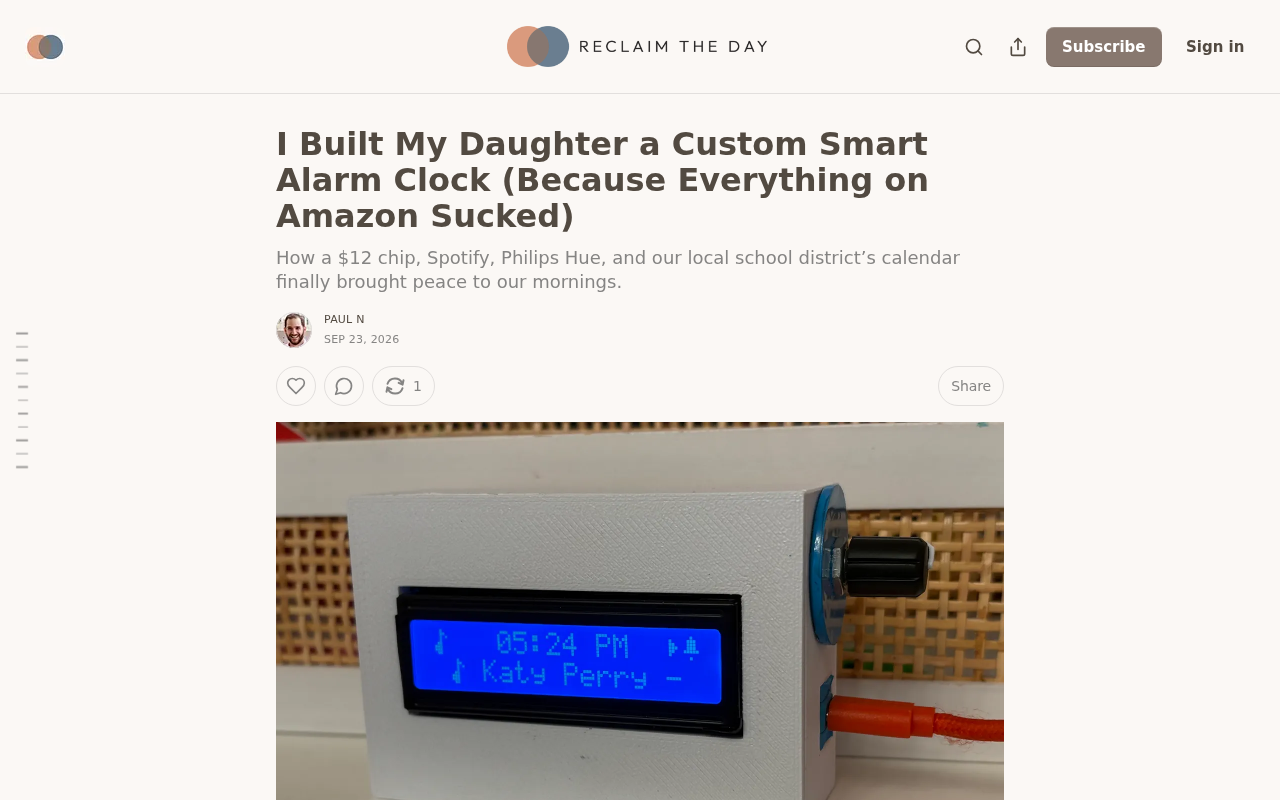
A developer shared a project on Hacker News: frustrated that none of the children's alarm clocks on Amazon were quite right, he decided to build a custom one for his daughter from scratch. This seemingly simple little project reflects a mindset common among many tech enthusiasts — when off-the-shelf products can't meet specific needs, why settle when you can just build it yourself?
Children's alarm clocks might seem like a mature product category, but parents who actually use them often run into all kinds of pain points: interfaces that aren't kid-friendly, features that are either too complex or too bare-bones, cheap build quality, poor customizability, and some products even stuffed with unnecessary connectivity features and ads. For a father with the skills to do something about it, these shortcomings become exactly the motivation to solve the problem himself.
The Real Value of DIY Hardware Projects
Personal hardware projects like this aren't uncommon in the developer community. They're typically driven by a few common factors.
Precisely Meeting Individual Needs
Commercial products target the largest common denominator of users, making it hard to accommodate every family's specific situation. Building a custom alarm clock for your child means designing it entirely around that child's sleep schedule, cognitive level, and aesthetic preferences — for example, using colors instead of numbers to signal "time to wake up," or incorporating sound effects and lighting the child actually enjoys. That kind of tailored fit is something no mass-produced product can offer.
Control Over Data and Privacy
Many smart children's devices today require internet connectivity, account registration, and even usage data collection. For privacy-conscious parents, a self-built device that runs entirely locally and doesn't depend on the cloud is far more reassuring. Code you wrote yourself, circuits you wired yourself — the logic is transparent and under your control.
A Double Payoff: Learning and Connection
Building a physical product is itself a complete software-hardware engineering exercise, touching on hardware selection, circuit design, firmware development, and even enclosure printing. And when the project is made for your own child, it carries an extra layer of emotional value — it's a one-of-a-kind object made with a parent's love.
From "Complaining" to "Building": A Technical Culture
"Everything on Amazon is terrible, so I made my own" — this sentence is almost a perfect encapsulation of the Hacker News community spirit. Rather than simply consuming and complaining, this community tends to use technical means to solve problems they personally encounter.
Underpinning this culture is the steadily falling barrier to hardware development. Open-source hardware platforms like Raspberry Pi, Arduino, and ESP32, combined with 3D printing, open-source firmware, and active community tutorials, have made it easier than ever to build a fully functional custom device. A weekend side project can now produce something genuinely useful.
That said, it's worth being realistic: the "cost" of a DIY project is not low. The components may be cheap, but the time invested, the debugging effort, and the ongoing maintenance responsibility all fall on the builder. The value of commercial products lies precisely in the fact that they bundle all those hidden costs together. So the point of projects like this usually isn't to save money — it's to get something the market doesn't offer, and to enjoy the process of making it.
Raspberry Pi is a single-board computer developed by a UK nonprofit, offering a low price point with a full Linux environment — suited for complex projects that require an operating system. Arduino is a development board based on AVR or ARM microcontrollers, known for its straightforward C/C++ programming model and ideal for embedded scenarios that directly drive sensors and peripherals. ESP32 is a low-power Wi-Fi/Bluetooth dual-mode chip from Espressif Systems; with built-in wireless capability and an extremely low price (often under $5), it has become the go-to choice for IoT projects. The three platforms serve different use cases, and selection typically involves trade-offs between processing power, power consumption, connectivity requirements, and development complexity. For a use case like a children's alarm clock, ESP32 or Arduino paired with a small display is often the most cost-effective combination — no full operating system required to handle core functions like timekeeping and audio/visual alerts.
What This Small Project Teaches Us
This post didn't generate much traction on Hacker News (3 points, 2 comments), but the thinking it represents is worth reflecting on for anyone in tech: when you're dissatisfied with a product, do you keep putting up with it, or do you treat it as an opportunity to build something yourself?
For engineers with children, projects like this carry an additional kind of value — they're the best way to show the next generation that "technology can create things." When a child wakes up every morning to an alarm clock their parent built by hand, the seed of curiosity about making things might just take root.
One unfortunate gap: the original post didn't include any specific technical details — what hardware platform was used, how the interaction was implemented, or what problems were encountered along the way. Those are exactly the parts the community finds most interesting. A great DIY write-up, paired with open-source code, a bill of materials, and a honest account of the pitfalls, often inspires far more people to join the "build it yourself" camp.
Related articles

Kimi K3.1 Hands-On Test: Open-Source Model Nears Opus, Video Generation Steals the Show
Kimi K3.1 completed motion graphics, 3D rendering, mini-games, and video generation in a live test. Analysis of its 2.8T MoE architecture, gap vs Opus/GPT, and hidden video generation.

Sam Altman: Why Life's Biggest Advice Should Still Come from Humans
OpenAI CEO Sam Altman on the limits of AI advice: AI can talk you out of an impulsive email, but life's biggest advice should still come from humans.

"Black October": Did AI Uncover 3% of All Critical Vulnerabilities Ever?
A Reddit post claims 3% of all critical software vulnerabilities ever were found in the past month, dubbed 'Black October.' We break down the statistical issues, how AI-assisted code auditing accelerates discovery, and how developers should respond.