DKnow-Jev-2: An Efficient Inference Solution for Provision-Level Answer Evidence Classification

DKnow-Jev-2 introduces a provision-level evidence classifier that jointly encodes question conditions and provision content for cross-paragraph evidence integration.
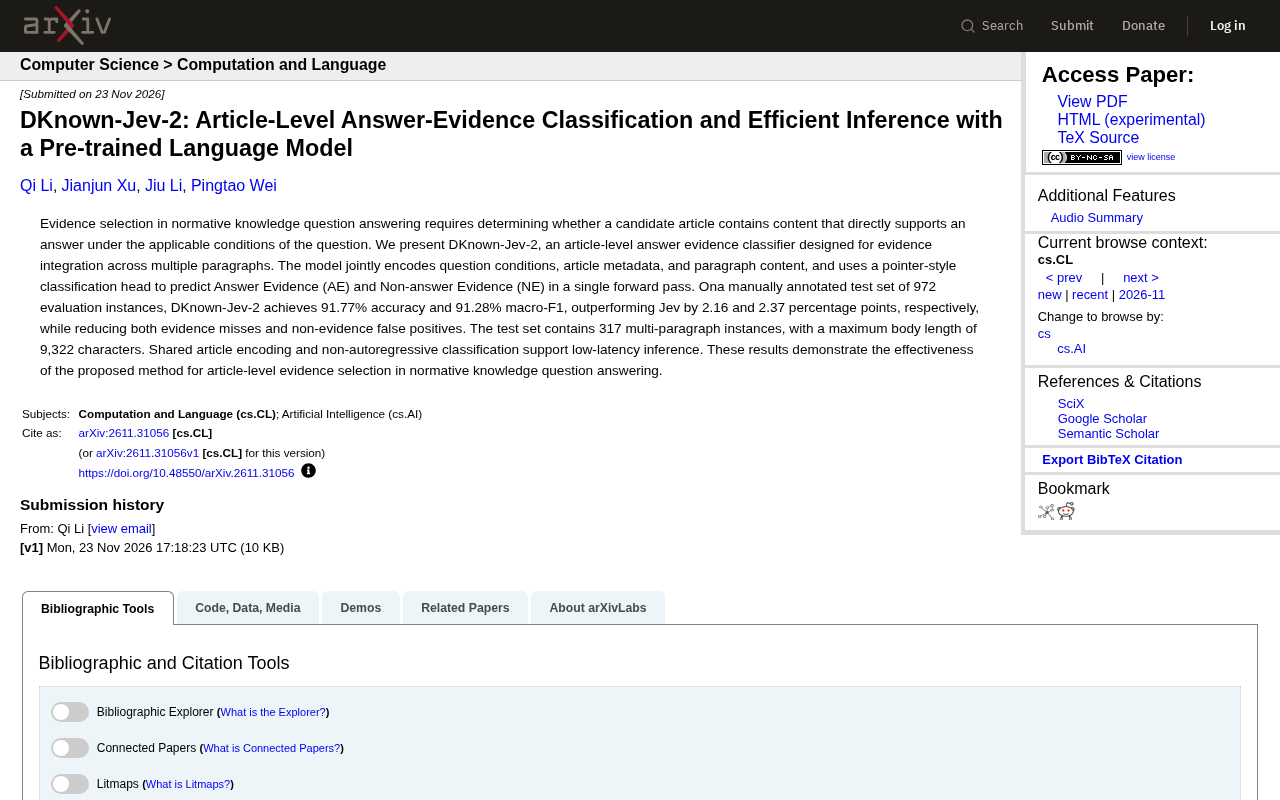
DKnow-Jev-2 is a provision-level answer evidence classifier for normative knowledge QA, designed to address the difficulty paragraph-level filtering has with cross-paragraph conditions and exceptions. The model jointly encodes question conditions, provision metadata, and paragraph content, uses a pointer-style non-autoregressive classification head to simultaneously predict Answer Evidence and Non-answer Evidence in a single forward pass, and achieves low-latency inference through shared provision encoding. On 972 manually annotated instances, it achieves 91.77% accuracy and 91.28% macro-averaged F1, improving over Jev by 2.16 and 2.37 percentage points respectively, while simultaneously reducing evidence misses and non-evidence false positives. The test set contains 317 multi-paragraph instances with a maximum body length of 9,322 characters. The authors note that this is a controlled evaluation; generalization to real-world distributions, handling of extremely long provisions, and robustness to missing metadata remain to be validated.
In normative knowledge QA, determining whether a candidate provision truly "supports" an answer is often trickier than finding the answer itself. Traditional approaches perform evidence filtering at the paragraph level, but in legal, regulatory, and standards texts, answers are often scattered across multiple paragraphs or even across chapters with conditions and exceptions. DKnow-Jev-2 is a provision-level answer evidence classifier proposed to address this pain point, with the core goal of achieving cross-paragraph evidence integration.
Problem Definition: Why Provision-Level Evidence Classification Is Needed
The difficulty of normative knowledge QA lies not in language understanding but in matching "applicability conditions." A candidate provision may contain wording highly similar to the question, yet fail to directly support the answer because its preconditions, scope of application, or exception clauses are not satisfied. In such cases, paragraph-level classifiers easily misjudge semantically similar but conditionally mismatched content as evidence.
DKnow-Jev-2 defines the task as follows: given question conditions, provision metadata, and paragraph content, determine whether the provision as a whole contains content that directly supports the answer under the question's applicability conditions, outputting Answer Evidence (AE) or Non-answer Evidence (NE). This provision-level modeling requires the model to simultaneously understand conditional constraints and cross-paragraph evidence distribution, rather than examining a single paragraph in isolation.
Normative Knowledge QA differs from open-domain QA in that answer correctness depends heavily on precise matching of provision applicability conditions. Here, "normative" texts broadly refer to legally binding documents such as statutes, administrative regulations, industry standards, and technical specifications. Their common feature is that answers are often nested within hierarchical provision structures (article-paragraph-item) and are subject to multiple constraints including scope of application, exception clauses, and preconditions.
A typical pitfall in this type of QA is that a candidate provision is highly similar to the question in literal terms, but its applicability conditions do not hold. For example, if a question asks whether a certain type of enterprise qualifies for a tax incentive, a provision may describe that incentive but restrict it to a different industry or size range—in which case a semantically similar paragraph does not constitute valid evidence. Therefore, evidence filtering in normative knowledge QA cannot rely solely on textual similarity; it must model the "condition–conclusion" correspondence. This is the fundamental reason why provision-level modeling fits the task structure better than paragraph-level modeling.
Model Design: Joint Encoding and Pointer-Style Classification Head
DKnow-Jev-2 uses a pretrained language model as its backbone and jointly encodes three types of input: question conditions, provision metadata, and paragraph content. The introduction of metadata allows the model to leverage hierarchical and source information of provisions, while joint encoding of multi-paragraph content supports cross-paragraph evidence integration.
The classification stage uses a pointer-style classification head that simultaneously predicts AE and NE in a single forward pass. This non-autoregressive design avoids the serial overhead of paragraph-by-paragraph generation, and combined with shared provision encoding, keeps inference latency at a low level. For QA systems requiring real-time responses, low-latency inference is as important as accuracy.
The pointer-style classification head draws on the idea of Pointer Networks, whose core is to use attention weights to directly point to positions or categories in the input sequence, rather than outputting fixed labels through an independent classification layer. In DKnow-Jev-2, this design manifests as simultaneously predicting the two labels AE and NE in a single forward pass, essentially compressing multi-label determination into single-step decoding.
In contrast, non-autoregressive decoding works as follows: traditional sequence generation models output tokens one by one serially, with inference latency growing linearly with output length; non-autoregressive designs produce all predictions in parallel at once. Combined with shared provision encoding—where multiple paragraphs within the same provision are encoded only once and their representations reused—the model's inference overhead is substantially reduced. This combination is especially critical for batch filtering scenarios involving hundreds or thousands of candidate provisions, because the latency advantage scales linearly with the number of candidates.
Experimental Results: Simultaneous Improvement in Accuracy, Misses, and False Positives
According to the paper, on a manually annotated evaluation set of 972 instances, DKnow-Jev-2 achieves 91.77% accuracy and 91.28% macro-averaged F1. Compared with Jev, accuracy is 2.16 percentage points higher and macro F1 is 2.37 percentage points higher.
More noteworthy is the change in error structure: the model simultaneously reduces evidence misses and non-evidence false positives. In evidence filtering, these two types of errors often trade off against each other, so reducing both indicates that the classification boundary has become clearer. The test set contains 317 multi-paragraph instances, with the maximum body length reaching 9,322 characters—a scale that poses a real challenge for cross-paragraph evidence integration.
Macro-averaged F1 is computed by first calculating the F1 value for each class separately (here, AE and NE) and then taking the arithmetic mean. Unlike micro-averaged F1, macro averaging assigns equal weight to each class, so when class sizes are imbalanced—for example, when non-evidence paragraphs far outnumber evidence paragraphs—macro F1 more sensitively reflects the recognition quality of the minority class (evidence), without being masked by the majority class's performance.
Evidence misses refer to cases that should be judged AE but are judged NE, corresponding to recall loss; non-evidence false positives refer to cases that should be judged NE but are judged AE, corresponding to precision loss. In evidence filtering, these two types of errors typically involve a trade-off: loosening the decision threshold reduces misses but raises false positives, while tightening the threshold does the opposite. Therefore, both decreasing simultaneously means the model has learned a more discriminative decision boundary, rather than merely moving the operating point along the trade-off curve.
Efficiency and Applicability Boundaries
Shared provision encoding and non-autoregressive classification are the two key designs for low-latency inference. The former avoids repeatedly encoding multiple paragraphs within the same provision, while the latter compresses classification into a single forward pass. For normative knowledge QA scenarios with large numbers of provisions requiring batch filtering, this efficiency advantage grows with the number of candidate provisions.
It should be noted that the current results are based on a test set of 972 manually annotated instances, constituting a controlled evaluation. The paper does not provide further data on the model's generalization performance under real-world business distributions, its ability to handle extremely long provisions (over 9,322 characters), or its robustness when metadata is missing. These directions remain to be validated as provision-level evidence classification moves toward engineering deployment.
Significance for Normative Knowledge QA
The value of DKnow-Jev-2 lies in elevating the granularity of evidence filtering from paragraphs to provisions and using joint encoding to handle the correspondence between conditions and content. For applications with high evidence accuracy requirements—such as regulatory retrieval, standards QA, and compliance review—reducing non-evidence false positives means downstream answer generation is less likely to be misled by incorrect grounds. Provision-level evidence classification does not replace paragraph-level methods; rather, it provides a modeling approach that better fits the task structure when cross-paragraph integration is needed.
Related articles

Michael Nielsen Takes Down His Classic Neural Network Textbook, Sparking Community Discussion
Michael Nielsen's classic free textbook Neural Networks and Deep Learning has been taken offline, sparking discussion on Hacker News about the reasons and impact.

Inside the AI Training Data Market: The Trade-off Between Exclusivity and Discounts
G2i founder Gabe Greenberg reveals the dual-track pricing of the AI training data market: labs pay a premium for exclusive data or accept discounts that allow others to buy it.

SessionGraph: Unifying All Coding Agent Sessions in One Interactive Graph
SessionGraph aggregates coding agent sessions into an interactive graph, helping developers review, debug, and manage AI coding workflows across sessions. This article examines its positioning, value, and open questions.