DLSite List: Complete Guide to the Open-Source Self-Hosted Digital Content Management System
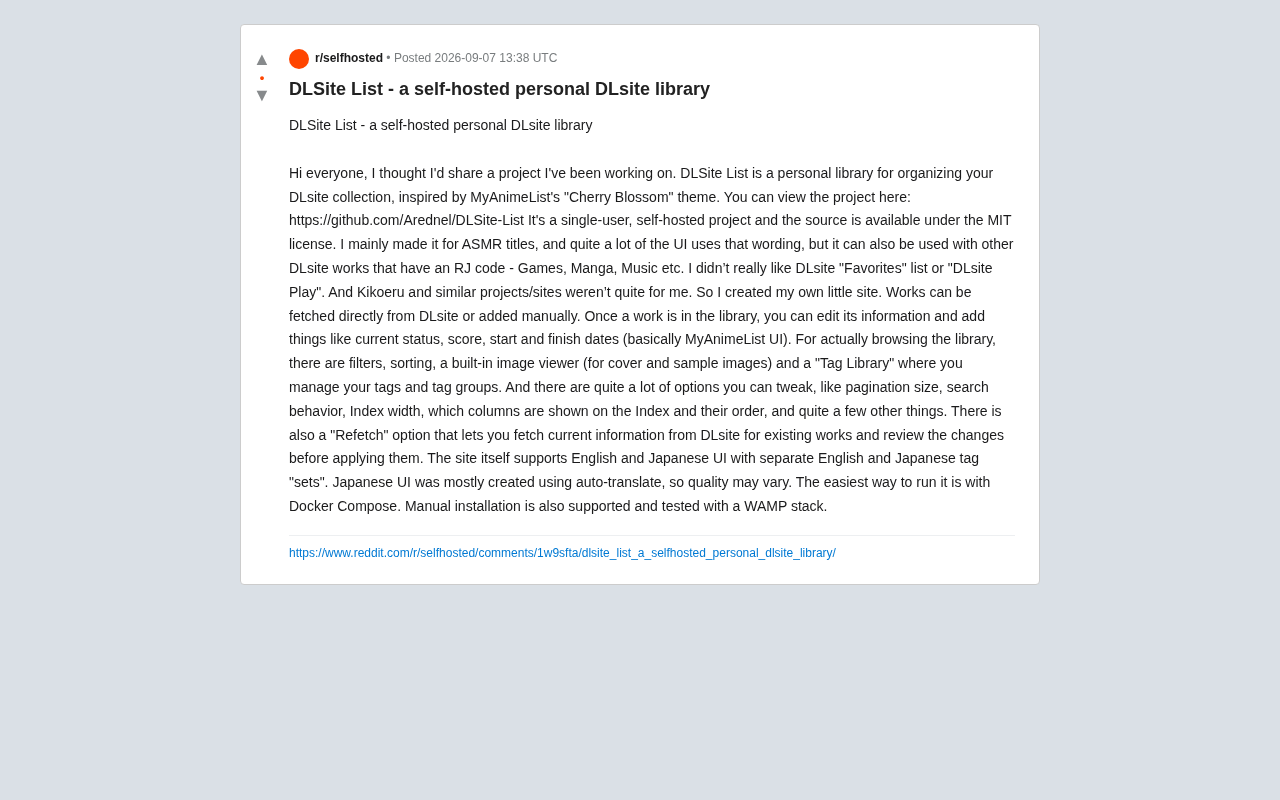
Open-source self-hosted system for managing DLsite collections with scraping, tracking, and custom tags
DLSite List is an MIT-licensed self-hosted digital content management system for DLsite users. It offers work data scraping, tracking management inspired by MyAnimeList, custom tagging, and a built-in image viewer. Built with front-end/back-end separation, it supports Docker and WAMP deployment, emphasizing data sovereignty and privacy for power users managing extensive collections.
DLSite List: Complete Guide to the Open-Source Self-Hosted Digital Content Management System
A developer recently open-sourced the DLSite List project on GitHub—a self-hosted personal library system designed specifically for DLsite platform users. Released under the MIT license, it offers a fresh solution for managing digital content collections.
Project Background: Why DLSite List Is Needed
DLsite Platform Background
DLsite is one of Japan's largest digital doujin content marketplaces, established in 1996. The platform primarily sells doujin games, ASMR audio works, manga, CG sets, and other digital content, with each work assigned a unique RJ number (like RJ01234567) as an identifier. DLsite is divided into adult-oriented (DLsite Maniax) and all-ages (DLsite.com) subsites, hosting over a million works and tens of millions of registered users. The platform's 'Favorites' feature only allows simple bookmarking of work links, while 'DLsite Play' cloud service focuses mainly on online playback—both lacking robust local management capabilities.
DLSite List was born from the developer's dissatisfaction with existing official DLsite tools. The platform's built-in "Favorites" feature and "DLsite Play" service fail to meet power users' management needs, while third-party projects like Kikoeru don't fully align with personal usage preferences. Against this backdrop, the developer decided to create a fully controllable private solution.
The project is designed as a single-user system primarily aimed at ASMR work collectors, but it equally supports games, manga, music, and all DLsite content with RJ numbers. This flexibility makes it a universal digital content management tool rather than being limited to specific types.
Core Features Explained
Work Addition and Data Synchronization
DLSite List supports two methods for adding works: directly scraping data from the DLsite platform or manual entry. This dual-track mechanism ensures data accuracy while providing flexibility for special cases.
You might not have noticed, but the system provides a "re-scrape" function that allows users to update existing works with the latest information and review changes before applying them, preventing accidental data overwrites.
Tracking Management and Metadata Recording
Borrowing from MyAnimeList's Tracking Model
MyAnimeList (MAL), founded in 2004, is the world's largest anime tracking community with over 16 million users. Its core functionality allows users to record viewing status (plan to watch/watching/completed/on hold/dropped), ratings (1-10 scale), viewing dates, rewatch counts, and other metadata, generating personal statistical reports. This 'Quantified Self' model has since been borrowed by platforms like Goodreads (books) and Letterboxd (films). MAL's success proves people are willing to invest time managing digital content consumption records, satisfying both collecting tendencies and facilitating review and recommendations.
Work information supports comprehensive editing, allowing users to record viewing status, ratings, start and completion dates, and other metadata. This design clearly borrows from MyAnimeList's classic interface logic, migrating the mature anime tracking model to digital content management.
Browsing, Search, and Custom Tags
The system provides multi-dimensional content browsing. Standard filtering and sorting functions are basic configurations, but more distinctive is the built-in image viewer, supporting direct browsing of cover art and sample images without jumping to external pages.
The "Tag Library" feature allows users to create custom tags and tag groups, establishing a personalized classification system.
Highly Customizable Personal Settings
In terms of personalization, DLSite List offers meticulous configuration options: pagination size, search behavior, index width, column display and sorting can all be adjusted according to personal preferences. This high level of customization is the core advantage of self-hosted solutions over cloud services.
Technical Architecture and Deployment Methods
Modern Front-End/Back-End Separation Architecture
Front-end/back-end separation is the mainstream architectural pattern in modern web development, decoupling the user interface (front-end) from business logic (back-end). The front-end typically uses frameworks like React/Vue/Angular, communicating with the back-end via RESTful API or GraphQL; the back-end focuses on data processing and interface provision, using languages like Node.js/Python/PHP. This architecture's advantages include: development teams can work in parallel, the front-end can flexibly switch technology stacks, supports multi-platform reuse (Web/mobile sharing APIs), and improves user experience (SPA single-page applications). Representative cases include Gmail and Twitter. For DLSite List, this architecture means independent mobile clients can be developed in the future without rewriting back-end logic.
The project adopts a front-end/back-end separation architecture, supporting bilingual interfaces in English and Japanese, maintaining independent tag sets for both languages. However, the developer admits the Japanese interface relies mainly on machine translation, with potentially variable quality.
Docker Containerized Deployment
Docker is a containerization platform born in 2013 that achieves 'build once, run anywhere' by packaging applications and their dependencies into standardized containers. Docker Compose is a tool for defining and running multi-container applications, describing service relationships through YAML configuration files. Compared to traditional virtual machines, containers share the host kernel, offering fast startup (seconds), and low resource consumption. For self-hosted projects, Docker solves the 'dependency hell' problem—users don't need to manually install PHP, MySQL, and other components; they just execute docker-compose up to start the complete system. By 2024, Docker Hub hosted over 13 million images.
For deployment, Docker Compose is the officially recommended simplest solution, while traditional WAMP stack manual installation is also supported.
WAMP Traditional Technology Stack
WAMP stands for Windows + Apache + MySQL + PHP, a classic web development environment combination. Apache is a veteran open-source web server (first released in 1995, once commanding 70% market share), MySQL is a widely used relational database, and PHP is a server-side scripting language powering about 77% of global websites (including WordPress and Wikipedia). WAMP's advantages lie in maturity, stability, and abundant documentation resources, while disadvantages include tedious configuration and Windows environment performance inferior to Linux. Modern alternatives include LAMP (Linux replacing Windows) and LEMP (Nginx replacing Apache), but WAMP remains the entry-level choice for Windows users.
This diverse deployment choice lowers the technical barrier, allowing users from different backgrounds to get started quickly.
Open-Source Ecosystem and Community Value
Openness of the MIT License
The MIT License is one of the most permissive open-source licenses, originating from the Massachusetts Institute of Technology. It allows anyone to freely use, copy, modify, merge, publish, distribute, sublicense, and sell copies of the software, with the only requirement being preservation of the original copyright and license notices. Unlike 'copyleft' licenses like GPL, MIT-licensed code can be used in closed-source projects, making it a commercially friendly choice. GitHub statistics show about 27% of open-source projects use the MIT License, including well-known projects like React and Node.js. This licensing model greatly reduces the legal risks of code reuse.
DLSite List's open-source nature gives it long-term evolution potential. The MIT License allows anyone to freely use, modify, and distribute the code, leaving room for community contributions and feature expansions. For developers with similar needs but different target platforms, this project also provides a reference architecture example.
Self-Hosting Movement and Data Sovereignty
Self-hosting refers to users deploying and running applications on servers they control, rather than relying on third-party cloud services. This trend accelerated after 2020, with representative projects including Nextcloud (cloud storage), Jellyfin (media server), and Bitwarden (password management). The core value of self-hosting lies in data sovereignty—users have complete control over their data, unaffected by platform policy changes, service shutdowns, or privacy breach risks. According to r/selfhosted community statistics, the number of self-hosting enthusiasts surpassed 1 million in 2023, with home NAS and Raspberry Pi being the most common deployment platforms.
Data Sovereignty refers to individuals or organizations having complete control over their data. After the EU's GDPR (General Data Protection Regulation) took effect in 2018, global privacy awareness significantly increased. Cloud service risks include: platforms may analyze user data for advertising, terms of service changes may restrict usage, company bankruptcy may lead to data loss, governments may demand data access. For sensitive content (like adult content collections), self-hosting is especially important—data is stored locally or on private servers, not uploaded to third parties. This aligns with the privacy-focused philosophy of services like Signal (encrypted communication) and ProtonMail (encrypted email). After the Snowden revelations, the self-hosting community grew by approximately 300%.
From a broader perspective, such self-hosted projects reflect users' emphasis on data sovereignty and privacy control. In an era dominated by cloud services, there remains a segment of technical users willing to invest effort in building private systems in exchange for complete autonomy and customization capabilities.
Target Audience and Limitations
This project is best suited for individual users with extensive DLsite content who desire fine-grained management. For casual users who only occasionally purchase a few works, official tools may suffice. Additionally, the system's single-user design means it's not suitable for team collaboration or social sharing scenarios.
Technically, self-hosted solutions require users to possess basic server operation skills. While Docker lowers deployment difficulty, there's still a learning curve. For users with no technical background whatsoever, third-party hosting services or community assistance may be needed.
The project is currently in active development, so feature completeness and stability may not compare to commercial products. However, this also means the development direction can quickly adjust based on actual needs, unburdened by commercial interests.
Key Takeaways
- DLSite List is an open-source self-hosted digital content management system designed specifically for DLsite users
- Supports core functions including work data scraping, tracking management, and custom tags
- Adopts front-end/back-end separation architecture, offering Docker and WAMP deployment options
- MIT License ensures code can be freely used and modified
- Reflects users' emphasis on data sovereignty and privacy control
- Suitable for power users with large collections and basic technical capabilities
Related articles
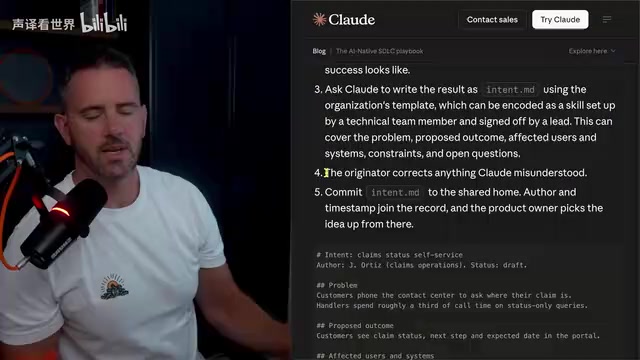
Intent.md Reshapes AI Development: Anthropic's New Paradigm for Agent Collaboration
Anthropic releases an AI-native SDLC handbook using Intent.md to restructure human-AI collaboration across the full development lifecycle, from requirements to maintenance.

Uncle Bob on AI Programming: Taming Agents with Deterministic Tools
Uncle Bob shares his AI programming methodology: using deterministic tools like CRAP scoring and mutation testing to constrain agents, building multi-agent pipelines for 4-5x productivity gains, while emphasizing software architecture fundamentals remain timeless.
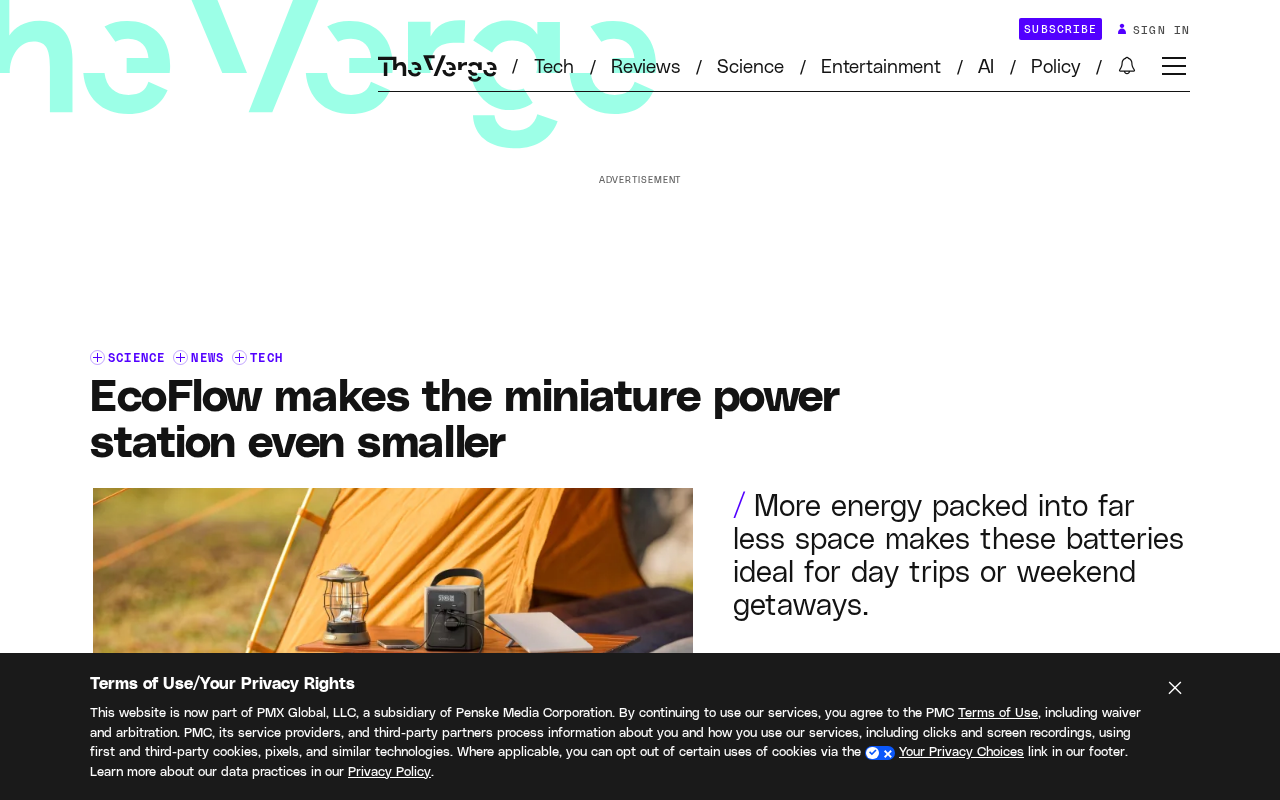
EcoFlow River Gen4 Review: Are the 256Wh/512Wh Portable Power Stations Worth It?
In-depth analysis of EcoFlow's River Gen4 portable power stations — covering the River 260 Gen4 (256Wh) and River 520 Gen4 (512Wh) in capacity, energy density, portability, and use cases.