Do AI Agents Save Time or Cause Trouble? Developer Community Debates the Efficiency Truth

AI agents speed things up, but rework costs may offset gains—the key is task verifiability.
The Reddit discussion reveals the efficiency paradox of AI agents: agents execute tasks quickly, but fixing their errors sometimes takes as long as redoing the work by hand. Consensus holds that net benefit depends on task type and error detectability—easily verifiable tasks show clear benefits, while complex tasks have hidden errors and high fix costs. The community suggests treating agents as "junior executors" and improving reliability through finer task granularity, intermediate verification steps, and human review checkpoints. The article notes that AI agents' time ledger isn't always positive, and designing human-AI collaboration boundaries is key to efficiency gains.
AI agents are infiltrating daily development and office workflows at an astonishing pace, but a sharp question has surfaced: do they actually save you time, or do they make you spend that saved time fixing their mistakes? A recent discussion in the Reddit community hit a real pain point for many developers.
The Illusion of Efficiency: Fast Is Real, Rework Is Real Too
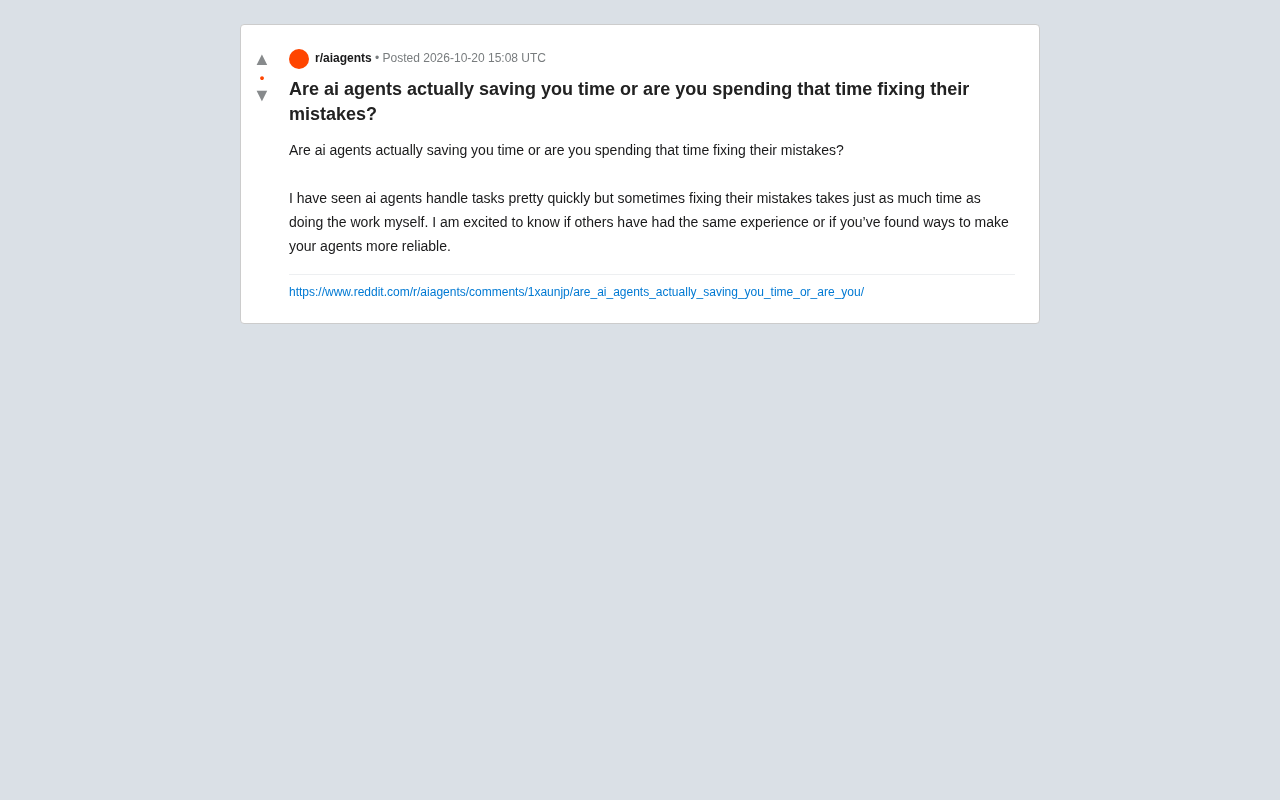
A developer posted on Reddit describing a contradictory experience: AI agents do handle tasks quickly, but sometimes the time spent fixing the errors they make is about the same as doing it by hand from scratch. He wondered if others felt the same way, or had found ways to make agents more reliable.
The post quickly resonated. Multiple responders said the key issue isn't whether the agent is "fast," but where errors occur and what they cost to fix. If an agent quickly produces results in code generation, data organization, or automated workflows, but hidden logic flaws or improperly handled edge cases lurk within, then locating and correcting these problems often requires extra cognitive load—sometimes even more exhausting than manual work.
AI Agents refer to AI systems capable of autonomous planning, tool invocation, and multi-step task execution, distinct from single-turn Q&A chatbots. Typical forms include code generation agents (such as Devin, Cursor Agent), browser operation agents, and automated workflow agents. Their core capability is the closed loop of "task decomposition—tool invocation—result integration," so the speed advantage comes from parallel and interruption-free execution. But precisely because of their autonomy, errors propagate along the task chain: a misunderstanding in an early step gets amplified in subsequent steps, creating results that "look complete but have hidden pitfalls." Understanding this mechanism helps explain why rework costs are high—the fixer needs to reverse-engineer the agent's decision path rather than simply redoing it.
Where Is the Tipping Point Between Time Savings and Rework
A consensus emerged in the discussion: the net benefit of AI agents depends on task type and error detectability. For tasks with easily verifiable outputs (such as format conversion, simple scripts, information retrieval), the agent's speedup is obvious because errors are immediately apparent and correction costs are low. For tasks with complex logic and context-dependent judgment (such as architecture design, complex business logic, long-chain reasoning), agent errors are often more hidden and more time-consuming to fix.
One responder noted that treating agents as "junior executors" rather than "senior decision-makers" is a more reasonable mindset: you are still responsible for the final result, and the agent merely accelerates draft generation.
Error detectability is a key dimension for evaluating an agent's net benefit. It refers to how easily task outputs can be verified: tasks like format conversion and syntax checking have deterministic criteria, so errors are exposed immediately; tasks like architecture design and business logic reasoning lack automatic criteria, so errors often only surface after integration or deployment. In engineering, this is often measured by the "verification cost/generation cost" ratio: the lower the ratio, the more cost-effective the agent. This also explains why the same agent receives polarizing reviews on different tasks—the benefit doesn't come from the model itself, but from the task's verifiable structure.
Practical Directions for Making Agents More Reliable
Although the post was mainly a question, the replies revealed some ideas for improving reliability: narrowing task granularity, adding intermediate verification steps, and providing agents with clearer constraints and examples. Some developers also mentioned that retaining human review checkpoints in critical workflows is more pragmatic than pursuing full automation.
This discussion didn't provide a universal answer, but it revealed a fact obscured by marketing rhetoric: the time ledger of AI agents isn't always positive, and how to design the boundaries of human-AI collaboration is the key to determining efficiency gains.
Task granularity refers to the size of subtasks split for the agent. The finer the granularity, the easier each step's output is to verify and the more precise error localization becomes, but splitting overhead and context loss risks increase; too coarse a granularity makes verification difficult and rework costly. A common compromise in practice is "small steps, fast iteration + checkpoints": each subtask comes with clear input-output contracts and acceptance criteria, and verification is triggered as soon as the agent completes a step, proceeding to the next only after passing. This shares the same origin as continuous integration thinking in software engineering, treating agent execution as a pipeline requiring quality gates rather than a one-time black-box delivery.
One-line Summary
AI agents offer obvious speedups, but rework costs may offset efficiency gains—the key lies in task verifiability.
Paragraph Summary
The Reddit community discussion revealed the efficiency paradox of AI agents: agents do execute tasks quickly, but fixing their errors sometimes takes as long as redoing the work by hand. The consensus is that net benefit depends on task type and error detectability—easily verifiable tasks like format conversion and simple scripts show clear benefits, while complex tasks like architecture design and long-chain reasoning have hidden errors and high fix costs. The community suggests treating agents as "junior executors" rather than "senior decision-makers," improving reliability by narrowing task granularity, adding intermediate verification steps, and retaining human review checkpoints. The article points out that the time ledger of AI agents isn't always positive, and designing the boundaries of human-AI collaboration is the key to efficiency gains.
Related articles

Chain of Thought Isn't Just for AI: How Humans Can Use CoT to Improve Thinking Quality
Chain of Thought isn't just a prompt trick for large models. Starting from a Hacker News discussion, this article analyzes why CoT works for human thinking too, breaks down actionable ways to transfer it, and highlights the key differences between human CoT and machine CoT.
Cloudflare Teams Up with OpenAI: Closi…
Cloudflare Teams Up with OpenAI: Closing the Loop from Vulnerability Discovery to Defense with AI
Cloudflare uses OpenAI Daybreak to investigate security vulnerabilities and generate reviewable remediation plans, while developers use Codex to boost coding efficiency and quality.

Orca Multi-Agent Orchestration in Practice: A Guide to Parallel Collaboration with Claude and Codex
Orca is Stable AI's free open-source agent workbench supporting 34 agents like Claude Code and Codex in parallel. Learn its Git worktree isolation, multi-model orchestration, and mobile management.