Do AI/ML Job Seekers Really Need to Grind LeetCode? The True Weight of Algorithms vs. AI Skills

A strategic guide to balancing DSA prep and AI skills for AI/ML engineering job seekers.
This article addresses whether AI/ML engineers truly need to grind LeetCode for job interviews. It analyzes how DSA requirements vary across roles like ML Engineer, Applied Scientist, and AI Engineer, provides a realistic competency baseline, and recommends a phased preparation strategy — deep AI focus during accumulation periods and intensive DSA cramming before interviews. It also offers differentiation tactics for those with weaker algorithm skills.
A Real Dilemma Facing AI Engineers
A recent Reddit post struck a nerve with countless AI/ML practitioners. The poster confessed: "I can spend 5 hours debugging a RAG pipeline, but I can't get through a 30-minute LeetCode problem." This self-deprecating quip hit the exact pain point that so many AI engineers face when job hunting.
This developer has a near-obsessive passion for AI technology — machine learning, deep learning, Transformers, LLMs, RAG, AI Agents, vector databases, model deployment — he can immerse himself in any of these for hours. When a RAG pipeline breaks, he actually enjoys the debugging process. But the moment he sits down in front of LeetCode, "my brain just checks out."
It's worth unpacking the complexity of RAG pipelines here, because they represent one of the core challenges of modern AI engineering. RAG (Retrieval-Augmented Generation) is one of the most important architectural patterns in large language model applications today. The basic principle is to retrieve relevant document fragments from an external knowledge base before the LLM generates a response, injecting them as context into the prompt so the model can produce more accurate, traceable answers based on real data. A complete RAG pipeline involves multiple stages: document parsing, text chunking, vector embedding generation, vector database storage and retrieval, reranking, prompt engineering, and the final LLM call. Debugging a RAG pipeline is complex and time-consuming because parameter choices at every stage (chunk size, embedding model, retrieval strategy, Top-K values) affect the final output quality — and the problems are often not code errors but vague quality issues like "the answer isn't good enough," requiring engineers to have deep understanding of the entire system. Being able to navigate this level of complexity with ease is itself proof of exceptional engineering ability.
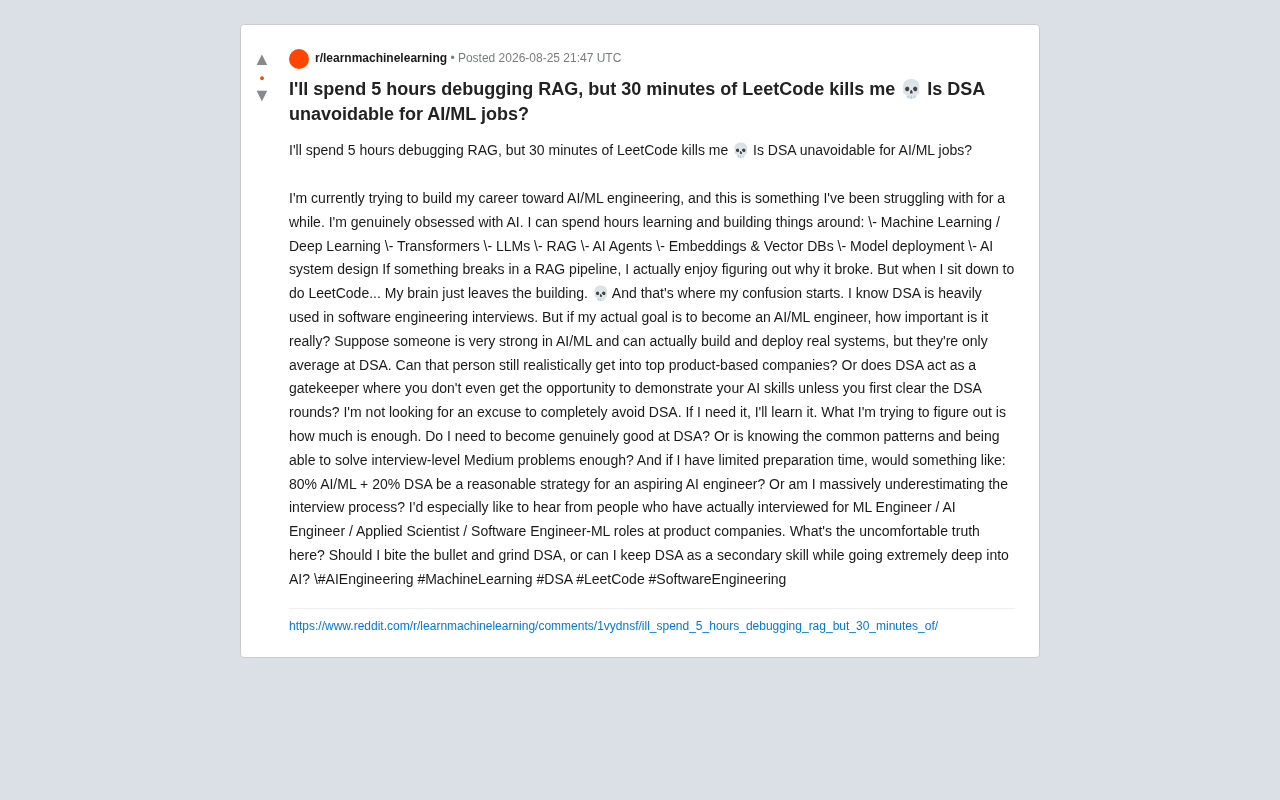
His core question is extremely practical: If the goal is to become an AI/ML engineer, how important are Data Structures and Algorithms (DSA) really? Can someone with strong AI skills who can actually build and deploy systems, but only mediocre DSA, still get into top product companies? Or is DSA a gatekeeper — without passing the algorithm round, you never even get a chance to demonstrate your AI expertise?
Is DSA an Unavoidable Hurdle?
We have to acknowledge an "uncomfortable truth": for most product-focused big tech companies (FAANG and similar), ML Engineer and Software Engineer-ML positions treat DSA as a hard screening requirement.
Why Big Tech Insists on Algorithm Interviews
The logic behind this isn't about making things difficult. Data structures and algorithms as a core technical interview component can be traced back to Google's interview system established in the early 2000s. At the time, Google faced the challenge of rapidly screening top engineers from a massive candidate pool and chose algorithm problems as a standardized assessment tool. This model was subsequently adopted by Facebook, Amazon, Apple, Netflix, and other tech giants, forming what's known as the "FAANG interview paradigm." The rise of the LeetCode platform further institutionalized this interview model — the platform currently has over 3,000 coding problems, creating a massive test-prep ecosystem.
ML Engineer roles at many companies are fundamentally "software engineers with ML expertise." You don't just need to train models — you also need to write production-grade code, optimize data pipelines, and handle performance issues in large-scale systems. Algorithm ability is seen as a proxy for engineering fundamentals. Additionally, standardized algorithm interviews make it easy to compare large numbers of candidates horizontally — it's an efficiency tool for hiring at scale. For new grad and junior positions, DSA carries even more weight because interviewers lack other dimensions to evaluate your engineering capabilities.
In recent years, the debate over whether DSA interviews truly predict job performance has never stopped. Critics argue that algorithm interviews primarily test "puzzle-solving ability" and test-taking skills rather than actual engineering capability; supporters maintain that they at least verify a candidate's logical thinking and coding fundamentals. Regardless of how the debate plays out, the reality is: these rules of the game won't change anytime soon, and what we can do is find the optimal strategy within them.
Job Type Determines Assessment Focus
You may not have noticed, but different roles have vastly different DSA requirements. Understanding the boundaries of these roles is crucial for developing a precise preparation strategy:
- Software Engineer-ML / ML Engineer: High DSA weight, typically requiring 1-2 rounds of algorithm interviews. At Google, Meta, and similar companies, ML Engineer is essentially a specialization within Software Engineer (usually labeled SWE-ML). Core responsibilities include converting research team model prototypes into production services, building and maintaining feature engineering pipelines, optimizing model inference latency and throughput, and setting up A/B testing and model monitoring infrastructure. A large portion of daily work involves writing distributed systems code, optimizing data pipeline performance, and handling data skew — pure engineering problems rather than tuning hyperparameters or reading papers. This is precisely why DSA requirements for these roles are nearly identical to regular SWE positions.
- Applied Scientist / Research Scientist: Greater emphasis on ML theory depth, publications, and project experience, with DSA being relatively secondary — though basic algorithms may still be tested. Research Scientists focus more on algorithmic innovation and publishing, while Applied Scientists sit between engineering and research.
- AI Engineer (application-focused): At startups and some product teams, hands-on project ability and system design carry more weight, and DSA may only serve as an entry-level screen. These roles care more about whether you can quickly build a usable AI application and iterate continuously.
How Good Does Your DSA Actually Need to Be?
The poster asked a critical question: "Do I need to truly master DSA, or is it enough to know common patterns and solve medium-difficulty problems?"
For the vast majority of AI/ML positions, the latter is sufficient. You don't need to be a competitive programming champion. Your target should be:
A Realistic Competency Baseline
- Master core data structures: Arrays, hash tables, stacks/queues, trees, graphs, heaps.
- Be familiar with common problem-solving patterns: Two pointers, sliding window, BFS/DFS, introductory dynamic programming, binary search.
- Be able to consistently solve Medium-difficulty problems: This is the practical difficulty ceiling for most interviews. Hard problems appear occasionally but are usually not decisive.
In other words, you don't need to "master" DSA — you need to "pass" it. Treating DSA as an exam to clear rather than a discipline to study for life is an important mindset shift.
Is 80% AI + 20% DSA a Reasonable Preparation Strategy?
The poster's proposed "80% AI/ML + 20% DSA" allocation is directionally correct, but it needs dynamic adjustment based on your job search phase.
Phase-Based Time Allocation Recommendations
Ongoing accumulation phase: You can adopt an 80/20 or even 90/10 ratio, going deep on AI capabilities and building real projects — this is your core competitive advantage that differentiates you from other candidates. Deep AI/ML expertise is what ultimately gets you the offer, carries you through the final technical round, and secures higher compensation.
Interview sprint phase (1-2 months before interviews): You should flip the ratio, investing 50% or more of your time on concentrated problem-solving. DSA is a "test-taking skill" — short-term, high-intensity cramming is far more effective than spreading it thin over time. Focused practice on 150-200 high-frequency problems (such as LeetCode's Blind 75 or the NeetCode series) is enough to handle the vast majority of interviews.
It's worth introducing the methodology behind structured LeetCode practice here. Blind 75 is a curated list of 75 LeetCode problems shared by a former Facebook engineer on the Blind forum, widely regarded as the "minimum viable set" for algorithm interview preparation. The list covers nearly all high-frequency interview topics — arrays, binary search, sliding window, linked lists, trees, graphs, dynamic programming, backtracking — with problems grouped by type for focused pattern training. NeetCode later expanded this into NeetCode 150, adding broader coverage. The core philosophy of structured practice is: algorithm interviews don't test how many problems you've seen, but whether you've mastered a finite set of problem-solving paradigms (patterns). For example, the "two pointers" pattern can solve at least a dozen different problems, and the "BFS/DFS" pattern covers nearly all tree and graph traversal problems. Therefore, categorizing by pattern and cramming intensively is far more efficient than randomly grinding through thousands of problems.
Differentiation Strategies for Survival
If DSA is genuinely your weak spot, you can adopt these strategies to minimize its impact:
- Prioritize startups and AI-first teams: These companies care more about whether you can deliver value immediately. Interviews tend to focus on project deep-dives and system design, with a lighter DSA component.
- Strengthen System Design and ML System Design: This is the AI engineer's "second battlefield" and where your AI experience can directly translate into advantage. ML System Design has been rapidly growing in weight in AI/ML interviews in recent years and is the assessment dimension where AI engineers have the most differentiated advantage over general software engineers. Typical ML system design questions include: design a recommendation system, design a real-time fraud detection system, design a large-scale document search engine, etc. Unlike traditional system design, ML system design requires candidates to demonstrate understanding of both the full machine learning lifecycle and distributed systems architecture. A complete answer typically needs to cover: problem definition and metric selection (offline vs. online metrics), data collection and feature engineering, model selection and training strategy, serving architecture (online inference vs. batch inference), and monitoring and iteration mechanisms. For AI engineers with real project experience, this is the best opportunity to directly convert daily work experience into interview advantage.
- Let your portfolio speak for you: Deployable RAG systems, open-source projects, and technical blogs can significantly boost your profile during resume screening and final interviews — even compensating for weaknesses in the algorithm rounds. A starred RAG project or AI Agent framework on GitHub proves your engineering delivery ability far more than your LeetCode solve count.
An Uncomfortable but Honest Conclusion
Returning to the original question: Should you grit your teeth and grind DSA, or treat it as a secondary skill?
The answer is: If you want to get into big tech, you must push through this hurdle — but you don't need to make it your career focus. DSA is a door-opener, not a moat. It determines whether you can get in the door, but what determines whether you land the offer and how far you go will always be your true AI/ML engineering ability.
For this developer who loves debugging RAG pipelines, the good news is: what he loves and excels at is precisely what the industry finds genuinely scarce and genuinely valuable. In today's era of exploding LLM applications, an engineer who can build, debug, and optimize a RAG system end-to-end has far more market value than someone who can only grind algorithm problems. DSA is just a checkpoint that requires short-term cramming and a deadline to clear. Treating it as a one-time cost rather than an ongoing investment is the most rational job search strategy.
Don't let 30 minutes of LeetCode stand in the way of your passion for 5-hour RAG debugging sessions. Grit your teeth, get through it, and then get back to the battlefield you truly love.
Related articles

Felix Rieseberg Personal Homepage
Felix Rieseberg's personal homepage sparks attention on Hacker News. This article covers the Slack engineer's technical background, the rise and fall of nativefier, and the value of a developer homepage as a tech calling card.

@ai-sdk/vue 3.0.306 Patch Release Syncs with [email protected] Update
@ai-sdk/vue 3.0.306 released, synced with [email protected]. A routine patch release for the Vercel AI SDK ecosystem with no public API changes; the Vue adapter layer stays version-aligned with the core package.

Gemini 4 Argon API Launches: The Era of Million-Token Output Begins
Google launches Gemini 4 Argon with sparse MoE architecture, up to 1M output tokens, and a 68.90% Vals Index score, available across API, AI Studio, and the Gemini app.