Do Codex Skills Actually Save Tokens? A Six-Run Task-Size Benchmark Test

Six-run benchmark tests whether Codex Skills truly reduce token consumption across varying task sizes.
A developer's community-driven benchmark on Hacker News tests whether OpenAI Codex Skills actually save tokens. Using six runs stratified by task size, the experiment explores the nonlinear cost-benefit curve of Skills — finding that token savings likely depend on task complexity thresholds. The test highlights the importance of empirical validation over marketing claims in AI tool evaluation.
A Question Worth Asking: Do Skills Actually Save Money?
As AI coding assistants become increasingly mainstream, the "Skills" mechanism in OpenAI Codex and its derivative tools has been met with high expectations. Developers widely believe that predefined, reusable skill modules can reduce the overhead of repeatedly explaining context with each model invocation, thereby saving precious tokens. But does this "common knowledge" hold up under data scrutiny?
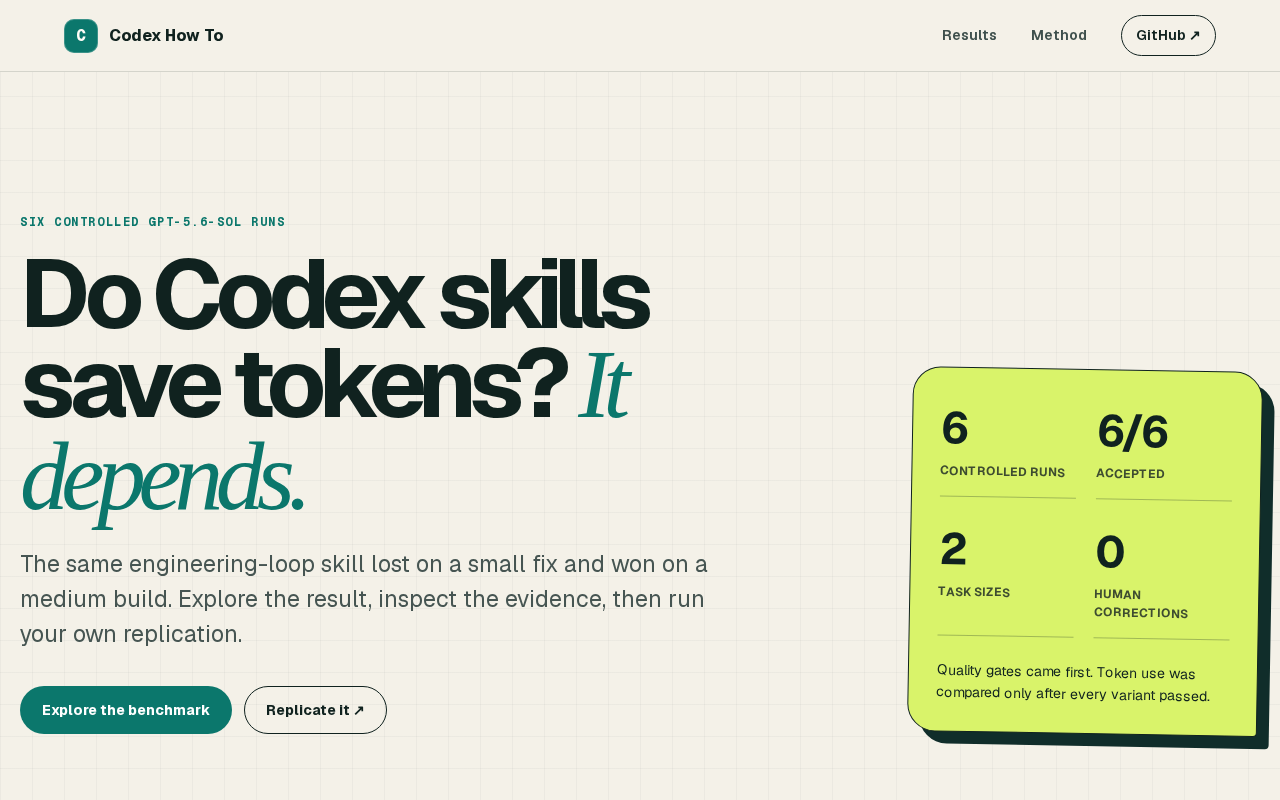
Recently, a developer launched a hands-on testing discussion on Hacker News titled "Show HN: Do Codex skills save tokens?" Using a set of six-run task-size benchmarks stratified by task complexity, they attempted to answer this widely assumed but rarely quantified question with data. This kind of community-driven, first-hand testing is precisely what's most scarce — and most valuable — in current AI tool evaluation.
What Are Codex Skills, and Why Are They Related to Token Cost
The Essence of the Skills Mechanism
Codex Skills can be understood as a form of "capability encapsulation": abstracting common programming operations, tool calls, or workflows into named skills that the model can reference directly during task execution, without needing to describe the complete logic from scratch in every interaction. In theory, this encapsulation brings two benefits: improved execution consistency and reliability, and reduced context redundancy through reuse.
OpenAI Codex was originally released in 2021 as a model specifically designed for code generation, serving as the core engine behind GitHub Copilot. As the GPT-4 series evolved, Codex's capabilities were integrated into more general-purpose model architectures. In 2025, OpenAI launched a new generation of Codex tools, positioned as a cloud-based coding agent capable of executing multi-step programming tasks in sandbox environments. The Skills mechanism is a further structuring of the System Prompt and Custom Instructions concept, allowing developers to encapsulate complex workflows into nameable, reusable capability modules.
Why Token Cost Is the Core Metric
For any product built on large language models, tokens are real money. Input tokens determine context-carrying capacity, while output tokens relate to response costs. When a skill is repeatedly invoked, if the full skill definition and instructions need to be injected each time, it could actually increase token consumption. But if the model can efficiently cache or reference skills, then savings are theoretically achievable. This is exactly what the benchmark test aims to clarify — Are Skills a token-saving weapon, or an additional burden?
In the business model of large language models, tokens are the fundamental billing unit. One token corresponds to roughly 4 characters in English or 1-2 Chinese characters. Taking OpenAI's pricing as an example, input tokens for GPT-4-class models cost tens of dollars per million tokens, with output tokens being even more expensive. In high-frequency production environments, daily token consumption can easily reach millions, with monthly costs running into thousands or even tens of thousands of dollars. Therefore, any technique that can reduce token consumption by 5%-20% means significant cost savings at scale. This explains why the token efficiency of Skills deserves serious attention.
It's worth noting that the token-saving potential of Skills is closely related to the underlying Prompt Caching technology. Vendors like OpenAI and Anthropic have implemented prompt prefix caching mechanisms — when multiple requests share the same system prompt prefix, subsequent calls only need to pay a discounted price for the cache-hit portion (typically 50% of the normal price). However, caching isn't a silver bullet: it depends on exact prefix matching, and even minor changes in the order or content of skill definitions will invalidate the cache. This means the actual token savings from Skills are highly dependent on their placement strategy within the context and their invocation patterns.
Design Philosophy of the Six-Run Task-Size Benchmark
The Significance of Stratifying by Task Size
The most commendable aspect of this test is its experimental design using "task size" as the stratification variable. This means the tester didn't simply run a single comparison, but observed Skills' performance separately across tasks of different complexity and context lengths.
There's solid logic behind this design: the cost-benefit of Skills is likely nonlinear. In small tasks, the overhead of the skill definition itself may be proportionally too high, diluting or even reversing the "token savings" benefit. In large, highly repetitive tasks, the savings from reuse may only then become truly apparent. The six runs covering different scales are designed precisely to capture this nonlinear cost curve.
In software engineering, nonlinear cost-benefit patterns for tools are common, with similar parallels in database indexing, CDN caching, and microservice architectures. Take database indexing as an example: for small table queries, the maintenance overhead of an index may exceed the cost of a full table scan; but once data volume grows beyond a certain threshold, the performance gains from indexing grow exponentially. Skills' token costs likely follow a similar pattern — there exists a "break-even point" where only after task complexity reaches a certain threshold does the fixed overhead of skill definitions get covered by reuse benefits. Identifying this threshold is key to refined cost management.
Rigor of the Controlled Experiment
To verify whether Skills save tokens, the most reliable approach is to set up two control groups — "with Skills" and "without Skills" — and compare total token consumption on identical tasks. Multiple runs help smooth out random fluctuations from individual calls, making conclusions more statistically meaningful. Although the post itself had low engagement (only 4 points, no comments at the time), this methodological self-awareness is precisely the hallmark of community evaluation maturing.
In AI system benchmarking, variable control is the core challenge. LLM outputs have inherent randomness (controlled by the temperature parameter), and the same prompt called multiple times may produce responses of different lengths and content. Additionally, model response length is influenced by task phrasing, context window fill level, and the model's internal attention allocation. Therefore, reliable token consumption comparison tests typically require: fixed random seeds (if the API supports it), multiple repetitions averaged, temperature set to 0 for deterministic output, and complete request/response metadata logging. The six-run repetition is specifically designed to statistically counteract these uncertainties.
Why This Kind of Hands-On Testing Matters More Than Marketing Rhetoric
Breaking the "Taken-for-Granted" Technical Narrative
AI tool marketing is often full of vague promises like "more efficient" and "cost-saving," but few vendors publish reproducible quantitative data. Community-initiated benchmark tests are a necessary counterbalance to this narrative. Whether the final conclusion is "Skills do save tokens" or "Skills are actually more expensive in certain scenarios," as long as it's based on transparent data and reproducible methods, it's more valuable than any marketing copy.
Hacker News's Show HN section has long been an important channel for developer tools to receive early feedback. Unlike academic peer review or vendor internal testing, the unique value of community evaluation lies in its proximity to real-world usage scenarios, methodological transparency and reproducibility, and freedom from commercial interests. Historically, many impactful technical insights have originated from community testing — such as independent database performance benchmarks (like the TPC series) and third-party monitoring of actual cloud provider latencies. In today's era of rapid AI tool iteration, this community-driven verification culture is especially important, forming a healthy counterbalance to vendor claims.
Guidance for Real Engineering Decisions
For teams evaluating whether to adopt Codex Skills, this kind of hands-on testing provides direct decision-making evidence. If data proves that Skills are only cost-effective for large tasks, teams can selectively enable them in appropriate scenarios rather than blindly rolling them out across the board. Cost-sensitive production environments especially need this kind of scale-based, refined judgment.
Conclusion: Let Data Answer the Question
"Do Codex Skills save tokens" may seem like a technical detail, but it actually reflects a deeper proposition across the entire AI application landscape: Is our trust in tools built on intuition and marketing, or on verifiable data?
This six-run benchmark test may be small in scale with few observers so far, but it represents a healthy community culture — using an empirical spirit to scrutinize every assumption taken for granted. For every developer building AI applications, rather than accepting the default assumption that "Skills definitely save money," it's better to run your own benchmark test tailored to your business scenario. After all, in an era where tokens equal cost, every bit of savings is worth measuring carefully.
Related articles

Chain of Thought Isn't Just for AI: How Humans Can Use CoT to Improve Thinking Quality
Chain of Thought isn't just a prompt trick for large models. Starting from a Hacker News discussion, this article analyzes why CoT works for human thinking too, breaks down actionable ways to transfer it, and highlights the key differences between human CoT and machine CoT.
Cloudflare Teams Up with OpenAI: Closi…
Cloudflare Teams Up with OpenAI: Closing the Loop from Vulnerability Discovery to Defense with AI
Cloudflare uses OpenAI Daybreak to investigate security vulnerabilities and generate reviewable remediation plans, while developers use Codex to boost coding efficiency and quality.

Orca Multi-Agent Orchestration in Practice: A Guide to Parallel Collaboration with Claude and Codex
Orca is Stable AI's free open-source agent workbench supporting 34 agents like Claude Code and Codex in parallel. Learn its Git worktree isolation, multi-model orchestration, and mobile management.