Do Learning-Based Trajectory Predictors Still Outperform Kinematic Models When Observation Frequency Drops?

Low-frequency observations weaken but do not eliminate learning-based trajectory predictors' advantage over kinematic models.
The study systematically evaluated the impact of reduced observation frequency on trajectory prediction using the Argoverse 2 dataset, downsampling the focal agent's 5-second history from 10 Hz to 5/2/1 Hz and predicting the next 6 seconds without maps or neighboring agents. It compared frequency-specific LSTMs, a 10 Hz model with linear interpolation, and CV/CA kinematic models. Results: frequency-specific RNN ADE increases by 3.1%, 10.1%, and 20.3%; the advantage over kinematic models remains 24–30% in straight and turning scenarios and does not vanish with sparsification; interpolation loses only 1.3% at 2 Hz but 11.5% at 1 Hz; CV models are more accurate for pedestrians. All hypotheses were only partially supported, emphasizing the need for evaluation at real frequencies.
Introduction
Autonomous driving trajectory prediction models are typically trained on data with a fixed sampling frequency, while position information received via vehicle-to-everything (V2X) communication often has a lower frequency (1–10 Hz). When the historical observation frequency drops, can learning-based predictors that rely solely on observation history still maintain their advantage over constant velocity (CV) and constant acceleration (CA) models? A study on the Argoverse 2 dataset systematically evaluated this question, and the results partly challenge intuition.
Experimental Setup
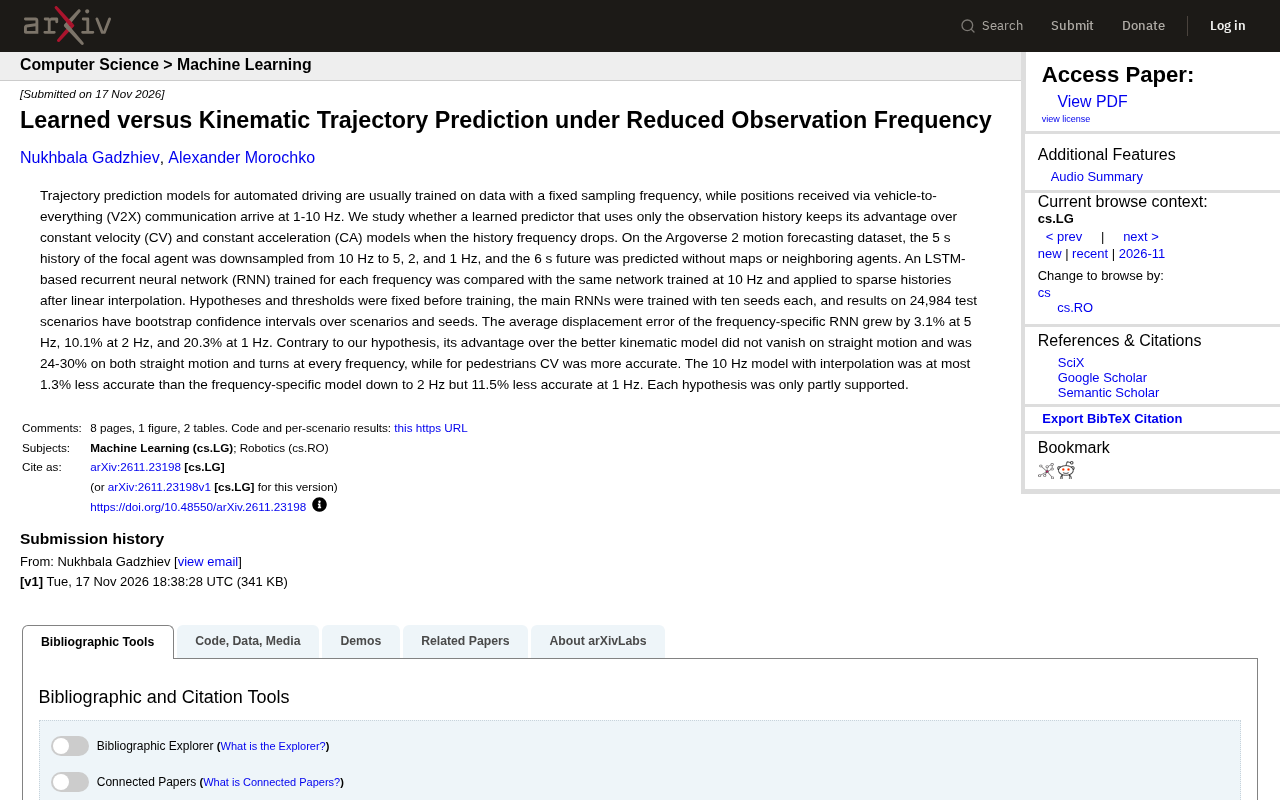
The study focuses on the Argoverse 2 motion forecasting dataset, downsampling the focal agent's 5-second history trajectory from 10 Hz to 5 Hz, 2 Hz, and 1 Hz, and predicting the trajectory for the next 6 seconds without using map or neighboring agent information.
The compared models include:
- An LSTM-based recurrent neural network (RNN) trained separately for each frequency
- The same network trained on 10 Hz data and applied to sparse histories via linear interpolation
- Constant velocity (CV) and constant acceleration (CA) kinematic models
The study pre-registered hypotheses and thresholds. The main RNN was trained with ten random seeds and evaluated on 24,984 test scenarios, providing bootstrap confidence intervals across scenarios and seeds.
Constant velocity (CV) and constant acceleration (CA) models are the most fundamental physical kinematic baselines in trajectory prediction. The CV model assumes the target maintains its current velocity vector, with future positions obtained by linear extrapolation; the CA model further assumes constant acceleration, extrapolating the trajectory via a quadratic polynomial. Neither depends on training data—only the positions from the most recent frames are needed to estimate velocity and acceleration, so they remain usable under low-frequency observations. In benchmarks like Argoverse 2, CV/CA often serve as a reference for whether learning-based models truly capture complex patterns—if a learning-based model still outperforms them under sparse observations, it indicates the model has captured higher-order behaviors beyond kinematics (such as interactions and intent).
Bootstrap confidence interval is a non-parametric statistical method: a large number of subsamples are repeatedly drawn with replacement from the original sample, the target statistic (e.g., average displacement error) is computed for each subsample, and interval estimates are derived from the empirical distribution of these statistics. In this study, the authors performed bootstrapping along both the scenario dimension and the random seed dimension to quantify the uncertainty of the evaluation results. Compared with the normal approximation, the bootstrap method does not rely on assumptions about the error distribution, making it suitable for skewed metrics like displacement error, and it also gives conclusions such as "an advantage of 24–30%" statistical significance support.
Main Findings
Error of learning-based models grows as frequency decreases
The average displacement error of the frequency-specific RNN increases by 3.1% at 5 Hz, 10.1% at 2 Hz, and 20.3% at 1 Hz. This shows that sparsifying observations does impair the accuracy of learning-based models, but the performance degradation is gradual.
The advantage over kinematic models does not disappear
Contrary to the hypothesis, the advantage of learning-based models over the better kinematic model does not disappear on straight-line motion. At every frequency, whether straight-line or turning, the advantage is 24–30%. However, for pedestrians, the CV model is more accurate. This finding indicates that learning-based models can still capture complex patterns that kinematic models cannot model under sparse observations.
Interpolation strategy is effective at moderate sparsity
Using the 10 Hz model plus linear interpolation results in an accuracy loss of at most 1.3% when downsampled to 2 Hz, but an accuracy loss of 11.5% at 1 Hz. This means that for moderate frequency reduction, interpolation is a viable compromise; but at extremely low frequencies, training a model specifically for that frequency is more necessary.
Average Displacement Error (ADE) is a standard metric for trajectory prediction, defined as the average Euclidean distance between the predicted trajectory and the ground-truth trajectory at each time step. It is often paired with Final Displacement Error (FDE), the distance between the predicted endpoint and the true endpoint. ADE is sensitive to deviations across the entire trajectory and reflects the model's overall accuracy within the prediction horizon. In this study, within the 6-second prediction window, the percentage change in ADE is used as the core measure of the impact of frequency reduction, so the increases of 3.1%, 10.1%, and 20.3% all refer to ADE growth relative to the 10 Hz baseline.
Conclusions and Implications
The study shows that reducing observation frequency weakens but does not eliminate the advantage of learning-based trajectory predictors. For autonomous driving system designers, this means that in scenarios where V2X communication frequency is limited, learning-based models are still worth adopting, but they need to be trained for the actual frequency or use an appropriate interpolation strategy. At the same time, pedestrian prediction may be better suited to kinematic models, suggesting that methods should be selected flexibly based on target type.
Each hypothesis was only partially supported, emphasizing the importance of systematic evaluation under real deployment conditions rather than relying on conclusions from fixed-frequency benchmarks.
One-line Summary
Low-frequency observations weaken but do not eliminate the advantage of learning-based trajectory predictors over kinematic models.
Paragraph Summary
This study systematically evaluated the impact of reduced observation frequency on trajectory prediction on the Argoverse 2 dataset, downsampling the focal agent's 5-second history from 10 Hz to 5/2/1 Hz and predicting the next 6 seconds without maps or neighboring agents. It compared frequency-specific LSTMs, a 10 Hz model with linear interpolation, and CV/CA kinematic models. Results show: the frequency-specific RNN's ADE increases by 3.1%, 10.1%, and 20.3% respectively; the advantage of learning-based models over kinematic models remains 24–30% in both straight and turning scenarios and does not vanish with sparsification; the interpolation strategy loses only 1.3% at 2 Hz but 11.5% at 1 Hz; for pedestrian prediction, the CV model is more accurate. All hypotheses were only partially supported, emphasizing the need to evaluate at real frequencies.
Related articles

Michael Nielsen Takes Down His Classic Neural Network Textbook, Sparking Community Discussion
Michael Nielsen's classic free textbook Neural Networks and Deep Learning has been taken offline, sparking discussion on Hacker News about the reasons and impact.

Inside the AI Training Data Market: The Trade-off Between Exclusivity and Discounts
G2i founder Gabe Greenberg reveals the dual-track pricing of the AI training data market: labs pay a premium for exclusive data or accept discounts that allow others to buy it.

SessionGraph: Unifying All Coding Agent Sessions in One Interactive Graph
SessionGraph aggregates coding agent sessions into an interactive graph, helping developers review, debug, and manage AI coding workflows across sessions. This article examines its positioning, value, and open questions.