Do Small Language Models Know What They Don't Know? Semantic Entropy Is the Key

Semantic entropy rescues SLM confidence signals where token-level entropy fails, enabling smart routing for up to +50pp accuracy gains.
This arXiv study evaluates seven entropy-based confidence methods for SLMs under 3B parameters. The key finding: token-level entropy is near-zero in 91% of test cases, unable to distinguish correct from incorrect answers. Semantic entropy — sampling multiple answers, clustering by meaning, then measuring distributional uncertainty — successfully recovers a usable signal. Routing low-confidence queries to larger expert models improves accuracy by up to 50 percentage points, with cross-family routing (+22.0%) far outperforming same-family routing (+6.8%). The conclusion: entropy's value in SLMs lies not in saving compute, but in allocating it intelligently.
The Core Question: Can SLMs Gauge Their Own Uncertainty
Small Language Models (SLMs) with fewer than 3 billion parameters are attracting growing attention for their ability to run entirely on consumer-grade hardware. But a critical question remains: do these models actually know what they don't know? In other words, when an SLM gives a wrong answer, can it signal in advance that it lacks confidence?
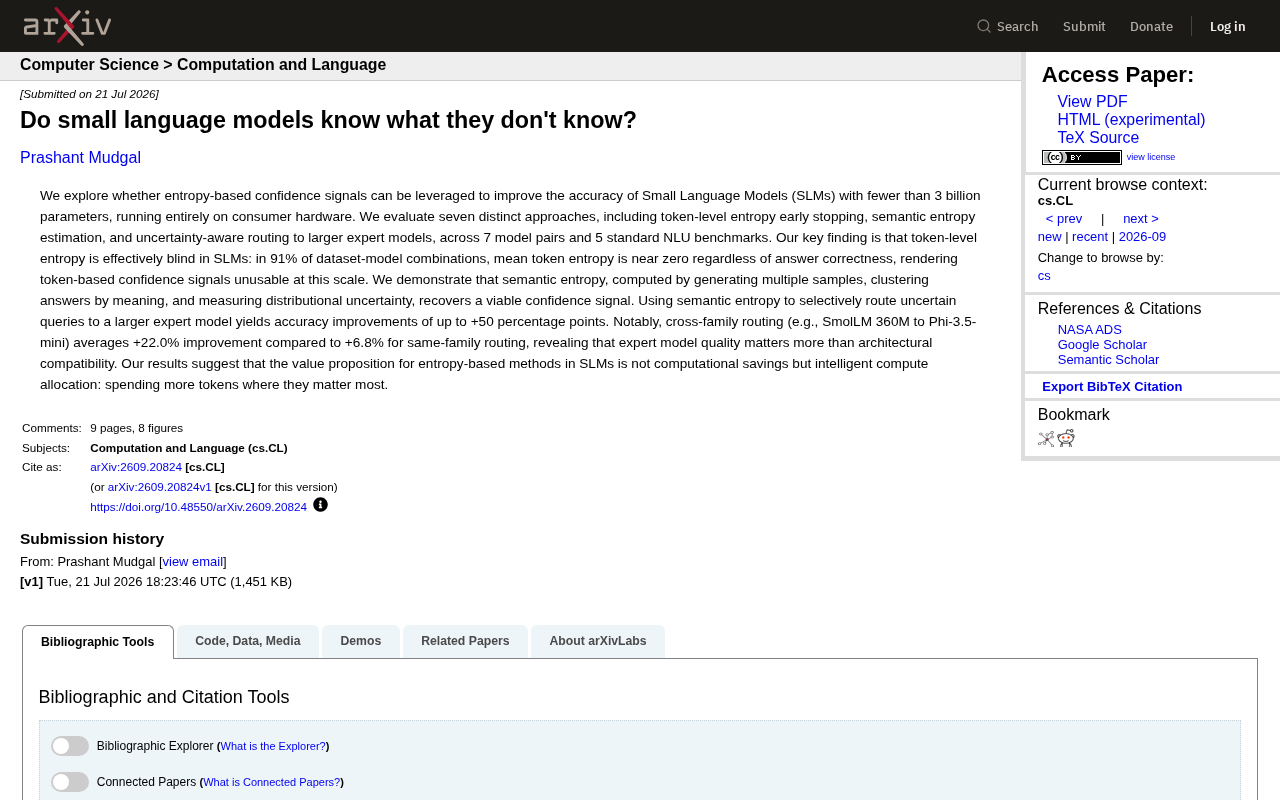
A study from arXiv (arXiv:2609.20824v1) systematically investigates this question. The research team evaluated seven entropy-based confidence signaling methods — including token-level entropy early stopping, semantic entropy estimation, and uncertainty-based routing to expert models — across 7 model pairings and 5 standard natural language understanding (NLU) benchmarks.
Key Finding #1: Token-Level Entropy Nearly Breaks Down in Small Models
The study's most important and counterintuitive finding is this: in small language models, token-level entropy is essentially blind.
In 91% of dataset-model combinations, average token entropy hovered near zero regardless of whether the answer was correct or not. This means the model appears extremely "confident" when generating each token — even when producing wrong answers. This uniformity renders token-entropy-based confidence signals entirely unusable at this scale.
This finding carries a clear warning for engineering practice. In large model settings, token entropy is often used as a cheap proxy for generation uncertainty. But directly porting this approach to SLMs yields a signal with zero discriminative power — the model sounds equally decisive whether it's right or wrong.
Key Finding #2: Semantic Entropy Recovers a Usable Signal
Since per-token entropy doesn't work, the researchers turned to semantic entropy. The approach works by generating multiple sampled answers to the same question, clustering those answers by meaning, and then measuring the distributional uncertainty across those clusters.
The core insight is to stop asking how certain the model is about each individual token, and instead observe whether it consistently produces semantically equivalent answers across multiple generations. If the model repeatedly gives responses that mean the same thing, it's likely confident. If the answers scatter across semantically distinct meanings, that reveals genuine uncertainty.
Experiments confirmed that semantic entropy successfully recovers a usable confidence signal, filling the blind spot left by token-level entropy. The trade-off is the need for multiple sampling passes and greater compute — but in exchange, the method delivers meaningful judgment capability.
Semantic entropy was originally proposed by Kuhn et al. at NeurIPS 2023 to address the disconnect between linguistic diversity and semantic consistency. Traditional token-level entropy focuses on probability distributions over the vocabulary: even when a model expresses the same meaning in different words (e.g., "Paris" vs. "the capital of France"), these are treated as distinct outputs, artificially inflating entropy and producing false uncertainty signals. Semantic entropy's solution is to first use a natural language inference (NLI) model to assess semantic equivalence among sampled answers, grouping semantically identical responses into the same cluster, and then computing entropy at the cluster level. This filters out surface-level diversity caused by paraphrasing, leaving only the signal that genuinely reflects the model's epistemic uncertainty. The main computational cost comes from multiple forward-pass sampling runs and NLI judgments — a non-trivial overhead for compute-constrained edge deployments.
Key Finding #3: Uncertainty-Based Routing Yields Up to +50 Percentage Points
With a usable confidence signal in hand, the research team went further to validate its practical value: selectively routing queries that semantic entropy flags as "uncertain" to a larger expert model.
This strategy produced dramatic accuracy improvements, reaching up to +50 percentage points. In short, letting small models handle questions they're confident about and delegating uncertain ones to a stronger model substantially boosts overall performance.
Even more illuminating is the cross-family comparison:
- Cross-family routing (e.g., routing from SmolLM 360M to Phi-3.5-mini) averaged +22.0% improvement
- Same-family routing averaged only +6.8% improvement
This gap points to an important conclusion: the quality of the expert model matters more than architectural compatibility. Choosing a genuinely more capable model for uncertain queries delivers far greater gains than choosing one that shares the same lineage.
Reframing the Value of Entropy Methods for SLMs
Ultimately, this research redefines what entropy-based methods mean for small language models. Their value proposition is not about saving compute — it's about intelligent compute allocation: spending more tokens exactly where they're needed most.
This perspective has direct practical relevance for edge deployment and on-device AI. When running SLMs on consumer hardware, rather than chasing raw compute savings, a more effective approach is to build a tiered inference system where small models serve as the default and large models step in as needed:
- Most simple queries are handled locally and quickly by the SLM;
- Semantic entropy identifies questions the model genuinely struggles with;
- Only those queries are escalated to a more powerful expert model.
This hybrid architecture preserves the efficiency advantages of small models while leveraging large models to ensure accuracy on the hard cases — a design pattern well worth adopting for localized AI applications.
Summary
Circling back to the original question — do small language models know what they don't know? The answer is: ask with the wrong method (token entropy), and they're clueless; ask with the right method (semantic entropy), and they actually have a sense of it. This research not only reveals the true nature of SLM confidence signals, but also provides solid empirical grounding for designing tiered inference systems in on-device AI.
Background
Entropy in information theory measures the uncertainty of a probability distribution: the more uniform the distribution, the higher the entropy; the more concentrated it is on a single outcome, the lower the entropy. During text generation, a language model outputs a probability distribution over its full vocabulary at each step — if the model is highly certain about the next token, that distribution is sharply peaked and the corresponding token-level entropy approaches zero; if the model is uncertain, the distribution spreads out and entropy rises. In theory, entropy serves as a cheap proxy for a model's "confidence level," requiring no additional labeled data or auxiliary scoring networks — just the logits already computed during inference. This is fundamentally why entropy has been so widely adopted for uncertainty estimation in large language models.
Related articles

Chain of Thought Isn't Just for AI: How Humans Can Use CoT to Improve Thinking Quality
Chain of Thought isn't just a prompt trick for large models. Starting from a Hacker News discussion, this article analyzes why CoT works for human thinking too, breaks down actionable ways to transfer it, and highlights the key differences between human CoT and machine CoT.
Cloudflare Teams Up with OpenAI: Closi…
Cloudflare Teams Up with OpenAI: Closing the Loop from Vulnerability Discovery to Defense with AI
Cloudflare uses OpenAI Daybreak to investigate security vulnerabilities and generate reviewable remediation plans, while developers use Codex to boost coding efficiency and quality.

Orca Multi-Agent Orchestration in Practice: A Guide to Parallel Collaboration with Claude and Codex
Orca is Stable AI's free open-source agent workbench supporting 34 agents like Claude Code and Codex in parallel. Learn its Git worktree isolation, multi-model orchestration, and mobile management.