Docker Enters the Agentic Era: Trusted Supply Chain, Sandboxes, and Governance
Docker pivots to the agentic era, building trust infrastructure with sandboxes and governance.
Docker's new tagline on Product Hunt, "Built to run on trust, for the agentic era," marks its shift from workload containers to trust infrastructure for agents. Docker views agents as "actors" requiring isolation, security, and governance, proposing a three-layer architecture: a trusted supply chain, Docker Sandboxes runtime isolation, and cross-team Docker AI Governance. A new brand identity and Moby whale logo were also unveiled.
Docker's new tagline on Product Hunt is "Built to run on trust, for the agentic era." Behind this slogan is a clear repositioning: containers are no longer just a tool for packaging and isolating workloads — they are meant to carry a new kind of entity: agents.
From Workloads to Actors: Docker's Reinterpretation of Agents
In its release notes, Docker offers a key insight: "Containers isolate workloads, but agents aren't workloads: they're actors that need isolation, security and governance."
This statement highlights the limitations of the traditional container model. Workloads are passive and predictable, executing predefined logic once started; agents, on the other hand, possess autonomous decision-making and tool-calling capabilities, making their behavioral boundaries harder to exhaustively enumerate in advance. Managing agents the way you manage workloads assumes agents won't do anything unexpected — which clearly doesn't hold.
Docker's response is to treat agents as "actors" and rebuild trust across three dimensions: trusted build provenance, isolated runtime environments, and cross-team governance.
A Three-Layer Trust Architecture: Supply Chain, Sandbox, and Governance
Trusted Supply Chain: Giving Agents a Solid Foundation
Docker proposes providing "a trusted supply chain for agents to build from." Agents often need to pull images, call tools, and depend on external components during execution — if any of these links are compromised, risk propagates along the call chain. Moving supply chain trust upstream to the agent build stage is an extension of Docker's existing container image signing and provenance verification capabilities.
Container image signing and provenance verification typically relies on tools like Sigstore/Cosign: images are digitally signed at build time, and at runtime policies verify the signer's identity and integrity, rejecting images of unknown origin or that have been tampered with. The SLSA (Supply-chain Levels for Software Artifacts) framework further defines tiered standards from build platform hardening to provenance attestation. For agents, supply chain risk extends beyond base images to include the MCP servers they call, tool plugins, and model weights — poisoning any link could cause an agent to execute malicious instructions. The essence of a "trusted supply chain," therefore, is extending signing, attestation, and admission policies from a single image to the entire dependency tree that agents rely on.
Docker Sandboxes: Isolation at the Runtime Level
The second layer is "a trusted runtime to isolate them (Docker Sandboxes)." Sandboxing isn't a new concept, but making it the default isolation mechanism for agent runtimes signals that Docker believes agent execution environments need stronger boundaries than ordinary containers. Agents may execute generated code, access networks, and manipulate file systems — the isolation layer provided by sandboxes can limit the blast radius when behavior goes out of bounds.
The sandbox isolation technology spectrum includes Linux namespaces and cgroups (standard containers), gVisor (user-space kernel intercepting system calls), microVMs like Firecracker (hardware virtualization-level isolation), and system call filtering mechanisms like seccomp/AppArmor. Standard containers share the host kernel, offering limited isolation strength; if agents execute auto-generated code, escape risk is higher, making stronger-boundary sandboxes a reasonable choice. Additionally, sandboxes typically pair with network egress allowlists, read-only file systems, and temporary credential injection to enforce "least privilege" for agents. This design parallels temporary execution environments in IDEs or CI, except that agent behavior sequences can't be pre-enumerated, placing higher demands on runtime observability.
Docker AI Governance: A Cross-Team Governance Layer
The third layer is "governance for agents across every team (Docker AI Governance)." As agents move from personal experiments to team collaboration, questions of who approves, who audits, and how permissions are allocated become unavoidable. Docker's decision to offer governance as a standalone product line indicates its judgment that the bottleneck for enterprise agent adoption isn't model capability — it's controllability.
In enterprise contexts, an AI governance layer typically needs to cover several capabilities: identity and permissions (who can deploy and invoke which agent), policy-as-code (declarative rules constraining available tools, data scopes, and external services), audit logs (recording every tool call and decision input/output of an agent), and approval and lifecycle management. Unlike model-level guardrails, the governance layer focuses on organizational controllability rather than single-inference safety. As agent numbers grow and cross-team reuse expands, the lack of unified governance leads to permission sprawl and audit blind spots — precisely the backdrop for Docker's decision to make it a separate product line.
Brand Refresh and the Moby Whale
In sync with its product direction, Docker has also unveiled a redesigned brand identity and a new Moby whale logo. For an infrastructure brand, visual updates are rarely isolated actions — they typically accompany repositioning, signaling to the world that "we're serving a new type of user/scenario." This time, that new scenario is agents.
What This Launch Means
Looking at Product Hunt data, the product received 90 votes and 1 comment, ranking 4th for the day, with categories spanning Developer Tools, Artificial Intelligence, and Security. The vote count isn't explosive, but the category combination itself reveals Docker's intent: using security capabilities as its entry point into the AI developer tools market.
Notably, Docker didn't choose to build an agent framework or orchestration platform, but instead continues to guard its most familiar territory — runtime environments and trust infrastructure. In today's increasingly crowded agent toolchain landscape, this choice is relatively restrained. It's betting that regardless of how agent frameworks evolve, the need for isolation and governance will persist long-term.
Whether this judgment holds depends on whether the sandbox and governance products can land in real team workflows. The release notes point the direction, but the specific integration methods and compatibility with existing container workflows await further product details.
One-line Summary
Docker pivots to the agentic era, building trust infrastructure with sandboxes and governance.
Paragraph Summary
Docker's new tagline on Product Hunt, "Built to run on trust, for the agentic era," marks its repositioning from workload containers to trust infrastructure for agents. The article notes that Docker views agents not as passive workloads but as "actors" requiring isolation, security, and governance, and thus proposes a three-layer trust architecture: a trusted supply chain for agent builds, runtime isolation via Docker Sandboxes, and a cross-team Docker AI Governance layer. A new brand identity and Moby whale logo were also unveiled. Product Hunt data shows 90 votes, 1 comment, and 4th place for the day, with categories spanning developer tools, AI, and security. The article argues that Docker chose to hold its ground in runtime environments and trust infrastructure rather than entering the agent framework race — whether this restrained bet pays off depends on the real-world adoption of its sandbox and governance products.
Related articles

MIT PhD Takes You from Scratch to Build DeepSeek: A 25-Hour Hardcore Course
MIT PhD Raj Dandekar launches a 25+ hour Bilibili course building DeepSeek from scratch—MoE, MLA, GRPO, hand-written code plus math derivations, aiming to reproduce mini R1.
DeepSeek Harness in Practice: From Installation to Plugin Ecosystem, Building a Fully Automated AI Workflow
Based on a hardcore Bilibili tutorial, this guide systematically covers DeepSeek Harness installation, three plugin installation methods, and real-world use cases to help developers quickly build customizable AI Agent workflows.
DeepSeek Harness in Practice: From Installation to Automated Workflows
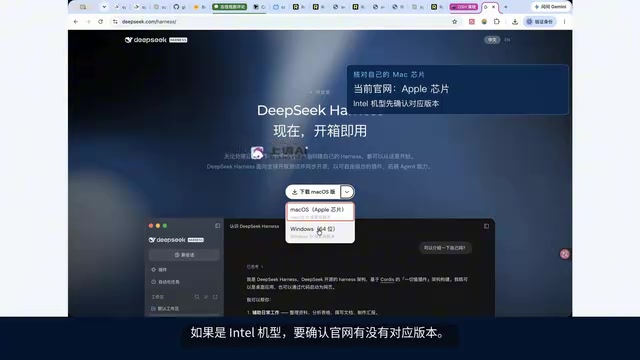
Hands-on DeepSeek Harness tutorial covering Mac/Windows installation, login, workspace binding, model & permission setup, and minimal closed-loop verification for AI automation workflows.