Does Claude Code Cost $110/Month on Pay-As-You-Go? A Deep Dive into Subscription vs. API Costs

Break down Claude Code's pay-as-you-go and subscription costs, with model-switching and scenario-based money-saving strategies.
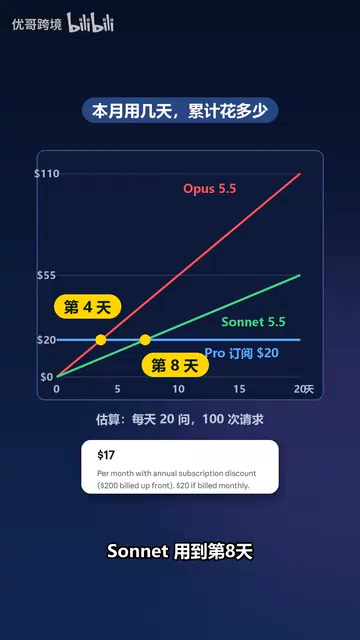
This article combines official pricing with a Bilibili creator's real-world testing to break down Claude Code's cost structure. Pay-as-you-go with the default Opus 5.5 model costs about $110 for 20 questions per day over 20 days per month; switching to Sonic 5.5 reduces it to about $55, and HiQ 5.5 costs only about $3. Compared with subscriptions, Opus exceeds the $20 Pro subscription by the 4th day and Sonic by the 8th day, so high-frequency users save more by subscribing. Enterprise heavy users average $150-250 per person per month, and Max 5x ($100) may be more economical. The article recommends pay-as-you-go for low-frequency users, subscriptions for high-frequency users, flexible model switching based on task complexity, and regularly checking the console usage page to optimize costs.
Introduction: The Claude Code Payment Puzzle
"Does not subscribing to Claude Code cost $110 a month?" This is a question many developers have when they first encounter Claude Code. In fact, this figure comes from a Bilibili creator's pay-as-you-go estimate: 20 questions per day, 20 days per month, using the official API prices from October 2026, with the default model Opus 5.5, the monthly cost is about $110. But the truth goes far beyond that—manually switching models and choosing subscription plans can dramatically change the bill. This article combines official pricing with the creator's real-world testing to break down the cost structure of Claude Code and help you find the most economical way to use it.

Core Cost Estimate: The Real Expense of Pay-As-You-Go
Default Model Opus 5.5: About $110 per Month
According to the official pricing page, the default model for Claude Code is Opus 5.5. The creator calculated the monthly cost at about $110 based on 20 questions per day and 20 days per month. This estimate is based on the API's pay-as-you-go model, where you pay for what you use; free accounts cannot use Claude Code. One detail to note: this figure is only an estimate, and the actual cost depends on task complexity—complex programming tasks consume more tokens and may cost more.
Tokens and Pay-As-You-Go: API billing for large language models uses tokens as the basic unit. A token is the smallest fragment of text processed by the model; in English it is roughly equal to 0.75 words, while in Chinese it varies depending on the tokenization method. Pay-as-you-go means billing based on the total number of tokens consumed by input (prompt) and output (completion) multiplied by the unit price—you pay for what you use. Unit prices differ significantly across models: the Opus series, as flagship models, typically costs dozens of times more per million tokens than lightweight models; Sonic is a mid-range balanced option, while HiQ focuses on low-cost narrow tasks. Therefore, for the same 20 questions, if they involve reading and writing long code files or complex reasoning, Opus's token consumption and unit price combined could push the monthly cost far above $110; conversely, simple Q&A may cost less than the estimate. Only by understanding token billing logic can you accurately predict your bill.
Switching Models: Costs Can Drop by More Than Half
In the video, the creator demonstrated how to manually switch models. After switching to Sonic 5.5, the monthly cost for the same usage drops to about $55; switching to HiQ 5.5 costs only about $3. The official documentation notes that HiQ 5.5 is better suited to narrow-scope tasks, while complex programming tasks should use Sonic or Opus. This means that if you mainly handle simple queries or narrow-scope tasks, switching models can save a lot of cost.

Subscription vs. Pay-As-You-Go: Where Is the Break-Even Point?
Subscription Plan Price Comparison
Claude Code offers subscription options: Pro at $20 per month and Max 5x at $100 per month. The creator compared pay-as-you-go with subscriptions: based on the Opus estimate, it becomes more expensive than Pro by the 4th day; based on the Sonic estimate, it exceeds Pro by the 8th day. In other words, if you use it more than 4 days per month (Opus) or 8 days (Sonic), subscribing to Pro is more cost-effective.

The Essential Difference Between Subscription and Pay-As-You-Go: A subscription (Pro/Max) is a fixed monthly fee in exchange for a certain usage quota; beyond that quota, you may face rate limits or additional charges. Pay-as-you-go is pure postpaid billing with no monthly threshold but a higher unit price. The two are not simply a matter of higher or lower price, but a trade-off between risk and flexibility: subscriptions suit users with stable, predictable usage and can cap costs; pay-as-you-go suits users with highly variable or occasional usage and avoids paying for unused quota. In addition, subscription plans usually include extra benefits such as the Claude web version and priority access to new features, while pure API pay-as-you-go only provides model invocation capability. When choosing, consider usage frequency, task complexity, and whether you need these additional features.
Heavy Users: Enterprise-Level Cost Reference
For heavy users who use it every day, the official documentation gives an enterprise average of $150 to $250 per person per month. This is far higher than the $20 personal Pro subscription, but enterprise-level usage is usually larger and involves more complex tasks. If your usage frequency is close to enterprise level, subscribing to Max 5x ($100) may be more economical than pay-as-you-go. The creator reminds viewers that the real bill should be checked on the usage page in the console, where precise consumption data is available.
How to Choose: Scenario-Based Recommendations
Occasional Use: Pay-As-You-Go Is More Flexible
If you only open Claude Code occasionally for a few days each month, pay-as-you-go is the more flexible choice. For example, using it 2-3 days per month costs only $10-15 based on the Opus estimate, far below the $20 Pro subscription. In this mode, you don't pay for unused days, making it suitable for project gaps or temporary needs.
High-Frequency Use: Subscriptions Are More Cost-Effective
If you use it almost every day, subscribing to Pro ($20) or Max ($100) can significantly reduce costs. Taking Opus as an example, after subscribing to Pro, with 20 questions per day, you can save about $90 per month. For heavy users, Max 5x provides a higher quota and suits enterprises or professional developers.
Model Selection Strategy
Choose models based on task type: use HiQ 5.5 for simple tasks (extremely low cost), Sonic 5.5 for medium complexity, and Opus 5.5 for complex programming. The creator emphasizes that the official recommendation is to use Sonic and Opus for complex programming, while HiQ suits narrow-scope tasks. Switching models reasonably can maximize cost savings while ensuring quality.
Conclusion: Key Points for Cost Optimization
Claude Code's payment model is flexible and diverse; the key is to choose a plan based on usage frequency and task type. Pay-as-you-go suits low-frequency users, subscriptions suit high-frequency users, and model switching is a powerful tool for reducing costs. The creator finally mentioned that to learn about the specific differences between Pro and Max, you can watch his next video. For developers, regularly checking the console usage page and adjusting strategy based on actual bills is the best practice for cost control.
One-line Summary
Break down Claude Code's pay-as-you-go and subscription costs, with model-switching and scenario-based money-saving strategies.
Paragraph Summary
This article combines official pricing with a Bilibili creator's real-world testing to break down Claude Code's cost structure. Pay-as-you-go with the default Opus 5.5 model costs about $110 for 20 questions per day over 20 days per month; switching to Sonic 5.5 can reduce it to about $55, and HiQ 5.5 costs only about $3. Compared with subscriptions, Opus exceeds the $20 Pro subscription by the 4th day and Sonic by the 8th day, so high-frequency users save more by subscribing. Enterprise heavy users average $150-250 per person per month, and subscribing to Max 5x ($100) may be more economical. The article recommends pay-as-you-go for low-frequency users, subscriptions for high-frequency users, flexible model switching based on task complexity, and regularly checking the console usage page to optimize costs.
Related articles

Chain of Thought Isn't Just for AI: How Humans Can Use CoT to Improve Thinking Quality
Chain of Thought isn't just a prompt trick for large models. Starting from a Hacker News discussion, this article analyzes why CoT works for human thinking too, breaks down actionable ways to transfer it, and highlights the key differences between human CoT and machine CoT.
Cloudflare Teams Up with OpenAI: Closi…
Cloudflare Teams Up with OpenAI: Closing the Loop from Vulnerability Discovery to Defense with AI
Cloudflare uses OpenAI Daybreak to investigate security vulnerabilities and generate reviewable remediation plans, while developers use Codex to boost coding efficiency and quality.

Orca Multi-Agent Orchestration in Practice: A Guide to Parallel Collaboration with Claude and Codex
Orca is Stable AI's free open-source agent workbench supporting 34 agents like Claude Code and Codex in parallel. Learn its Git worktree isolation, multi-model orchestration, and mobile management.