Does ML Deployment Always Require Dockerization? A Practical Guide to Containerization

A practical guide on when to Dockerize ML components and when to keep things simple.
This article explores whether every component in an ML project needs Docker containerization. It covers the core problems Docker solves (environment consistency, isolation, orchestration), provides a framework for deciding what to containerize based on execution patterns, dependency complexity, and architecture, and offers a progressive three-phase approach from local development to full orchestration.
Introduction: A Common Deployment Dilemma
When learning to deploy machine learning projects, many beginners encounter the same question: Should everything be containerized with Docker? While seemingly simple, this question touches the core of modern software engineering and MLOps practices.
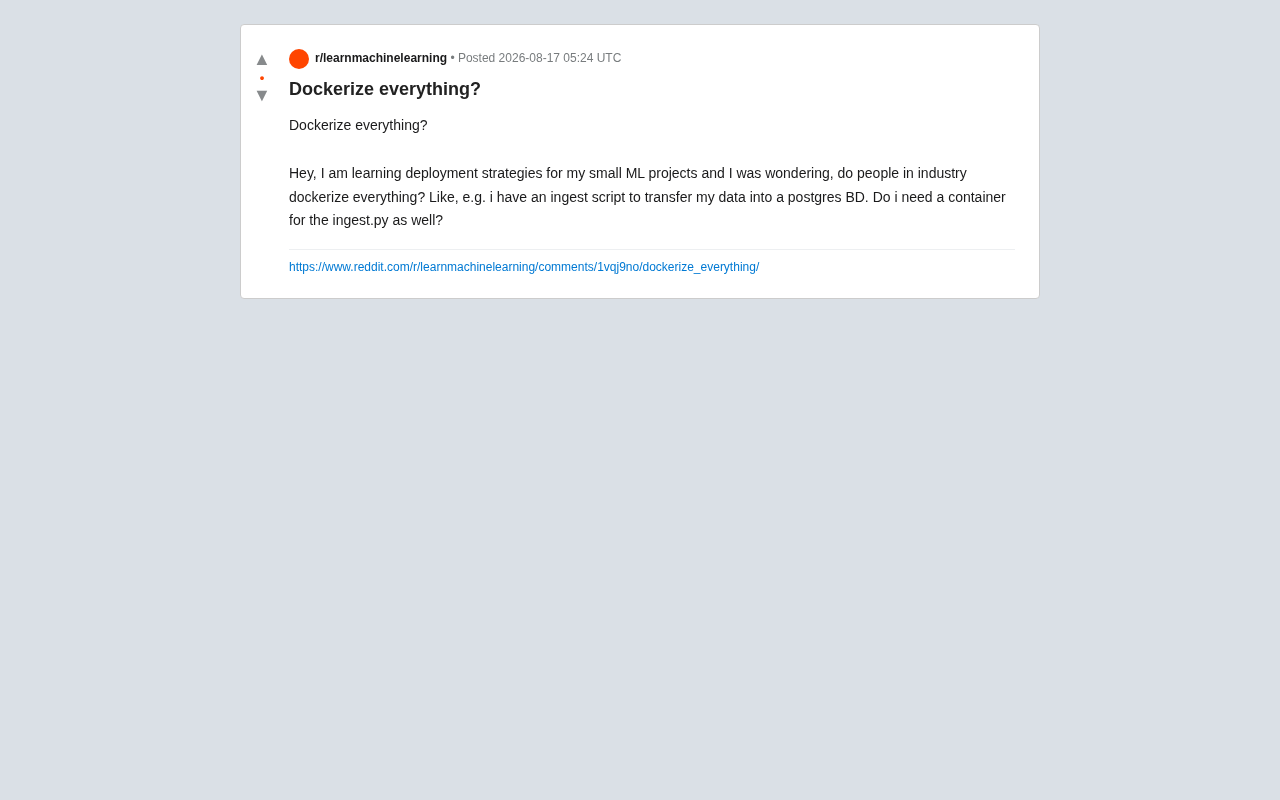
Recently, a Reddit user raised this question in the community: "I'm learning deployment strategies for small ML projects and wondering whether industry practice is to containerize everything. For example, I have an ingest script that loads data into a PostgreSQL database — do I need to create a separate container for this ingest.py as well?"
This is a very typical question worth exploring in depth from the perspectives of principles, scenarios, and practice.
The Essence of Containerization: What Problem Does It Actually Solve?
Before answering whether to "Dockerize everything," we need to understand what Docker actually solves.
Docker was born in 2013, open-sourced by dotCloud (later renamed Docker Inc.). It leverages Linux kernel technologies — cgroups (control groups) and namespaces — to achieve lightweight OS-level virtualization. Unlike traditional virtual machines, containers don't need to emulate complete hardware and operating systems. Instead, they share the host kernel, resulting in extremely fast startup times (typically in seconds) and far less resource overhead than VMs. Today, Docker images follow the OCI (Open Container Initiative) standard, meaning any OCI-compatible runtime (such as containerd or CRI-O) can run Docker-built images.
Environment Consistency
Docker's core value lies in packaging dependencies and runtime environments, achieving "build once, run anywhere." It solves the classic pain point of "it works on my machine." When your code, Python version, system libraries, and environment variables are all encapsulated in an image, behavior is consistent regardless of which server you deploy to.
Docker images are built using a layered file system (Union File System), where each Dockerfile instruction generates a read-only layer. This layering mechanism not only saves storage space (multiple images can share base layers) but also dramatically accelerates build and distribution — only changed layers need to be retransmitted. For ML projects, this means you can place large base dependencies (like CUDA toolkit, PyTorch) in lower layers and frequently changing business code in upper layers, so each image rebuild only processes minimal changes at the top.
Isolation and Reproducibility
Containers provide process-level isolation, preventing dependency conflicts between different projects. For ML projects, dependency hell is especially common — compatibility issues between different versions of CUDA, PyTorch, and NumPy can be maddening. Containerization allows these dependencies to be precisely locked and reproduced.
A typical manifestation of "dependency hell" in ML: PyTorch 2.x requires CUDA 11.8+, but your GPU driver only supports CUDA 11.7; or a data processing library pins NumPy<1.24, while your model framework requires NumPy>=1.24. Such conflicts are especially fatal when running multiple projects on the same development machine. The traditional solution is Python virtual environments (venv, conda), but these only isolate Python packages — they can't isolate system-level dependencies (like C libraries, CUDA runtime). Containers provide complete filesystem-level isolation, encapsulating everything from OS libraries to Python packages, truly achieving "environment as code" reproducibility.
Deployment and Orchestration
Containers are naturally compatible with orchestration tools like Kubernetes and Docker Compose, making service scaling, rolling updates, and health checks standardized. This is a major reason industry widely adopts containers.
Kubernetes (commonly abbreviated as K8s) is a container orchestration platform open-sourced by Google that can automatically manage the deployment, scaling, and failure recovery of hundreds or even thousands of containers. Docker Compose is a lightweight orchestration tool for single-machine multi-container applications, defining all services and their network relationships through a single YAML file. In ML scenarios, a typical orchestration architecture might include: model inference services (horizontally scaled with multiple replicas), feature store services, monitoring services (like Prometheus + Grafana), and data processing pipelines. Orchestration tools make lifecycle management of these components declarative and automated — you only describe the "desired state," and the system automatically adjusts the actual state to match.
Back to the Question: Does the Ingest Script Need Its Own Container?
For the original poster's specific scenario — an ingest.py script that loads data into PostgreSQL — the answer is it depends.
Dimension 1: Execution Pattern
If ingest.py is a one-time or occasionally-run batch task, it doesn't necessarily need a long-running container. You can:
- Run it as a one-shot Docker container (
docker run --rm your-image python ingest.py), destroyed after completion; - Or trigger it as a Kubernetes Job / CronJob on a schedule;
- Or in small projects, simply execute it in a virtual environment on the host machine.
Two Kubernetes concepts need explanation here: A Job is a workload resource that ensures a specified number of Pods successfully complete, suitable for one-time tasks (like data migration, batch computation); a CronJob adds scheduled triggering on top of Jobs, similar to Linux's crontab, automatically creating Jobs according to a set schedule (e.g., every hour, every day at 3 AM). For data ingestion tasks that need periodic execution, CronJob is a very natural choice — each execution starts a fresh container, automatically cleaned up after completion, without occupying persistent resources.
The key point: containerization doesn't mean "must run persistently." One-time tasks can equally benefit from the environment consistency that containers provide.
Dimension 2: Dependency Complexity
If ingest.py only depends on standard psycopg2 and pandas with simple dependencies, the marginal benefit of containerization is small. But if it involves complex data processing libraries or specific version constraints, containerization can significantly reduce environment configuration costs.
Dimension 3: Relationship to Overall Architecture
If your project will ultimately deploy to a containerized production environment (e.g., the entire pipeline runs on Kubernetes), keeping ingest containerized ensures consistency across development, testing, and production environments, reducing "environment drift."
"Configuration Drift" refers to the phenomenon where configurations across different environments gradually diverge over time. For example, a developer installs a system patch locally, or a test environment has a configuration file manually modified — if these changes aren't recorded as code, they lead to "works fine in test, breaks in production." Containerization codifies the environment build process through Dockerfiles, and combined with CI/CD pipelines, ensures the same image is used from development to production, fundamentally eliminating the possibility of drift.
Real-World Industry Practices
So does industry actually "Dockerize everything"?
Most Long-Running Services Are Indeed Containerized
For API services, model inference services, web backends, and other long-running services, industry almost defaults to containerization. They need high availability, scalability, and observability — containers are the standard answer.
Batch Processing and Scripts Are Handled More Flexibly
For data ingestion, ETL, and scheduled tasks, practices are more diverse:
- Mature teams tend to incorporate them into unified containerized pipelines, managed through orchestration tools like Airflow or Dagster, where each task is essentially a container;
- Small projects or early stages often stay lightweight, using simple cron + virtual environments to avoid over-engineering.
Apache Airflow and Dagster are currently the most popular data/ML workflow orchestration tools. Airflow was developed by Airbnb in 2014 and entered the Apache Foundation in 2016. It uses DAGs (Directed Acyclic Graphs) to define dependency relationships and execution order between tasks. In containerized mode, Airflow's KubernetesExecutor dynamically creates a Pod (i.e., container) for each task, destroying it after completion, achieving task-level resource isolation and elastic scaling. Dagster is a newer framework emphasizing the "Software-defined Assets" philosophy, focusing more on data asset lineage tracking and type safety. Both support packaging each data processing step as an independent container, forming observable, retryable, and traceable production-grade data pipelines.
Databases Are Usually Not Self-Deployed via Docker
Interestingly, stateful services like PostgreSQL are generally not recommended for self-managed Docker deployment in production environments. Instead, managed services from cloud providers (like AWS RDS, GCP Cloud SQL) are preferred. However, using Docker for databases in local development is very convenient.
The core reason behind this lies in the fundamental difference between Stateful Services and Stateless Services. Container design philosophy follows the "cattle model" — they can be destroyed and replaced at any time, which perfectly fits stateless services. But databases require persistent storage, data consistency guarantees, replication, automated backups, and failover — requirements that conflict with containers' ephemeral nature. Although Kubernetes provides StatefulSet and PersistentVolume to support stateful workloads, self-managing production-grade databases still requires handling backup strategies, high-availability configuration, performance tuning, security patches, and much more. Cloud providers' managed database services (like AWS RDS, Google Cloud SQL, Azure Database) encapsulate all this operational complexity, offering automated backups, multi-availability-zone deployment, one-click scaling, and more, letting teams focus on business logic rather than infrastructure management.
Practical Advice for Beginners: Progressive Containerization
For small ML projects, here's a progressive approach:
Phase 1: Local Development
Use docker-compose to organize PostgreSQL and your application together for easy one-click local environment setup. The ingest script doesn't need separate containerization yet — it can run within the application container.
Phase 2: Standardized Tasks
Once the project stabilizes, package ingest-type tasks as independent images (or reuse the main image), running them via one-shot containers or scheduled tasks to gain environment consistency and reproducibility.
Phase 3: Orchestration and Automation
As the project scales, introduce Airflow or Kubernetes CronJob to bring all tasks under a unified scheduling system. At this point, "everything is a container" truly holds.
Conclusion: Avoid Over-Engineering
Returning to the original question — don't containerize for the sake of containerizing. Docker is a tool, not a goal. When deciding whether to containerize, focus on three core questions:
- Does it need environment consistency and reproducibility?
- Will it run long-term or require orchestration?
- Do the benefits of containerization exceed the maintenance costs?
For small ML projects in the learning phase, mastering docker-compose for service organization and understanding the difference between one-shot and long-running containers is sufficient for most scenarios. True engineering wisdom lies in knowing when to containerize and when not to.
Related articles

Felix Rieseberg Personal Homepage
Felix Rieseberg's personal homepage sparks attention on Hacker News. This article covers the Slack engineer's technical background, the rise and fall of nativefier, and the value of a developer homepage as a tech calling card.

@ai-sdk/vue 3.0.306 Patch Release Syncs with [email protected] Update
@ai-sdk/vue 3.0.306 released, synced with [email protected]. A routine patch release for the Vercel AI SDK ecosystem with no public API changes; the Vue adapter layer stays version-aligned with the core package.

Gemini 4 Argon API Launches: The Era of Million-Token Output Begins
Google launches Gemini 4 Argon with sparse MoE architecture, up to 1M output tokens, and a 68.90% Vals Index score, available across API, AI Studio, and the Gemini app.