Does Non-Determinism Really Not Matter? Revisiting the Randomness Debate in LLM Inference

LLM non-determinism doesn't affect value in most scenarios, but code generation and compliance auditing require semantic stability.
The article centers on the Hacker News debate over "Non-Determinism Doesn't Matter," outlining the sources of non-determinism in LLM inference: sampling strategies, accumulated floating-point errors, and batch configuration differences, noting that even temperature=0 cannot fully eliminate it. Proponents argue that semantically equivalent outputs are sufficient in most scenarios, that pursuing bit-wise determinism sharply reduces throughput, and that environmental differences are themselves non-reproducible. Opponents emphasize that in code generation, compliance auditing, and scientific computing, non-reproducibility is a real risk and adds extra variance to evaluation. The author ultimately proposes a pragmatic stance: distinguish "needing determinism" from "pretending to need determinism," and use constrained decoding, schema validation, and similar methods to approximate semantic stability rather than pursue complete underlying determinism.
The Origins of the Non-Determinism Debate
A recent discussion on Hacker News has reignited the debate about non-determinism in LLM inference, with a title that cuts straight to the point—"Non-Determinism Doesn't Matter." This claim touches on a core issue that has been repeatedly argued about in current large model deployments: why does the same prompt produce different outputs across two calls? Is this non-determinism a technical flaw that needs to be fixed?
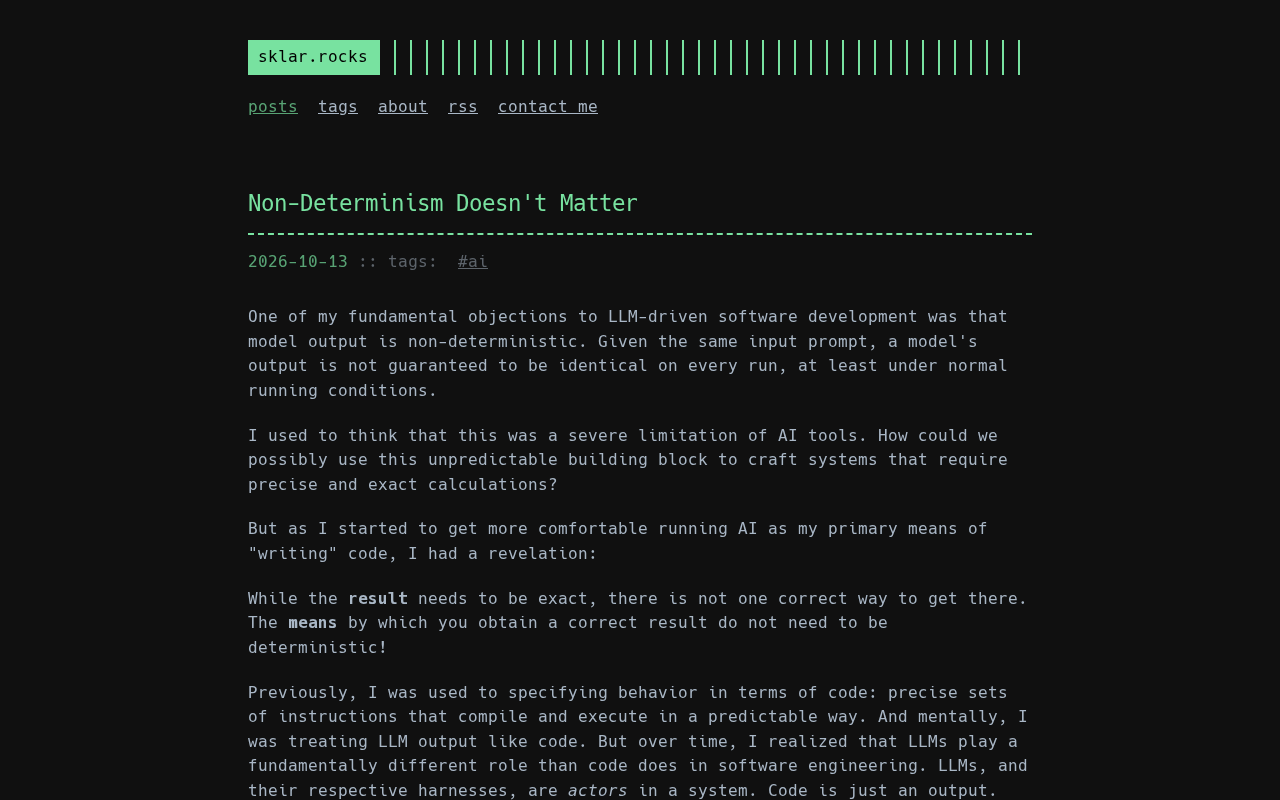
To understand the weight of this claim, we first need to clarify where non-determinism comes from. Randomness in LLM inference has at least several independent sources: sampling strategies (temperature, top-p, etc.) are themselves intentionally introduced randomness; floating-point operations accumulate errors across different hardware and parallel configurations, leading to tiny deviations in logits; and dynamic changes in batch size alter the reduction order of matrix multiplications. The latter two persist even under greedy decoding with temperature=0, meaning that even if you disable all sampling randomness, outputs may still be inconsistent.
Greedy Decoding refers to the model selecting the token with the highest probability at each generation step, rather than randomly sampling according to the probability distribution. It is equivalent to setting temperature to 0 and applying no top-k / top-p filtering. It is often mistakenly assumed to be equivalent to "deterministic output," but this is not actually the case: although the sampling step no longer introduces randomness, the computation of logits itself is still affected by the order of floating-point operations. Matrix multiplications, normalization, and softmax reductions on GPUs often use parallel tree reductions; different batch sizes, sequence lengths, and parallel partitions change the order of additions, which in turn causes the last bits of floating-point results to shift. When the probabilities of two candidate tokens are extremely close, this last-bit shift is enough to make argmax select a different token, and subsequent generation then diverges completely. Therefore, greedy decoding can only eliminate explicit sampling randomness; it cannot guarantee bit-wise reproducibility.
Bit-wise determinism means that given the same input, the output tensor is identical in every bit across any hardware, driver, or batch configuration. It is a much stricter requirement than "semantic consistency," and is typically emphasized in scientific computing and reproducible research. For LLM inference, achieving bit-wise determinism means fixing all reduction orders, disabling GPU operators that depend on non-determinism (such as certain cuBLAS/cuDNN kernels and atomic adds), disabling dynamic batching, and padding inputs to fixed lengths. These constraints weaken operator fusion and parallelism, directly reducing throughput and memory efficiency, so they are almost never adopted in production services facing massive request volumes.
Stability at the semantic level is a more permissive goal relative to bit-wise determinism: it allows different output token sequences, but requires key information, structured fields, and logical conclusions to remain consistent. Implementation methods include constrained decoding (such as JSON schema or regex grammar guidance), structured output validation, voting or consistency filtering after multiple samplings, and rule-based post-processing for key fields. For scenarios such as code generation and data extraction, this kind of stability is often closer to actual needs than verbatim reproduction, and is easier to implement in engineering practice.
Why Some Say It Doesn't Matter
The logic behind the claim "Non-Determinism Doesn't Matter" rests on several premises. First, the output space of LLMs is itself continuous and high-dimensional; two semantically equivalent outputs may be completely different at the token level, but this does not affect the actual quality of task completion. For example, if you ask a model to summarize a passage, two generations may use different wording, but both information coverage and accuracy are within an acceptable range—do users really care whether the two outputs are verbatim identical?
Second, from an engineering practice perspective, the cost of pursuing fully deterministic inference is extremely high. To achieve bit-wise determinism across hardware and batch configurations, one needs to fix reduction orders, disable certain GPU optimizations, and force padding to fixed lengths. These measures can significantly reduce throughput. For an inference service handling millions of requests per day, sacrificing more than 30% of throughput for determinism is not a worthwhile trade-off in most scenarios.
Third, much of what is called "non-determinism" is actually observable but non-reproducible environmental variation. The same model deployed on different versions of CUDA, different GPU models, or even different driver versions on the same GPU will produce different outputs. Rather than being a property of the model, this is better understood as an emergent behavior of the entire software and hardware stack.
Dissenting Voices: Where Non-Determinism Is Truly Fatal
But the judgment that it "doesn't matter" has clear boundaries. In code generation scenarios, non-determinism may mean that the same prompt sometimes generates a correct bounds check and sometimes omits it—for software engineering processes that require auditing and reproducibility, this is a real risk. According to feedback from developer communities, when integrating LLM code generation into CI/CD pipelines, non-deterministic outputs make regression testing extremely difficult: you cannot tell whether a test failure is because the model "didn't generate well this time" or because the code itself has a problem.
In scientific computing and data analysis, non-determinism is also an obstacle. If LLMs are used to assist with numerical computation or data processing pipelines, the non-reproducibility of outputs directly violates the basic requirements of the scientific method. Compliance audit scenarios (such as finance and healthcare) face a similar dilemma: regulators require explainable, reproducible reasoning chains for AI-assisted decisions, and stochastic outputs make this requirement difficult to satisfy.
More subtly, there is the evaluation problem. When comparing models or optimizing prompt engineering, non-determinism introduces additional variance. If the same prompt run 10 times yields 3 different levels of output quality, how do you determine which of two prompt versions is better? This requires a large number of repeated experiments to eliminate noise, significantly increasing evaluation costs.
Constrained decoding is a class of techniques that force outputs to satisfy a specific grammar or schema during generation. By applying a mask to logits at each step, it sets the probability of illegal tokens to zero, thereby ensuring that the final result conforms to a predefined JSON, SQL, or regex grammar. For code generation and structured data extraction, constrained decoding can significantly improve output consistency without pursuing underlying determinism—the same prompt may still produce different wording, but field names, types, and nested structures remain stable, facilitating downstream validation and regression comparison. Common implementations include finite-state-machine-based grammar guidance and dynamic masking based on JSON schema, at the cost of introducing a small amount of extra computation and limiting some free-generation capability.
A Pragmatic Stance: Distinguish "Needing Determinism" from "Pretending to Need Determinism"
The most valuable part of this discussion is that it forces teams to clarify a question that had previously been handled vaguely: does your application actually need determinism?
For scenarios such as content generation, creative assistance, and dialogue systems, non-determinism is not a bug but a feature—it makes interaction more natural and outputs more diverse. For scenarios such as code generation, structured data extraction, and automated decision-making, what is needed may not be bit-level determinism, but stability at the semantic level: outputs may be phrased differently, but key fields and logic must be consistent. This kind of stability can be approximated through constrained decoding, schema validation, post-processing checks, and other means, without pursuing complete determinism at the underlying level.
What truly deserves vigilance is another situation: a team observes non-deterministic outputs during development and spends a great deal of effort trying to "fix" it, without first asking, "Does this problem affect user value?" Engineering resources are limited. Spending time locking down a source of randomness that essentially does not need to be locked down may be the biggest misjudgment of priorities.
Reproducibility in software engineering and the scientific method generally means: given the same input, code version, and environment configuration, the same output or conclusion can be reproduced. It is not completely equivalent to "determinism": determinism is a system property, while reproducibility depends on complete recording and control of the broader environment (model version, weights, inference framework, drivers, random seed). In LLM services, even if the model itself is deterministic, if the backend continuously updates weights or switches hardware, historical outputs cannot be reproduced. Therefore, a common practice for audit and compliance scenarios is to fix model snapshots, record inference parameters and version numbers, save intermediate inputs and outputs, and replay with the same snapshot when needed, rather than requiring an online service to always output bit-for-bit identical results.
Conclusion
The statement "Non-Determinism Doesn't Matter" is half right. The right half is: in most application scenarios, non-determinism in LLM outputs does not affect the delivery of core value, and it is not worth investing a large amount of engineering resources to eliminate. The wrong half is: in scenarios such as code generation, compliance auditing, and scientific computing, the lack of reproducibility caused by non-determinism is a real and serious engineering challenge, and it needs to be addressed with semantic constraints rather than underlying determinism. The key is not whether non-determinism itself matters, but whether your application needs reproducibility—answer that question first, and then decide whether to wrestle with randomness.
Related articles

Chain of Thought Isn't Just for AI: How Humans Can Use CoT to Improve Thinking Quality
Chain of Thought isn't just a prompt trick for large models. Starting from a Hacker News discussion, this article analyzes why CoT works for human thinking too, breaks down actionable ways to transfer it, and highlights the key differences between human CoT and machine CoT.
Cloudflare Teams Up with OpenAI: Closi…
Cloudflare Teams Up with OpenAI: Closing the Loop from Vulnerability Discovery to Defense with AI
Cloudflare uses OpenAI Daybreak to investigate security vulnerabilities and generate reviewable remediation plans, while developers use Codex to boost coding efficiency and quality.

Orca Multi-Agent Orchestration in Practice: A Guide to Parallel Collaboration with Claude and Codex
Orca is Stable AI's free open-source agent workbench supporting 34 agents like Claude Code and Codex in parallel. Learn its Git worktree isolation, multi-model orchestration, and mobile management.