Dogra: Open-Source Self-Hosted Voice AI Platform — Say Goodbye to VAPI's Sky-High Bills

Open-source project Dogra tackles high costs and vendor lock-in in voice AI development
Voice AI development faces three major challenges: stacking costs, vendor lock-in, and system complexity. The open-source project Dogra addresses these through three core capabilities — a voice engine, a visual workflow builder, and a platform layer — enabling developers to bring their own providers, design conversation logic with flowcharts, and gain full observability tools, all while maintaining control over the entire system with one-click local deployment via Docker.
The Hidden Pain of Voice AI: Bills and Loss of Control
You just built a voice AI Agent. It works great. Then the bill arrives — LLM costs, text-to-speech costs, telephony costs, plus the platform's cut on top. Worse still, you don't truly own the system. When the platform raises prices, you just have to accept it. When they change restrictions, same story. Need a custom deployment? You'll probably hit a wall.
This is the reality facing voice AI developers today. And an open-source project called Dogra is trying to fundamentally change the game.
Voice AI Development Is Far More Complex Than It Looks
From the outside, the voice AI pipeline seems straightforward: receive call → speech-to-text → send to LLM → text-to-speech → done. But anyone who has actually built a voice Agent knows that real-world calls are full of uncertainty.
Users will interrupt you, go silent, switch topics, and ask completely unexpected questions. Your Agent needs to call various external APIs, and when things go wrong, you need to pinpoint exactly which component failed.
A voice Agent is far more than "ChatGPT with a phone number." It's a real-time system with numerous moving parts: speech-to-text (STT), large language models (LLM), text-to-speech (TTS), state management, tool calling…
Technical Context: The Multi-Layer Vendor Ecosystem of Voice AI
A voice AI tech stack is composed of multiple independent components chained together, each with its own specialized vendor ecosystem. In the STT (Speech-to-Text) space, major players include Deepgram, AssemblyAI, and OpenAI Whisper, each with different trade-offs in latency, accuracy, and pricing. The TTS (Text-to-Speech) space features ElevenLabs (known for high fidelity), Cartesia (focused on low latency), and Microsoft Azure Neural Voice (enterprise-grade stability). At the LLM layer, it's a competition among GPT-4, Claude, Gemini, and others. This multi-layer vendor structure creates a unique cost-stacking effect — each layer bills independently, and managed platforms often add another profit margin on top, causing bills to far exceed expectations at scale.
When a call goes wrong, "the bot gave a wrong answer" isn't nearly enough information. Was the prompt poorly written? Was the wrong model selected? Did an API call time out? You need a complete call chain to troubleshoot.
What Is Dogra? A Deep Dive Into Its Three Core Capabilities
At its core, Dogra provides three layers of capability: a Voice Engine, a Visual Workflow Builder, and a Platform Layer. Together, these form a complete open-source voice AI development platform.
Voice Engine: Making Calls Actually Work
The voice engine is Dogra's core, responsible for connecting callers, telephony providers, STT, LLM, and TTS. It handles all real-time interaction scenarios during a call, including complex situations like interruption handling and silence detection.
Interruption Handling is one of the most technically challenging aspects of voice AI systems. When a user interrupts while the AI is speaking, the system needs to accomplish the following within milliseconds: stop the current TTS audio stream, discard generated-but-unplayed content, reset the LLM context state, and re-enter STT listening mode. Any delay in any of these steps will cause noticeable stuttering or "glitching" for the user. Silence Detection is equally critical — the system needs to distinguish between a user's "thinking pause" and "actually finished speaking." Overly aggressive detection will cut users off, while overly conservative detection makes the conversation feel sluggish.
The most critical point: you can bring your own providers — your own LLM, your own TTS provider — without being locked into any single vendor.
Visual Workflow Builder: Design Conversation Logic with Flowcharts
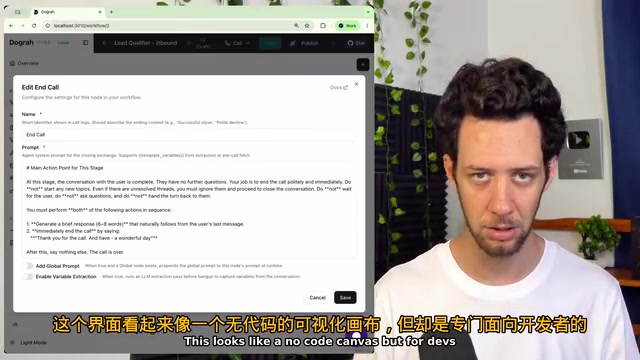
The workflow builder lets you design your entire conversation logic visually. Instead of hard-coding every prompt, conditional branch, API call, and transfer rule, you map out the complete flow like drawing a flowchart: ask this question → wait for the answer → call this API → branch here → transfer there.
It looks like a no-code canvas, but it's designed for developers. Its value isn't in being "no-code" per se, but in not wasting code — you don't need to write mountains of glue code to wire components together. Save your code for the places that truly need custom logic, and let the builder handle orchestration.
Technical Context: The Evolution of Conversation Flow Orchestration
The orchestration approach for dialogue systems has evolved from hard-coded state machines, to rule-based dialogue trees, to today's LLM-driven dynamic flows. Early IVR (Interactive Voice Response) systems relied entirely on predefined key-press menus with extremely limited flexibility. Modern voice AI introduced LLMs that dramatically improved natural language understanding, but also brought new challenges: purely LLM-driven conversations tend to "go off the rails" and struggle to reliably execute critical business nodes (like collecting required information or triggering specific APIs). This is precisely where visual workflow builders add value — they strike a balance between LLM flexibility and business process determinism, allowing developers to precisely control the skeletal structure of a conversation while preserving the LLM's natural language capabilities within each node.
Platform Layer: Testing, Tracing, Recording, and Analytics All in One Place
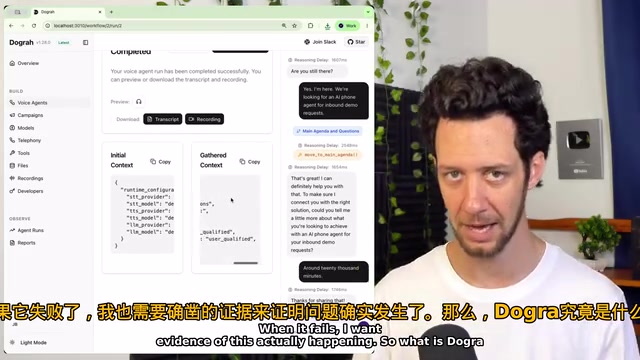
This is the part every production voice AI project eventually needs but often overlooks. Dogra provides comprehensive testing tools, call tracing, call recording, and analytics capabilities. When your Agent has issues, you can see the complete transcript, execution traces, actual tool calls triggered, and state changes.
Technical Context: The Three Pillars of Observability
Observability is a core concept in modern distributed systems engineering, built on three pillars: Logs, Metrics, and Traces. This framework was standardized by CNCF (Cloud Native Computing Foundation) in the OpenTelemetry project. For real-time systems like voice AI, traditional monitoring approaches often fall short — a single failed call might involve network latency (on the telephony carrier side), model hallucinations (on the LLM side), tool call timeouts (on the API side), and these issues often intertwine. Complete distributed tracing can generate a timestamped event sequence for each call, allowing developers to replay the entire interaction like watching a recording. This is exactly what APM tools like Datadog and Jaeger solve in traditional software, and Dogra natively integrates similar capabilities into its voice AI platform.
This is the observability developers actually need — not just knowing "the bot worked," but understanding why it worked, and when it fails, having sufficient evidence to quickly identify the root cause.
Hands-On Demo: Building a Lead Qualification Agent
Local Deployment: One-Click Start with Docker
Dogra's local deployment is remarkably simple — just three steps:
git clone <dogra-repo-url>
cd dogra
docker compose up
Docker Compose is the de facto standard tool for container orchestration. It uses a single docker-compose.yml configuration file to define the dependencies and network configurations between multiple services (such as databases, backend APIs, frontend UIs, message queues, etc.), launching the entire application stack with a single command. For a platform like Dogra that includes multiple microservice components, a Docker-first deployment approach means developers don't need to manually configure the runtime environment for each component, significantly reducing the likelihood of "works on my machine" issues and laying the groundwork for future migration to production-grade orchestration platforms like Kubernetes.
Once the containers are running, simply access Dogra's Web UI to start building your voice Agent. For a project that claims to be "built for developers," this is a solid start.
Related articles
 Product Reviews
The Programmer's Desk Setup Guide: Building a Workspace That Feels Like Home
Discover how programmers build productive, comfortable workspaces. From multi-monitor setups to ergonomic design, explore the desk philosophy that drives focus and flow.
 Product Reviews
Qoder vs Cursor Real-World Comparison: Which $20/Month AI IDE Is Better?
Hands-on comparison of Qoder vs Cursor AI IDEs: Agent autonomy, human interaction count, and architecture decisions. Qoder needed only 2 interactions vs Cursor's 8.
 Product Reviews
Cursor Cloud Agent Demo: Eliminating Bottlenecks Across the Entire Software Development Lifecycle
Deep analysis of Cursor's Cloud Agent demo showing how cloud VMs, automated test artifacts, and a full-chain control plane systematically eliminate human bottlenecks across the software development lifecycle.