DOGS Framework: Reshaping AI Logo Generation Through Design Space Sampling

DOGS reframes Logo generation as graph-structured design space sampling with built-in trademark avoidance.
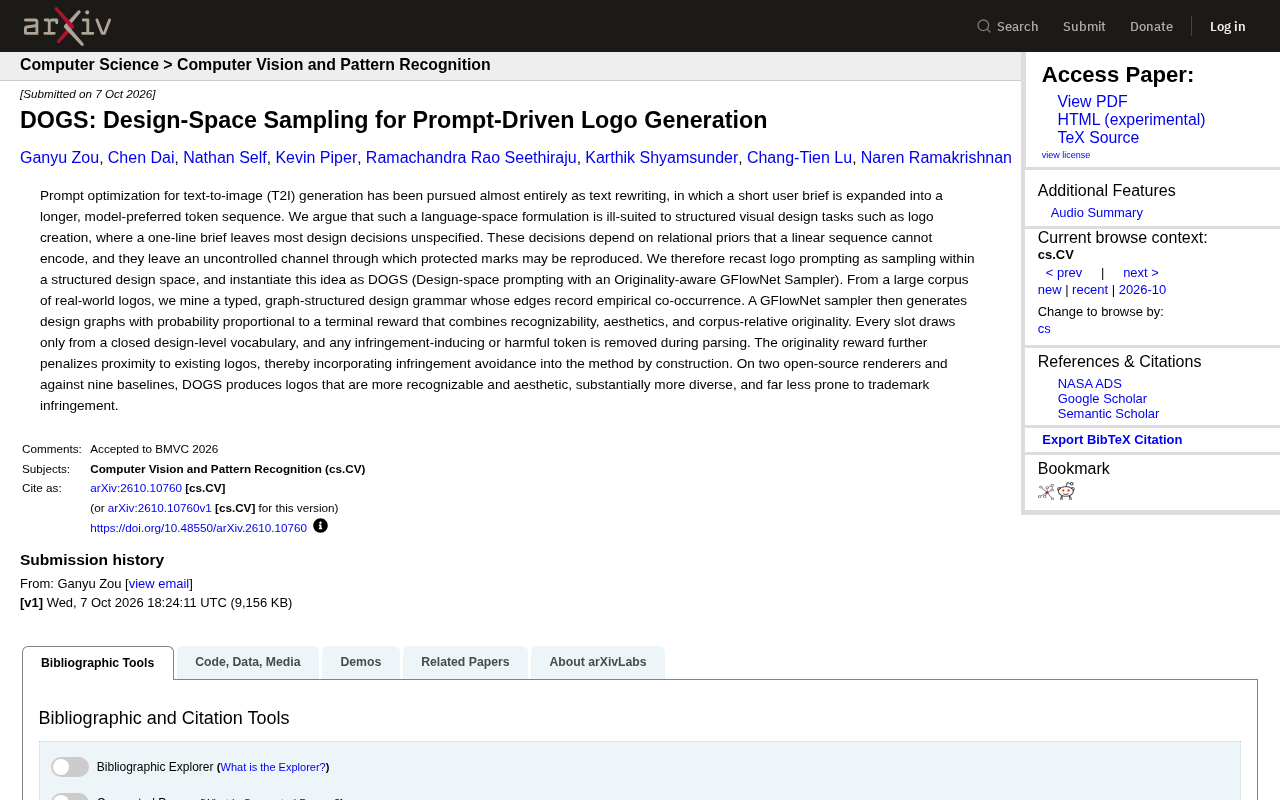
DOGS (Design-space prompting with an Originality-aware GFlowNet Sampler), published on arXiv (arXiv:2610.10760), reframes Logo generation as sampling within a typed, graph-structured design space mined from real Logo corpora — rather than text rewriting. A GFlowNet sampler generates diverse, high-quality designs optimized across recognizability, aesthetics, and corpus-relative originality, while a closed vocabulary and originality penalty structurally prevent trademark infringement by construction. Experiments against nine baselines show comprehensive improvements across all evaluated dimensions.
When Text Rewriting Meets Structured Design Challenges
Prompt optimization in text-to-image (T2I) generation has long been treated as a pure text rewriting task: expanding a user's brief description into a longer sequence of words that better suits the model's preferences. This approach works reasonably well for generating realistic scenes or artistic illustrations, but falls short when confronted with highly structured visual tasks like Logo design.
A one-sentence design brief typically leaves the vast majority of design decisions open — how typography and graphics should pair together, how colors should be distributed, how spatial relationships between elements should be organized. These decisions rely on relational priors that a linear text sequence simply cannot encode. Making matters worse, this uncontrolled channel can inadvertently cause models to reproduce protected trademarks.
A newly published paper on arXiv (arXiv:2610.10760) proposes a method called DOGS that attempts to fundamentally redefine how Logo prompting is formulated as a problem.
DOGS's Core Idea: From Text Rewriting to Space Sampling
DOGS stands for "Design-space prompting with an Originality-aware GFlowNet Sampler." Its fundamental shift is this: rather than treating Logo prompting as text rewriting within a language space, it frames the problem as sampling within a structured design space.
Mining Design Grammar from Real Logo Corpora
The first step of the method is mining a typed, graph-structured design grammar from large-scale real-world Logo corpora. The edges of this grammar record empirical co-occurrence relationships between design elements. In other words, the system learns not "what words to write" but "which design elements frequently appear together in real Logos."
This graph structure is naturally suited to expressing relational constraints in Logo design that linear text cannot carry — for instance, that certain icon styles typically pair with certain font weights, or that certain color palettes tend to accompany specific typographic treatments.
A "typed, graph-structured design grammar" can be understood as a formal description of Logo constituent elements and their relationships. "Typed" means each node is labeled with a specific semantic category — such as "primary graphic," "company name text," "tagline text," or "background color block" — rather than being undifferentiated visual pixels. "Graph-structured" means the edges connecting these elements carry relational semantics, such as "icon sits above the text" or "color A applies to shape B." This shares conceptual similarities with dependency parse trees in NLP: the meaning of a sentence lies not in the linear arrangement of words, but in the structural relationships between them. For Logos, "blue shield icon paired with bold sans-serif typeface" and "red circular icon paired with thin serif typeface" carry entirely different brand semantics — a distinction that can only be precisely encoded in a graph-structured representation and is difficult for linear text prompts to differentiate. Mining co-occurrence relationships from a corpus is essentially learning "which design choices frequently appear together in successful Logos" — providing AI with an implicit rulebook distilled from real-world design practice.
GFlowNet Sampler and Terminal Rewards
DOGS then uses a GFlowNet sampler to generate design graphs, with generation probability proportional to a terminal reward. This reward function integrates three dimensions:
- Recognizability: whether the Logo is clear and legible
- Aesthetic quality: whether it is visually appealing
- Corpus-relative originality: how distinctive it is relative to existing Logos
The key advantage of GFlowNet is its natural tendency to generate diverse high-reward samples, rather than converging to a single optimal solution as traditional optimization does — this is especially valuable for design tasks that require a rich pool of candidate options.
GFlowNet (Generative Flow Network) is a class of generative model framework proposed by Yoshua Bengio's team in 2021. Unlike policy gradient methods common in reinforcement learning, GFlowNet's training objective is not to maximize a single expected reward, but to make the probability distribution of generated objects proportional to the reward function — meaning high-reward regions are sampled more frequently, but the model does not degenerate into outputting only one "optimal solution." This property is particularly valuable in tasks requiring exploration of diverse solution spaces: traditional RL or beam search tends to collapse onto a handful of high-scoring samples, while GFlowNet maintains coverage across the entire high-reward region. In the Logo design context, this means a single brand brief can consistently produce multiple stylistically distinct yet equally high-quality candidate designs, rather than repeatedly generating similar "optimal" results. GFlowNet training typically requires defining flow conservation conditions on a directed acyclic graph (DAG), with training signals derived from terminal node rewards — a process naturally compatible with both autoregressive text sequence generation and stepwise graph construction.
Building Trademark Infringement Avoidance Into the Method Itself
One notable design choice in DOGS is that it embeds compliance considerations directly into the generation mechanism, rather than treating them as post-hoc filtering.
Every design slot only draws values from a closed design-level vocabulary, with any tokens that could trigger infringement or harm removed at the parsing stage. Meanwhile, the originality reward penalizes proximity to existing Logos, structurally incorporating infringement avoidance into the method's design.
This "by construction" approach — guaranteeing compliance through architectural design rather than output-side screening — is harder to circumvent and better suited to the strict intellectual property requirements of commercial Logo design. For teams hoping to deploy AI Logo generation in production environments, this aspect carries substantial practical value.
Trademark infringement represents a material legal risk in AI-generated content. Generative models encounter vast numbers of registered trademarks in their training data and may, without the user's knowledge, reproduce similar patterns or color combinations at inference time, constituting "likelihood of confusion" — the core standard in trademark law for determining infringement, which does not require exact reproduction. The closed vocabulary strategy's logic is straightforward: if all selectable design elements come from a pre-vetted set that excludes the distinctive identifiers of registered trademarks, then generated outputs are inherently shielded from direct copying risk at the element level. The originality reward's penalty mechanism further structurally pushes away from the distribution of existing Logos, making it difficult for generated results to create confusion with existing marks even at the level of overall visual impression. By contrast, post-hoc filtering relies on additional similarity detection models, carries a risk of missed detections, and cannot correct the underlying tendencies of already-generated content — making it less reliable in compliance-strict commercial environments.
Experimental Results and Industry Significance
The paper evaluates DOGS against nine baseline methods across two open-source renderers. Results show that DOGS-generated Logos comprehensively outperform baselines on:
- Recognizability and aesthetic quality
- Significantly higher diversity
- Substantially lower trademark infringement tendency
From a methodological standpoint, DOGS's significance extends beyond Logo generation itself. It suggests that for structured visual design tasks, persistently framing the problem as "longer and better text prompts" may be a dead end. The real breakthrough may lie in identifying the underlying structure of the task and modeling it with representations (such as graph structures) and sampling mechanisms (such as GFlowNet) that match that structure.
Implications for AI Design Tools
Most AI design tools on the market today remain at the stage of text-prompt-driven generation. Research like DOGS points toward a more specialized direction: building domain-specific design grammars and reward functions for particular design fields, replacing general-purpose text rewriting with structured sampling. This suggests that future AI design assistants may no longer be merely "artists who understand natural language," but true collaborators who genuinely understand design rules and constraints.
It should be noted that the information in this article comes from a single arXiv paper abstract. The specific experimental data details, methods for constructing the design grammar, and the GFlowNet training process still await confirmation through a thorough reading of the full paper.
Related articles

RAG Getting Started in Practice: From Principles to Building an Enterprise Knowledge Base
Bilibili RAG course highlights: from retrieval-augmented generation principles, document chunking and vectorization, to five accuracy factors and enterprise knowledge base boundaries, with fine-tuning vs RAG selection advice.

AI Model Selection Guide: DeepSeek vs. Qwen3 in Practice
How should AI developers choose models? Based on a Bilibili tutorial, this article breaks down the Function Calling differences between DeepSeek V3 and R1, Qwen3's programmatic thinking mode switching and agent capabilities, and outlines a multi-model learning path and practical selection logic.

Anchoring, Loss Aversion, and Nudges: 5 Psychological Tactics Retailers Use to Make You Spend
Behavioral economics reveals how retailers use anchoring, framing, loss aversion, and nudge theory to manipulate your spending decisions. This article breaks down 5 common psychological tactics and offers counterstrategies like slowing down decisions and setting your own anchors to see through the pricing design behind discounts.