Domain Renewal Jumps from $10 to $3,000: Exposing Hover's Renewal Trap and How to Protect Yourself

Hover domain renewal jumps from $10 to $3,000 — how to avoid registrar pricing traps.
A Hacker News user reported their Hover domain renewal skyrocketing from $10 to $3,000, exposing structural issues in domain pricing. This article explains premium domain mechanisms, registry-registrar dynamics, and offers practical strategies including choosing transparent registrars like Cloudflare, multi-year renewals, domain transfers, and prioritizing traditional TLDs for core business domains.
A Domain Renewal Price Hike Warning from Hacker News
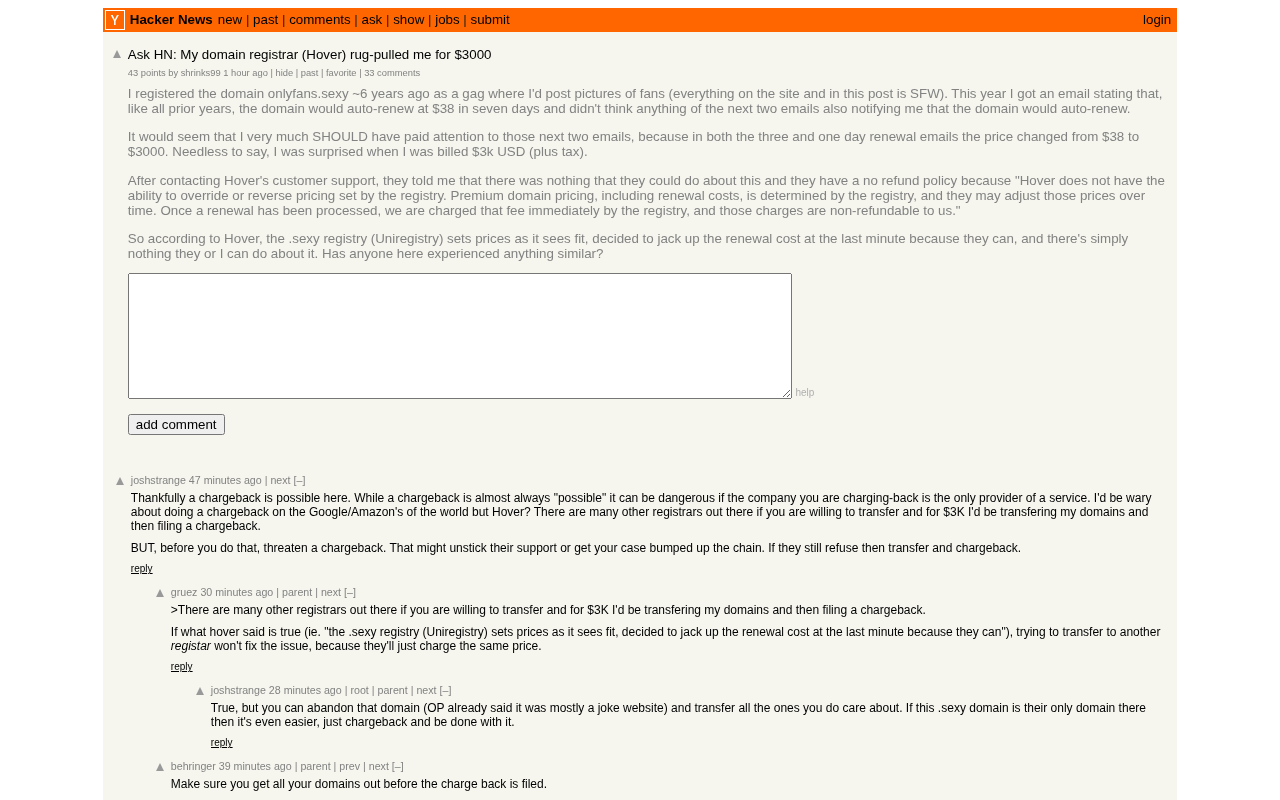
Recently, a user posted on Hacker News accusing their domain registrar Hover of a "rug-pull": a domain that previously cost a standard renewal fee was suddenly priced at $3,000 to renew. The post, titled "Ask HN: My domain registrar (Hover) rug-pulled me for $3000," quickly attracted community attention, garnering 36 upvotes and over 30 comments.
Hover is a domain registration brand under Tucows, a Canadian internet services company. Founded in 1993, Tucows is one of the world's largest domain registrars, managing over 25 million domain names. Hover has long been known for its clean interface and no-upsell approach, enjoying a solid reputation in the tech community. This is precisely why the renewal price hike shocked so many users — they chose Hover specifically because they trusted its relatively transparent pricing strategy.
This is not an isolated case. The "hidden inflation" of domain renewal prices is becoming a growing pain point for individual developers and small businesses alike. On the surface, it's a commercial pricing decision, but underneath it reveals a long-standing structural problem in the domain ecosystem — the loss of bargaining power once users are locked in.
What Is a Domain "Rug-Pull"?
The term "rug-pull" (literally "pulling the rug out from under someone") originated as crypto slang, referring to project teams absconding with funds after attracting significant investment. In the domain context, it's been extended to mean: a registrar attracts users with low or even free registration prices, then dramatically raises renewal prices once the user becomes dependent on the domain (through website, email, or brand association).
Why Users Can't Easily Escape the Renewal Trap
The unique nature of domains lies in their "irreplaceability." Once a domain is used for:
- A long-running website that has accumulated SEO authority and backlinks
- Business email addresses (e.g., name@yourdomain.com)
- Brand identity and user recognition
The migration cost of abandoning that domain becomes extremely high. Take SEO authority as an example: search engines evaluate a domain's trustworthiness through a combination of factors including domain age, quantity and quality of backlinks, and content history. A domain operated for many years may have accumulated thousands of external links (backlinks) from other websites, directly impacting its search result rankings. If you switch domains, even with proper 301 redirects, you can expect to lose 15-30% of organic search traffic, with a recovery period that may stretch 6-12 months. For businesses that depend on organic search traffic, this loss often far exceeds the $3,000 renewal cost.
Registrars exploit precisely this "sunk cost" dynamic, leaving users virtually powerless when faced with renewal price hikes. While $3,000 for a renewal is outrageous, for some users who have deeply integrated the domain into their business, abandoning it could cause even greater losses.
The Industry Chaos Behind Domain Pricing Mechanisms
To understand the root cause of domain price increases, you first need to understand the commercial architecture of the domain system. The business operations of the Domain Name System (DNS) are built on a strict hierarchical structure. A Registry is the exclusive operator of a given top-level domain — for example, Verisign operates .com and .net, Donuts operates hundreds of new gTLDs, and Internet Computer Bureau operates .io. Registries maintain the authoritative database of all domains under their TLD and set wholesale prices. Registrars are the retail-facing entities that sell domains to end users, and must be ICANN-accredited to do so. Users cannot purchase domains directly from registries; they must go through registrars.
This two-tier structure means:
- First-year registration prices are often promotional, sometimes even below cost
- Renewal prices can be far higher than registration prices, and registrars can adjust them at any time
- Certain high-value TLDs (such as .ai, .io, and some new gTLDs) have wholesale prices that are continuously climbing
The original intent of this architecture was to introduce market competition to lower end-user prices, but in practice it also provides two layers of opportunity for price manipulation — registries can raise wholesale prices, and registrars can add arbitrary markups on top.
Interestingly, extreme prices like $3,000 typically arise in two scenarios: either the domain has been classified as a "high-value" or "Premium Domain" with the registry itself setting a high renewal fee, or the registrar has unilaterally changed its policies. In either case, users are rarely clearly informed about future renewal costs at the time of initial registration.
The Hidden Renewal Costs of Premium Domains
In 2012, ICANN (Internet Corporation for Assigned Names and Numbers) launched the New gTLD program, allowing companies and organizations to apply to operate their own top-level domains. This resulted in over 1,000 new TLDs emerging beyond the traditional .com/.net/.org, including .app, .dev, .xyz, .club, and more. To recoup application fees of up to $185,000 and turn a profit, many new gTLD operators introduced a "premium domain" mechanism: dictionary words, short character combinations, and other commercially valuable domain names are marked as premium, with registration and renewal prices ranging from tens to hundreds of times the price of ordinary domains. For example, a standard .io domain renewal costs about $50/year, but a premium .io domain renewal could run into thousands of dollars.
The problem is that some registrars don't adequately highlight "this is a premium domain with equally expensive renewals" when displaying prices, causing users to see only the lower first-year price at registration. Worse still, some domains weren't premium at the time of registration, but the registry later reclassified them as premium through policy changes, causing renewal prices to spike — completely unexpected by users, who have virtually no recourse.
How to Protect Yourself When Domain Renewal Prices Spike
Drawing from Hacker News community discussions and industry experience, here are several practical recommendations:
1. Always Check Domain Renewal Prices Before Registration
Don't just look at the first-year registration price. Before checking out at any registrar, make sure to verify the Renewal Price, especially for new gTLDs and premium domains. Reputable registrars should clearly state this on the checkout page. It's also advisable to check the registry's official price list (usually available on the registry's website) to determine whether the registrar is significantly marking up the wholesale price.
2. Prioritize Domain Registrars with Transparent Pricing
Registrars like Cloudflare Registrar operate on an "at-cost" model, charging only the registry wholesale price with no markup and no promotional traps. Cloudflare launched its domain registration service in 2018 under the "at cost" banner — charging users only the registry's wholesale price plus ICANN's $0.18 annual administrative fee, making zero profit from domain registration itself. This model works because Cloudflare's core business relies on CDN, security protection, and enterprise network services; domain registration is merely an entry point to their ecosystem, designed to attract users to their paid value-added services.
Other well-regarded options include Porkbun (known for low prices and a friendly interface) and Namecheap (a veteran registrar with relatively transparent pricing). When choosing a registrar, paying attention to whether they offer a "price lock" guarantee or have a history of price increases matters more than first-year discounts.
3. Lock In Prices by Renewing in Bulk for Multiple Years
Most registries allow multi-year renewals at once (typically up to 10 years maximum, which is the longest registration period permitted by ICANN). For core domains, locking in long-term renewals in advance can hedge against future price increases. For .com domains, for example, Verisign has been authorized by the U.S. Department of Commerce to raise prices by up to 7% per year — if you renew for 10 years at once, you're effectively locking in the current price for the next decade.
4. Consider Transferring Your Domain to Another Registrar
If you're dissatisfied with your current registrar, domains can be transferred to another one. According to ICANN's Inter-Registrar Transfer Policy, domain holders have the right to transfer their domain from one registrar to another, subject to the following conditions: the domain must have been registered or last transferred at least 60 days prior; the domain cannot be in "Registrar Lock" status; and the transfer requires obtaining an EPP authorization code (Auth Code) from the current registrar. The transfer process typically takes 5-7 days, and the receiving registrar generally charges one additional year of renewal fees.
However, note that transferring can only avoid registrar markup — it cannot avoid premium pricing set by the registry itself. If the price increase originates at the registry level, the renewal price won't decrease regardless of which registrar you transfer to.
5. Choose Traditional TLDs for Core Business Domains
For domains carrying core business functions, prioritize traditional TLDs like .com, .net, and .org. These top-level domains are bound by contracts between ICANN and the registries, with explicit caps on price increases (e.g., .com can increase by a maximum of 7% per year). In contrast, many new gTLDs and country-code TLDs (ccTLDs) allow their registries to adjust prices without restriction, posing higher risk.
A Deeper Reflection: The Ownership Dilemma of Digital Assets
At its core, this incident is yet another example of the blurred boundary between "ownership" and "usage rights" in the digital age. Users think they "own" a domain, when in reality they've only obtained a usage license contingent on annual renewal. From a legal perspective, a domain is not a property right but a contractual right — the service agreement between the user and registrar grants the user the right to use that domain for a specific period, but the continuation of this right depends on continued payment and compliance with agreement terms. Once the pricing party holds the initiative, the user's so-called "ownership" becomes fragile.
This connects to numerous recent controversies around cloud services, SaaS subscriptions, and digital goods: we increasingly "rent" rather than "own" digital assets. From Adobe converting Photoshop to a subscription model, to Unity engine suddenly changing its pricing policy and sparking developer protests, to Twitter/X dramatically raising API access prices — all these events share a common underlying logic: once users develop deep dependency on a platform, the platform holds near-unilateral pricing power.
For individuals and businesses that treat domains as core assets, this Hover incident is a wake-up call — before depending on any third-party service, make sure to read the terms, assess the risks of being "locked in," and preserve your exit options.
Conclusion
The price jump from $10 to $3,000 may seem absurd, but it genuinely reflects the information asymmetry and lack of user bargaining power in the domain ecosystem. For tech professionals, "transparency" and "predictability" when choosing a registrar are every bit as important as price itself. After all, in the digital world, your domain is your street address — and no one wants to be told one day that renewing their address requires an astronomical fee.
Related articles

Getting Started in Machine Learning Research: Essential Paper Reading List and Research Internship Application Path
A complete path from zero to research internship for ML beginners, covering essential classic papers (AlexNet, ResNet, Transformer), paper reading methods, reproduction tips, and practical advice for research internship applications.

Claude Code Hands-On Tutorial: Complete Guide from Installation to Automated Development
Complete guide to Claude Code covering environment setup, permission configuration, Go Goals autonomous loops, Skills system, MCP protocol integration, and version control for automated development.

Gemini 3.7 Flash Release and GPT-5.6 Ultra-Fast Mode: AI Open Source Enters the Ecosystem Era
Google releases Gemini 3.7 Flash for coding and Agent optimization while OpenAI launches GPT-5.6 Ultra-Fast mode with 14x speed gains. AI open source shifts from open models to open ecosystems.