Don't Be Fooled by the Hair! AI Hair Swap Images of Bezos and Statham Go Viral

AI hair swap fake images of Bezos and Statham are going viral across platforms, highlighting the governance dilemma of AI-forged content.
The article uses the fake AI images of Bezos and Jason Statham "growing hair" as an entry point, noting that such images are circulating simultaneously on X, Threads, Bluesky, and other platforms, while the two celebrities' actual appearances remain unchanged. The forgers deliberately chose bald celebrities with extremely high public recognition and highly stable physical features to amplify visual contrast and viral effect. The article analyzes that generative AI tools have drastically lowered the barrier to forgery, and cross-platform spread makes it hard for debunking on any single platform to keep up with diffusion—this is the core challenge of governance. It also offers practical methods for ordinary people to identify forged images, including observing hair-edge junctions, checking lighting consistency, reverse image search, and reviewing poster account history. Ultimately, it emphasizes that the flood of forged content is shaking the public's baseline perception of real appearances, and platform governance and media literacy urgently need improvement.
One Fake Hair Image Gives Two Bald Tough Guys a Full Head of Hair
Recently, several photos have been circulating on X, Threads, and Bluesky: Amazon founder Jeff Bezos and actor Jason Statham are both sporting thick heads of hair. But according to tech outlet Engadget, these images are fake—both celebrities still appear bald, and nothing has changed over the past few days. This is not the first time a celebrity has had their appearance "forcibly" altered by AI technology, but this incident is worth paying attention to because it once again reminds us: on social media, seeing is not necessarily believing.
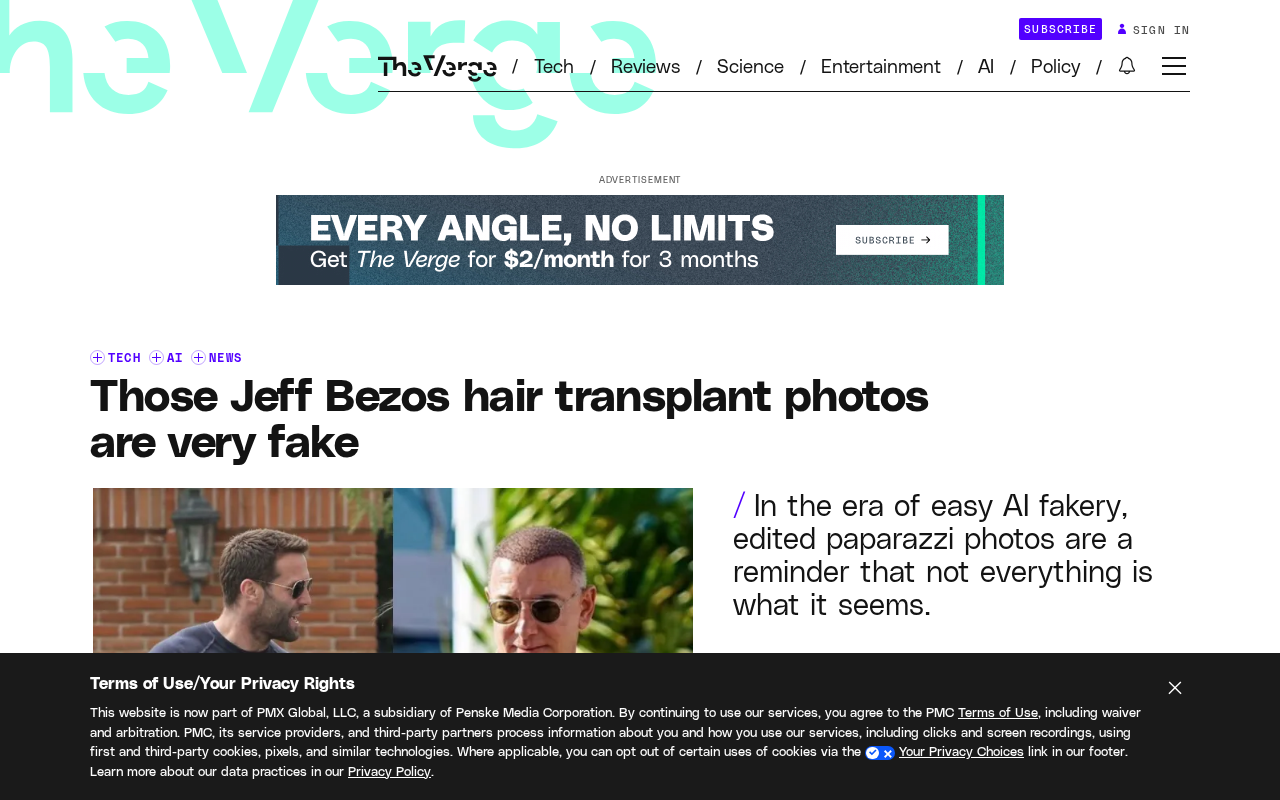
Why Them?
Bezos and Statham share a striking common feature: their signature bald heads. Bezos has appeared bald since the early 2000s, and Statham has maintained this look since the days of Lock, Stock and Two Smoking Barrels. Precisely because of this, when images of them "growing hair" appear, the visual contrast is enormous and the viral effect is especially strong. The forgers clearly understand this well—by targeting celebrities with extremely high public recognition and highly stable physical features, the "impact" of fake images is multiplied.
AI Forged Images Are Moving from "Tech Demos" to "Everyday Content"
This incident is not an isolated case. In recent years, the proliferation of generative AI tools has drastically lowered the barrier to forging celebrity images. What once required a professional retoucher hours to complete can now be generated in seconds with just a text prompt, producing fairly convincing results. More critically, these images spread extremely fast on social platforms—users often do not carefully verify sources before sharing, and platform recommendation algorithms prioritize highly engaging content, creating viral diffusion.
According to Engadget, these fake hair images of Bezos and Statham are currently circulating simultaneously on multiple platforms, including X, Threads, and Bluesky. Cross-platform spread means that debunking on a single platform can hardly keep up with the speed of diffusion—this is one of the core challenges facing the governance of AI-forged content.
Identifying Forged Images: What Can Ordinary People Do?
Although the quality of AI-generated images continues to improve, there are still clues to look for. First, observe the junction where hair meets the scalp and ears—AI-generated images often show blurring or unnatural transitions in this area. Second, check whether lighting and shadows are consistent: the direction of hair shadows should match shadows on other parts of the face. In addition, reverse image search and checking the account history of the earliest poster are also effective quick verification methods.
One of the core technologies behind generative AI image tools is the diffusion model. These models learn the distribution patterns of massive image datasets through a "noise addition—denoising" process: during training, noise is gradually added to images; during inference, the model starts from pure noise and reconstructs an image step by step based on a text prompt. This mechanism is exactly what enables the model to synthesize faces and hair with quite natural lighting and texture. Compared with earlier generative adversarial networks (GANs), diffusion models have clear advantages in detail coherence and prompt adherence, which is the technical root of the dramatic improvement in forged image quality over the past two years. However, diffusion models do not "understand" the physical world—they only mimic statistical patterns—so they are still prone to flaws in areas requiring strict geometric consistency, such as the junction between hair and ears and the direction of lighting.
The reason text-to-image tools can produce images in seconds relies on the interaction method of "text prompts." Users describe what they want in natural language, the model encodes it into semantic vectors, and then guides image generation accordingly. This means forging a celebrity image requires no retouching skills at all—just knowing the person's name and descriptions like "thick hair." The lowering of the barrier to prompt engineering is a direct driver of the flood of forged content, and it has also shifted content moderation from "identifying tampering traces" to "identifying whether the entire image is synthetic," significantly increasing the difficulty. Some platforms have begun embedding invisible digital watermarks or C2PA content credentials into generated images, attempting to leave traceable marks along the dissemination chain.
Reverse image search is one of the most practical verification methods for ordinary people. Upload a suspicious image to Google Images, TinEye, or Bing Visual Search, and the tool will search the internet for identical or highly similar images and list the earliest appearance time and source pages. If a "news image" cannot be traced to any original source, or only appears in social media reposts, it deserves high vigilance. In addition, checking the registration date, historical content style, and follower composition of the posting account can also help determine whether it is an account dedicated to creating sensationalism. It should be noted that reverse search has limited effectiveness for images generated entirely by AI for the first time—the fact that it cannot find a source precisely suggests that the image may not exist in the real world at all.
The Speed of Debunking Can Never Catch Up with the Speed of Generation
The most intriguing aspect of this incident is that the fact that Bezos and Statham's appearances "have not changed" itself became news. This shows that when forged content is abundant enough, the public's baseline for "reality" becomes shaken—you have to repeatedly confirm what a person actually looks like. For the tech industry, this is not just a technical issue but also a matter of platform governance and media literacy. Generating a fake image takes only seconds, while the cost of debunking, verifying, and correcting perceptions is orders of magnitude higher. In an era where AI-generated content is increasingly realistic, maintaining caution and verifying from multiple sources may be a habit we all need to develop.
Related articles

Claude Sonnet 6 Suspected Leak: Anthropic's Internal Model Acceleration Is Astonishing
Anthropic suspected leak of Sonnet 6; Meter reports its AI R&D accelerated 1.9x; OpenAI releases GPT-6 Cyber, GPT-6.2 Astra may be coming; Google Gemini Omni 1.2 Flash tops video generation leaderboard; Meta stealth models and real-time avatars unveiled; despite market volatility, Google still invests $17 billion in data centers.

How Accurate Are Sci-Fi's Predictions About AI?
How accurate are sci-fi's predictions about AI? Drawing on a Hacker News discussion, this article analyzes sci-fi's foresight and blind spots in AI development, arguing its true value lies in inspiring thought rather than precise prediction.

SwarmEvolve: Latent-Space Agent Swarms Accelerate Evolutionary Search
SwarmEvolve lets hundreds of low-cost agents swarm-reason in latent space, sharing info via KV caches to achieve fast evolutionary search for math and science problems—reaching in a median of 3–8 minutes the best scores other frameworks need 60 minutes for.