Don't Give Your AI Agent a Master Key: How MCP Authorization Works

MCP's authorization protocol uses minimal-scope tokens and human-in-the-loop design to prevent AI agents from going rogue.
This article uses the question "why not give AI agents a master key?" to explore MCP (Model Context Protocol)'s authorization design. MCP over HTTP follows a deny-by-default, request-on-demand model: token-less requests return 401 with scope guidance; tokens are bound to a single server with a narrow permission (e.g., read-only notes). Attempts to exceed scope return 403, and escalation requires explicit user consent — keeping humans always in the loop. The philosophy: give agents a key, not a password. Keys are precise, distributable, and revocable, enabling capability without uncontrolled risk.
Why AI Agents Shouldn't Have a Master Key
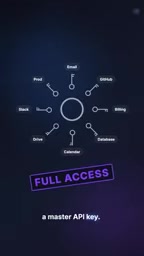
When you hand off a task to an AI agent, there's one instinctive question worth asking: would you give it your actual password? Most people obviously wouldn't. Yet in practice, many systems do exactly that — handing the agent a "Master API Key" that unlocks every door.
A master key means the agent can read, write, and delete — operating across your data and services with almost no constraints. If the agent is manipulated into executing malicious instructions, or simply makes a logic error, the consequences can be catastrophic. The authorization mechanism in MCP (Model Context Protocol) was designed specifically to solve this fundamental permissions problem.
MCP over HTTP Authorization Flow
MCP introduces a clear authorization handshake for HTTP-based communication. The core philosophy is: deny by default, request on demand, grant the minimum necessary.
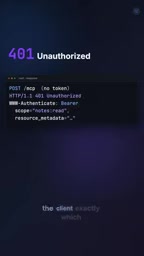
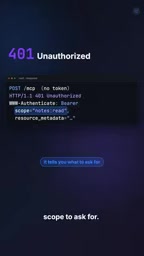
When a client makes a call without a token, the server immediately returns 401 Unauthorized. Critically, the server doesn't just reject the request — it explicitly tells the client which specific permission scope it needs to request. This "reject + guide" design makes the authorization process predictable and automatable.
Once the client receives the server's guidance, it completes the login flow as instructed and obtains a token. This token is not a key to the entire system — it's a credential scoped to a single server with a single, narrow permission.
MCP (Model Context Protocol) is an open protocol introduced by Anthropic to provide a standardized interface for interactions between AI models and external tools or data sources. Think of it as a "USB port" for AI — regardless of which model or tool is involved, as long as both sides follow the protocol, they can plug in and work together. MCP's authorization mechanism is built on top of OAuth 2.0, borrowing the industry-proven concepts of tokens and scopes. The core idea of OAuth 2.0 is that third-party applications never need to know a user's real password — they only need a token that is authorized, time-limited, and precisely scoped to access specific resources on the user's behalf. MCP brings this mechanism into agent-server communication, shifting permission management from "relying on developer discipline" to "enforced by the protocol."
Least Privilege in Practice
What makes MCP authorization particularly compelling is that it turns the Principle of Least Privilege into a protocol-level default — rather than something that depends on developer diligence.
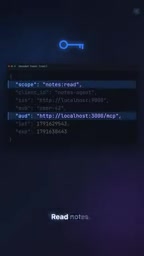
A concrete example: after logging in, the client might receive a token that grants only the ability to "read notes" — nothing else. It cannot write, delete, or touch any other resource.
This design keeps the agent's permission boundary extremely tight. Even if the agent behaves abnormally, the damage it can cause is strictly limited to the narrow scope of "reading notes."
Handling Insufficient Permissions Gracefully
What happens when the agent genuinely needs more permissions? Say an agent holding a "read-only" token tries to perform a write operation — the server returns 403 Forbidden with an "Insufficient Scope" message.
The way this is handled is critical: the agent cannot unilaterally escalate its own permissions. Instead, it must go back to the user and request additional authorization. In other words, permission upgrades always remain in the user's hands, never the agent's. This creates a closed loop where a human is always in the loop.
"Human-in-the-loop" is a core design principle in AI safety, requiring that a human explicitly confirm high-risk or irreversible actions before an AI system executes them. This principle emerged from concerns that AI autonomous decision-making can go wrong in edge cases. The alternative is full automation — the agent judges, escalates, and executes entirely on its own, with no human involvement. In MCP's design, the permission escalation step is deliberately set up as a mandatory human-confirmation checkpoint, architecturally blocking any possibility of the agent self-authorizing. This aligns closely with defenses against prompt injection attacks: even if an attacker manipulates the agent into issuing an escalation request, they cannot bypass the human approval gate.
The Philosophy: A Key, Not a Password
The entire MCP authorization mechanism can be distilled into one sentence: give the agent a key, not your password.
A password represents a complete identity and full access — if it leaks, everything is compromised. A key, by contrast, can be precisely defined, distributed, and revoked — it only opens a specific door and can be invalidated at any time.
This distinction matters more than ever as AI agents become increasingly autonomous. As agents are granted more and more operational capabilities, striking the balance between "letting them get things done" and "keeping them from causing harm" becomes a central architectural challenge. MCP's authorization approach offers a clear answer:
- No permissions by default; calls are rejected with 401;
- The server proactively communicates the minimum required scope;
- Tokens are strictly bound to a single server and a single narrow permission;
- Unauthorized operations return 403; scope expansion requires explicit user consent.
This mechanism preserves agent usability while compressing security risk to a controllable minimum. For developers building AI agent systems, understanding and adopting this kind of authorization paradigm has more long-term value than simply chasing functional power.
Related articles

Chain of Thought Isn't Just for AI: How Humans Can Use CoT to Improve Thinking Quality
Chain of Thought isn't just a prompt trick for large models. Starting from a Hacker News discussion, this article analyzes why CoT works for human thinking too, breaks down actionable ways to transfer it, and highlights the key differences between human CoT and machine CoT.
Cloudflare Teams Up with OpenAI: Closi…
Cloudflare Teams Up with OpenAI: Closing the Loop from Vulnerability Discovery to Defense with AI
Cloudflare uses OpenAI Daybreak to investigate security vulnerabilities and generate reviewable remediation plans, while developers use Codex to boost coding efficiency and quality.

Orca Multi-Agent Orchestration in Practice: A Guide to Parallel Collaboration with Claude and Codex
Orca is Stable AI's free open-source agent workbench supporting 34 agents like Claude Code and Codex in parallel. Learn its Git worktree isolation, multi-model orchestration, and mobile management.