DoorDash Spent $1.4 Million to Block Mamdani's Mayoral Run — Here's Why

DoorDash spent $1.4M to influence NYC's mayoral race, driven by fears over delivery worker labor policies.
DoorDash invested $1.4 million to block NYC mayoral candidate Zohran Mamdani, with The Intercept tying the spending directly to wage theft settlements and gig worker labor policy. The platform's core business model depends on classifying riders as independent contractors to avoid minimum wage and benefits obligations. New York City already leads the country in delivery worker pay protections, and a mayor with a strong pro-labor stance could dramatically raise the platform's legal and compliance exposure. The move follows the playbook Uber, Lyft, and DoorDash used on California's Prop 22 — intervening early in the political process rather than fighting policy after the fact — reigniting debate over the legitimacy of using corporate capital to shape democratic elections.
DoorDash's $1.4 million effort to stop Zohran Mamdani from becoming New York City mayor recently sparked heated discussion on Hacker News (281 upvotes, 122 comments). The story, reported by The Intercept, pulls back the curtain on a hidden web of interests connecting the platform economy with political maneuvering.
A Political Expenditure Worth a Closer Look
According to The Intercept, DoorDash poured $1.4 million into the election cycle to prevent Mamdani from taking over City Hall. For a food delivery platform, a political investment of this scale sends a strong signal — the candidate's positions directly threatened the company's core business interests.
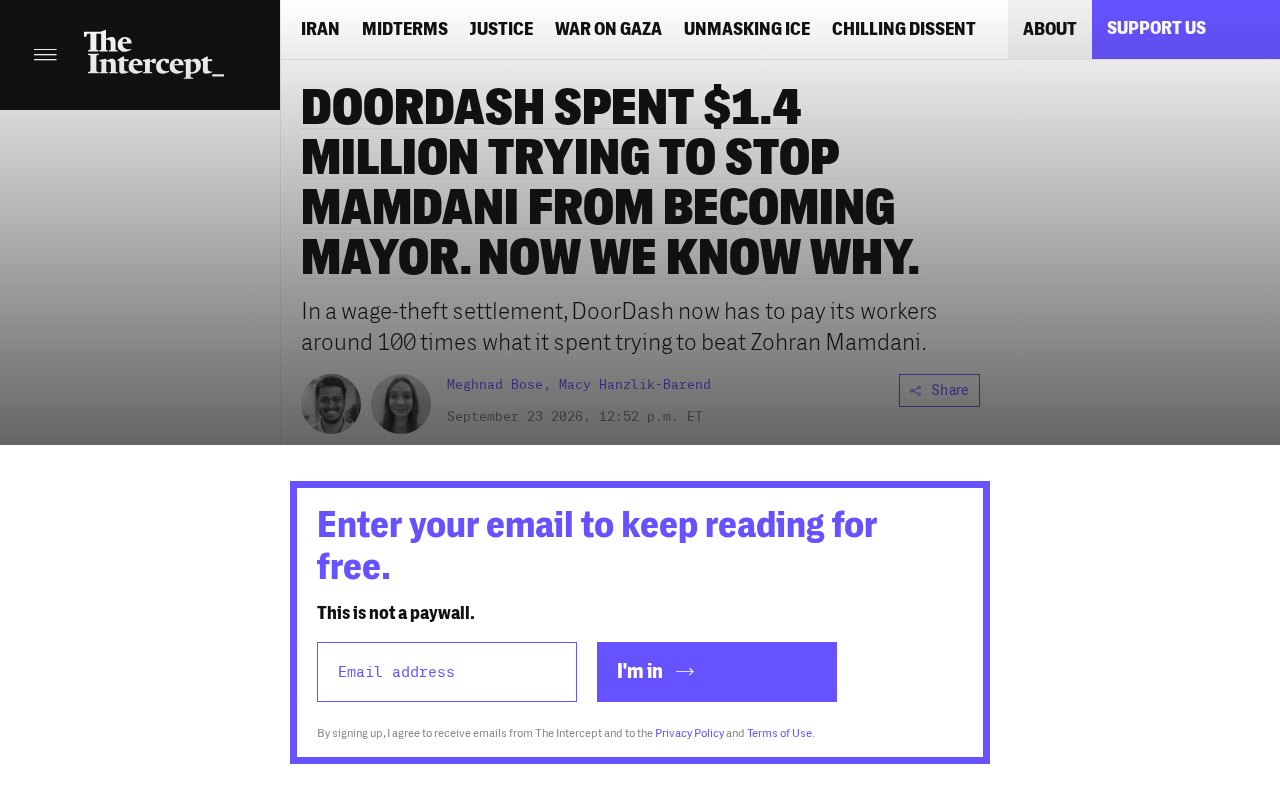
The headline — "Now We Know Why" — implies this spending wasn't driven by simple political preference, but was tied directly to specific legal and policy risks the platform faces. The report zeroes in on a wage theft settlement involving delivery workers.
The Gig Economy's Labor Problem
Gig economy platforms have long been at the center of labor rights disputes. Whether delivery workers are classified as independent contractors or full employees directly determines how much platforms must spend on minimum wage compliance, benefits, and social insurance. In recent years, New York City has led the country in establishing minimum pay protections for delivery workers, placing real cost pressure on platforms like DoorDash and Uber Eats.
The phrase "wage theft settlement" in the report suggests that DoorDash feared a mayor with a tough stance on labor rights would push for stricter legislation protecting riders — or ramp up enforcement against existing violations. For the platform, it's more cost-effective to intervene at the election stage than to absorb compliance costs after a policy is enacted. That's the business logic behind the $1.4 million.
In 2023, New York City introduced a minimum pay requirement for delivery workers, mandating that platforms like DoorDash and Uber Eats pay riders at least approximately $17.96 per hour including tips — the first city-level minimum wage protection of its kind in the United States. After the rule took effect, both DoorDash and Uber Eats cited rising compliance costs as justification for adding consumer surcharges or scaling back delivery zones. In this context, a "wage theft settlement" refers to claims by workers or regulators that platforms underpaid riders before or after the wage rule took effect, with disputes resolved through out-of-court settlements. If a mayor were to take an aggressive stance on such cases, platforms could face significantly broader investigations and larger settlement amounts.
The Limits of Tech Platform Political Influence
This episode brings back into focus a familiar question: how should tech platforms be allowed to use money to influence public policy? In recent years, from California's AB5 to Prop 22, gig economy platforms have repeatedly poured enormous sums into lobbying and ballot measure campaigns. Uber, Lyft, and DoorDash collectively set a spending record in California history with their joint investment in Prop 22.
New York's case follows the same pattern: when a platform's business model depends heavily on classifying workers as independent contractors, any political force that might change that classification becomes a threat. This kind of spending blurs the line between commercial competition and political interference, and continues to raise public questions about transparency in governing the platform economy.
California's AB5 (2019) is essential context for understanding this pattern. The law required companies to apply an "ABC test" to determine worker classification, raising the bar significantly for treating workers as independent contractors — effectively compelling Uber, Lyft, DoorDash, and similar platforms to reclassify large numbers of riders and drivers as employees. The platforms pushed back immediately, joining forces to spend over $200 million promoting the 2020 Prop 22 ballot measure, which ultimately secured an exemption for them — the highest corporate spending on a single ballot initiative in U.S. history. A California court struck down Prop 22 as unconstitutional in 2021, though the legal battle continues. This precedent has led platforms to favor an "election-first" strategy: intervening at the candidate stage rather than waiting for policies to take shape and then responding through litigation or legislation.
What the Hacker News Community Is Saying
Across 122 comments on Hacker News, the tech community has shown intense interest in the story. Discussions typically focus on a few threads: whether platforms should be required to disclose political spending of this kind, where gig economy worker classification is headed long-term, and whether it's legitimate for tech companies to use capital to influence local elections. These conversations reflect tech workers grappling with the broader social responsibilities of the industry they work in — not just a narrow technical debate.
It's worth noting that this article is based on a summary of The Intercept's original reporting and community discussion data. For specific settlement figures, legislative details, and responses from all parties, readers are encouraged to consult the original report.
Conclusion
DoorDash's $1.4 million political expenditure is a microcosm of the ongoing struggle between the platform economy and labor policy. It's a reminder that behind the convenience of food delivery, the battle over rider rights, platform costs, and political influence never really stops. As the gig economy continues to expand globally, finding the right balance between commercial efficiency and worker protections will remain a long-term challenge for regulators, platforms, and the public alike.
Related articles

@ai-sdk/vue 3.0.306 Patch Release Syncs with [email protected] Update
@ai-sdk/vue 3.0.306 released, synced with [email protected]. A routine patch release for the Vercel AI SDK ecosystem with no public API changes; the Vue adapter layer stays version-aligned with the core package.

Gemini 4 Argon API Launches: The Era of Million-Token Output Begins
Google launches Gemini 4 Argon with sparse MoE architecture, up to 1M output tokens, and a 68.90% Vals Index score, available across API, AI Studio, and the Gemini app.

DukaanAI: Turning Product Photos into Inventory Lists with Open-Source AI
DukaanAI is an AI inventory tool for small retailers that turns product photos into inventory entries using the open-source Gemma 3 model, with local inference, editable fields, and CSV export.