Dots Launches an Always-On AI Assistant: Giving You Back Your Time

Dots is a 7×24 always-on AI assistant focused on reclaiming your time and attention.
Dots is a 7×24 always-running AI assistant unveiled on Twitter, positioned to shift from the traditional "you ask, it answers" to "it keeps watch for you while you focus on your work." It emphasizes around-the-clock operation and being outcome-oriented, directly delivering things that have been taken care of rather than having users build automation workflows themselves. The article notes that this represents a trend in AI product competition shifting from model capability to attention reclamation, where the truly scarce resource is human attention and cognitive load. However, based on a single launch tweet alone, Dots' key capability boundaries—such as its degree of autonomy, controllability, and depth of integration—remain unclear, which is also the shared challenge facing all always-on AI assistants.
AI tools are shifting from the passive mode of "you ask, it answers" to the proactive mode of "it keeps watch for you while you focus on your work." Dots, recently unveiled on Twitter, is built around exactly this idea—a 7×24 always-running AI assistant designed to free you from trivial tasks and let you reinvest your time and attention into higher-level work.
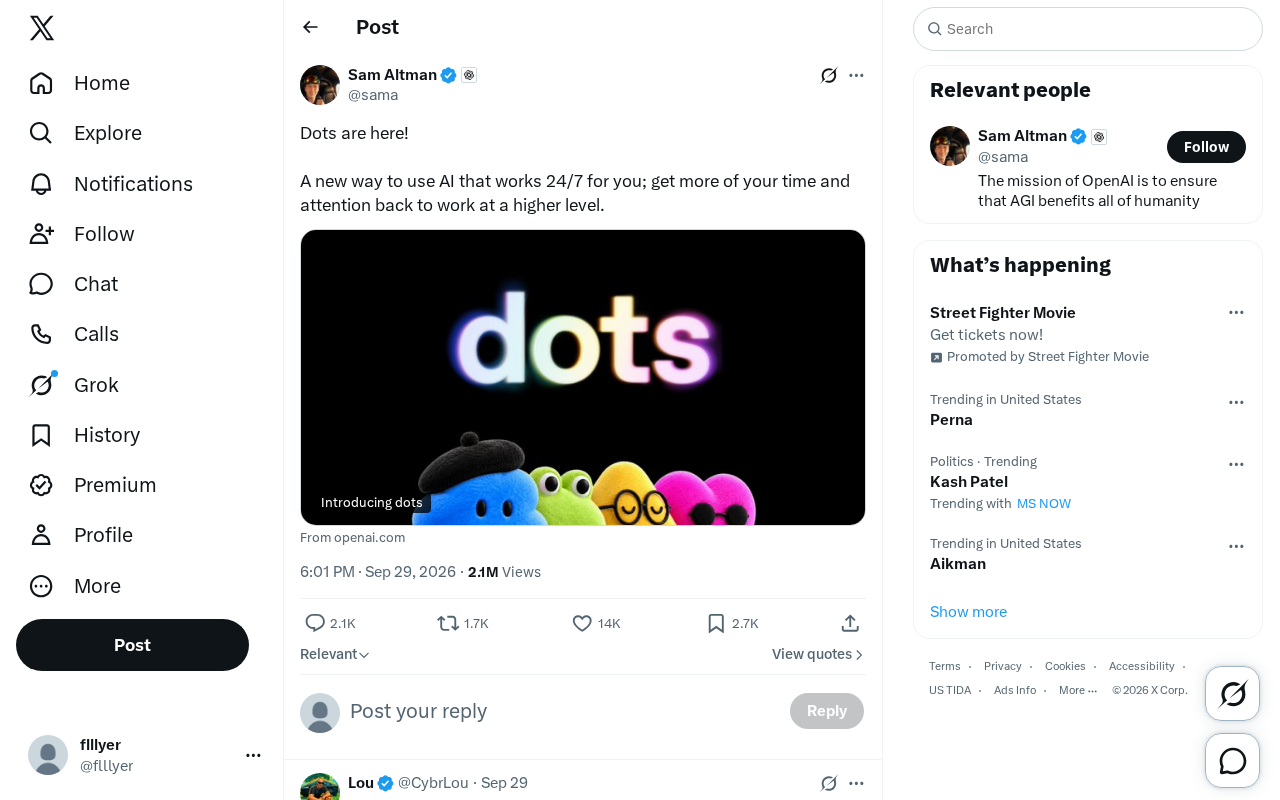
What Problem Is Dots Trying to Solve?
The official pitch is direct: "A new way to use AI that works around the clock for you; so you can get more of your time and attention back for higher-level work." Two keywords stand out in that sentence: around the clock and higher-level.
Traditional AI assistants operate on a synchronous rhythm: you open a chat box, type in a request, wait for a response, then decide the next step. This workflow suits one-off tasks but not long-running needs—such as continuously monitoring an information source, repeatedly organizing incoming materials, or pushing a workstream forward while you're offline. Dots is positioned to fill exactly this gap: turning AI from an "on-call tool" into "a colleague who's always online."
What Does "Running 24/7" Actually Mean?
Keeping an AI running continuously in the background is a fundamentally different product form from having it respond to an occasional query. The former has to deal with a whole series of engineering and experience challenges: how tasks are triggered, how intermediate states are preserved, when and in what form results are pushed to the user, and how to roll back when things go wrong.
Judging from Dots' marketing language, it emphasizes being outcome-oriented—not making you manage a pile of automation workflows, but directly delivering "things that have been taken care of," thereby freeing up your attention. This creates a route divergence from the many automation tools on the market that make you build the workflows yourself: one gives you a set of building blocks, the other gives you an assistant that's already up and running.
Always-on agents differ fundamentally in architecture from traditional conversational assistants. Conversational assistants are "stateless": one request maps to one response, and context is discarded once the session ends. A 7×24 assistant, by contrast, must maintain persistent state, including long-term memory, task queues, trigger conditions, and execution history. This typically involves several key components: a task scheduler that wakes the agent at specific times or when events occur; a memory layer that stores cross-session context and user preferences; an execution layer that calls external tools (APIs, browsers, file systems) to perform actions; and a feedback layer that decides when and how to push results to the user. The challenges this architecture brings are also different from ordinary chatbots—for example, error accumulation during long-running processes, state inconsistency, and security risks from long-term open permissions. If Dots truly wants to be "a colleague who's always online," these underlying mechanisms will determine the product's success far more than the model itself.
Why "Reclaiming Attention" Is the Keyword for This Wave of AI Products
Over the past year or two, the focus of competition among AI products has gradually shifted from "how powerful is the model" to "how much effort can it save you." The reason isn't hard to understand: once model capabilities converge, what's truly scarce is human attention.
Dots puts "get more of your time and attention back" in the very first line of its marketing, indicating that what it targets isn't an efficiency number but cognitive load. For knowledge workers, frequently switching tasks, repeatedly confirming details, and keeping an eye on progress are hidden costs in themselves. The value of a truly always-on AI assistant lies not just in completing tasks, but in freeing you from having to keep thinking about it.
Cognitive load is a psychological term referring to the pressure on working memory when processing information. Much of the exhaustion knowledge workers feel doesn't come from the task itself but from task switching, context rebuilding, and the persistent occupation of the mind by "unfinished items"—known in psychology as the Zeigarnik effect. If an always-on AI assistant can transfer the responsibility of "watching something" from the human brain to the system, it can free up working memory that was previously occupied. This also explains why "reclaiming attention" is more compelling than "efficiency gains": efficiency gains merely let you do the same thing faster, whereas reclaiming attention removes a thing from your mental checklist entirely. Dots' emphasis on freeing you from having to keep thinking about it targets precisely this hidden benefit, rather than sheer output speed.
Points Worth Watching
Based on a single launch tweet and link alone, it's impossible to judge the actual limits of Dots' capabilities. Several key questions currently have no answers:
- Degree of autonomy: How much can it decide on its own, or does it always require human confirmation at key checkpoints?
- Controllability: How does an always-running assistant handle errors, overreach, or misjudgments?
- Depth of integration: Which data sources and tools it connects to determines what it can truly do for you.
These are also the shared challenges facing all "always-on AI assistants." The vision in the marketing language is clear, but whether the product can deliver depends on its trade-offs on these details.
If you're interested in the direction of "letting AI work for you in the background," Dots is worth adding to your watchlist.
Autonomy level in the AI agent field is usually divided into several tiers: from assistive types that only offer suggestions, to tool types that execute single-step operations, to agent types that can plan multi-step tasks on their own and complete them without supervision. The higher the level, the higher both efficiency and risk rise in tandem. The key criterion isn't "how much it can do" but "how it asks for help when uncertain." A good always-on agent should have confidence-assessment capabilities: acting autonomously on low-risk, high-certainty tasks; proactively pausing and requesting confirmation when money, privacy, or irreversible operations are involved. In addition, protection against overreach and misjudgment relies on the principle of least privilege—an agent should only receive the minimum permissions necessary to complete the current task, rather than being granted full account and data access all at once. These design details are the underlying factors that determine whether an always-on assistant can truly be trusted.
One-line Summary
Dots is a 7×24 always-on AI assistant focused on reclaiming your time and attention.
Paragraph Summary
Dots is a 7×24 always-running AI assistant unveiled on Twitter, positioned to shift from the traditional "you ask, it answers" to "it keeps watch for you while you focus on your work." It emphasizes around-the-clock operation and being outcome-oriented, directly delivering things that have been taken care of rather than having users build automation workflows themselves. The article notes that this represents a trend in AI product competition shifting from model capability to attention reclamation, where the truly scarce resource is human attention and cognitive load. However, based on a single launch tweet alone, Dots' key capability boundaries—such as its degree of autonomy, controllability, and depth of integration—remain unclear, which is also the shared challenge facing all always-on AI assistants.
Related articles

Workbuddy for Absolute Beginners: How a Desktop AI Agent Fits Into Real Workflows
A beginner's guide to the Workbuddy desktop AI agent: installation, claiming credits, file management, and building automated workflows—compared with CodeX for fit and cost, helping professionals shift from AI question-askers to AI managers.

OpenAI's New Agent Stack: Computer Use, Decisions API, and Ultra-Fast Workflows
OpenAI Dev Day unveiled a new agent stack: Computer Use outperforms humans, Decisions API delivers ultra-low-latency classification via Luna, Agents API opens the same Computer Use capabilities, and GPT-6.1 Sol costs only one-seventh of Astra. Core updates, benchmark data, and developer insights.

Liang Wenfeng Open-Sources DeepInfo Inference Framework, Takes On U.S. Ban
DeepSeek open-sources its DeepInfo inference framework after its models, featuring GPU/CPU cross-pipelining, small-model prediction with large-model verification, and full Huawei Ascend and NVIDIA chip support—facing the U.S. federal ban head-on. This article analyzes its significance for AI deployment and open-source strategy.