dots Unveiled: Decoding the Always-On Agent Powered by GPT-6 Astra

A tweet about dots and GPT-6 Astra sparks discussion on always-on agents — but the claims remain unverified.
A tweet mentioning the new product dots drew attention for referencing "GPT-6 Astra" and "always-on agents." The article explains always-on agents as a key AI evolution — continuously running, proactively aware, and capable of autonomous multi-step tasks. It flags that "GPT-6 Astra" appears only in this tweet with no official verification, and urges readers to evaluate such products on reliability, controllability, and real capability limits rather than marketing language.
The Signal Behind a Tweet
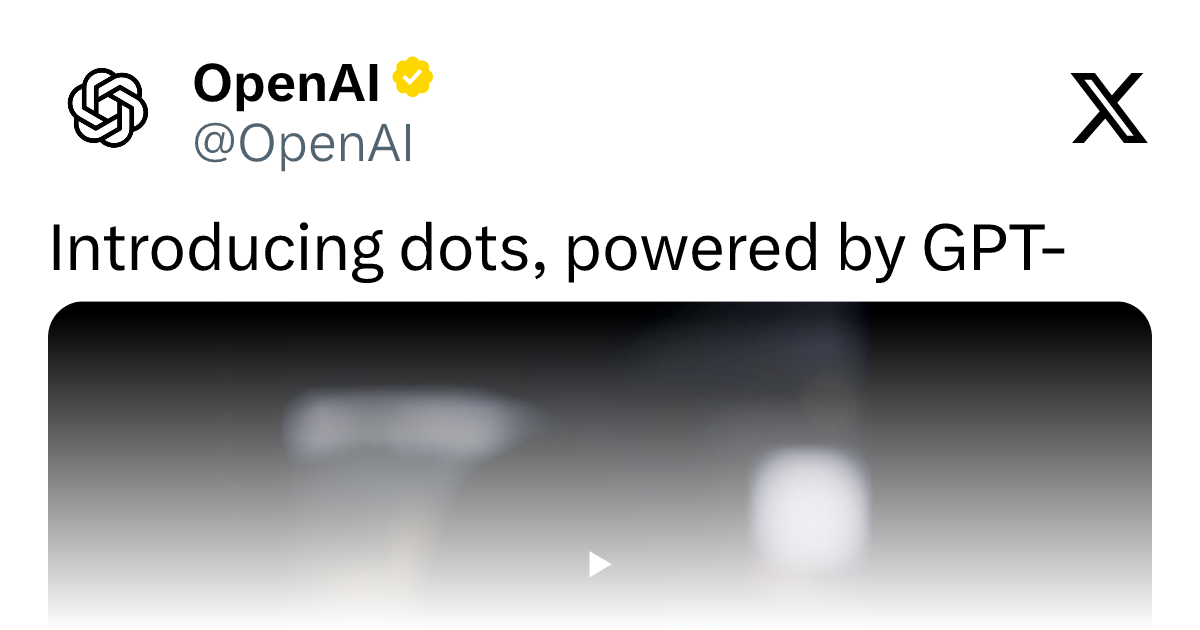
A brief tweet announced a new product called dots, describing it as powered by GPT-6 Astra and positioned as a remarkably capable, always-on agent built to handle everything. While the original post offered almost no detail, a few key terms it contained — GPT-6, Astra, always-on agents — were enough to spark industry discussion.
It's worth noting upfront: this article is based solely on the one piece of public information available — that tweet. Official details about the product's specific features, pricing, and availability have not been disclosed. What follows is an analysis of the conceptual direction, not a statement of verified facts.
What Are "Always-On Agents"?
"Always-on agents" represent an important direction in the evolution of AI applications. Unlike traditional question-and-answer conversational assistants, always-on agents emphasize continuous operation, proactive awareness of environmental changes, and task completion without requiring users to explicitly trigger them each time.
This model means the agent is no longer purely reactive — it can:
- Continuously monitor information streams or system states
- Autonomously plan and execute multi-step tasks toward predefined goals
- Run persistently in the background, ready to act at any time
The phrase "built to handle everything" highlighted in the dots tweet is a textbook expression of this vision: a general-purpose, always-available agent. It reflects the product team's intent to elevate AI from a "tool" to an "executor."
The technical implementation of always-on agents typically relies on several core components: persistent memory (the ability to preserve context and task state across sessions), tool-calling capabilities (interaction with external APIs, file systems, or browsers), and task scheduling mechanisms (automatic execution triggered by specific times or events). This is fundamentally different from today's mainstream stateless conversation models, which "forget" everything after each session and cannot initiate actions on their own. There have been early explorations in this space — AutoGPT and Devin among them — but they commonly suffer from error accumulation and context loss over long tasks, and have yet to produce reliable commercial products. True deployment of always-on agents requires substantial advances in the underlying model's long-chain reasoning stability, not just engineering-level workarounds.
What Does GPT-6 Astra Signify?
The mention of "GPT-6 Astra" is the most attention-worthy detail in the tweet. If accurate, it would represent another leap in underlying model capability. It must be emphasized that, as of now, this model name has only appeared in this single tweet — there is no official technical documentation or third-party verification. Readers should approach the claim with appropriate skepticism.
From a naming standpoint, "Astra" as a codename is commonly associated with enhanced reasoning, long-horizon task execution, or multimodal capabilities. For always-on agents, the underlying model's capabilities directly determine whether the agent can reliably perform long-chain planning, tool calling, and error recovery — which are precisely the core requirements for delivering on the promise of "handling everything."
The codename "Astra" bears a notable resemblance to Google DeepMind's Project Astra, released in 2024 — a multimodal real-time assistant prototype emphasizing continuous perception and instant response. Whether any connection exists between the two is unknown, but the naming overlap itself is a reminder that, pending official clarification, the source and validity of technical claims deserve careful scrutiny. For always-on agents, model inference efficiency is equally critical — long-term background operation means finding a balance between compute costs and response quality, an engineering challenge that remains unsolved in current large model deployments.
Hype vs. Reality
Phrases like "remarkably capable" and "handle everything" are commonplace in AI product launches. They paint an appealing vision, but frequently fall short of the actual experience.
For any agent claiming to do everything, the real test comes down to several dimensions:
Reliability
Long-term operation of an always-on agent means even a small error rate gets amplified over time. Whether the system can maintain stable execution without human supervision is what separates a demo from a real product.
Controllability and Safety
"Always-on" also means the agent may take actions while the user isn't actively watching. Permission boundaries, auditability of operations, and fallback mechanisms when things go wrong determine whether users will actually trust it with real tasks.
Actual Capability Limits
"Everything" is marketing hyperbole. Real products typically excel in specific scenarios — information organization, scheduling, code assistance — while still facing significant limitations with complex, open-ended tasks in the real world.
How to Approach This Kind of Launch
For readers following AI developments, the more rational stance when facing high-concept, low-detail announcements like this is to focus on the technical trend they point toward, rather than letting a single marketing phrase drive your judgment.
Always-on agents are widely recognized as the next major form factor in the industry, and multiple leading companies are investing in this direction. The emergence of dots — whatever its final form — is another data point in that trend. But until the product officially launches, independent evaluations appear, and real user feedback surfaces, a reasonable degree of skepticism toward unverified technical claims like "GPT-6 Astra" is warranted.
A meaningful assessment of its capabilities will only be possible once official documentation is released or the product is available to try. Until then, this tweet reads more like a directional teaser than a verifiable product track record.
Related articles

Chain of Thought Isn't Just for AI: How Humans Can Use CoT to Improve Thinking Quality
Chain of Thought isn't just a prompt trick for large models. Starting from a Hacker News discussion, this article analyzes why CoT works for human thinking too, breaks down actionable ways to transfer it, and highlights the key differences between human CoT and machine CoT.
Cloudflare Teams Up with OpenAI: Closi…
Cloudflare Teams Up with OpenAI: Closing the Loop from Vulnerability Discovery to Defense with AI
Cloudflare uses OpenAI Daybreak to investigate security vulnerabilities and generate reviewable remediation plans, while developers use Codex to boost coding efficiency and quality.

Orca Multi-Agent Orchestration in Practice: A Guide to Parallel Collaboration with Claude and Codex
Orca is Stable AI's free open-source agent workbench supporting 34 agents like Claude Code and Codex in parallel. Learn its Git worktree isolation, multi-model orchestration, and mobile management.