Doubao Agent Complete Beginner's Tutorial: Build Intelligent Agent Workflows from Scratch

Doubao upgrades from a chat tool to an AI Agent that can operate computers; the tutorial details its advantages and learning path.
Through a folder operation comparison, the article reveals that ordinary chat AI can only give suggestions while Doubao's work task mode can directly execute local file operations, introducing the AI Agent concept. It argues four reasons to choose Doubao over Codex—plug-and-play, domestic office ecosystem integration, friendly pricing, and one-click skills—and highlights cloud computer support for remote task assignment. It also introduces a 28-point course across four sections, with workflow automation and the skill ecosystem as the advanced core.
Doubao is transforming from a chat tool into a "digital employee" that can directly operate your computer. In their latest tutorial, a Bilibili creator uses an intuitive side-by-side demonstration to reveal the fundamental difference between traditional chat AI and Doubao's work task mode, and systematically maps out the complete path from getting started to building workflows.
Ordinary Chat AI vs. Doubao Agent: A Folder Operation Comparison
The tutorial designs a typical office scenario: converting all PPT files in a "Demo" folder to PDF and archiving them. When a regular chat AI (such as DeepSeekAd) faces this request, it can only provide operation steps and cannot touch local files. But after switching to Doubao's work task mode, the same prompt is directly executed—Doubao automatically creates a "PDF Archive" folder and completes all conversions.
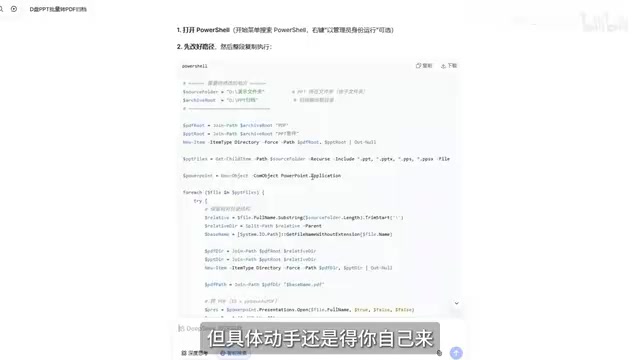
This comparison reveals the core difference: traditional chat AI is a consultant that answers questions one at a time, while Doubao Agent is an employee that can take action. The creator collectively refers to software that can operate computers and execute instructions as AI Agents, and points out that people who use AI in the future are essentially managing AI. The PPT shown in the tutorial is exactly the result Doubao automatically generated based on the folder path.
The fundamental difference between an AI Agent and ordinary chat AI lies in "action capability." Chat AI is essentially a language model interface that receives text and generates text—all output stays at the conversation level. An Agent, beyond the language model, also layers on tool use, environment perception, and task planning modules, enabling it to read and write files, run commands, call external APIs, and adjust its next actions based on execution results. The industry typically describes an Agent's working method as a closed loop of "perception—planning—action—feedback." This concept can be traced back to agent research in reinforcement learning, and entered mainstream awareness after 2023 as large models' function-calling capabilities matured. Understanding this distinction helps determine which tasks are suitable for Agents (multi-step, involving local resources, requiring repeated execution) and which remain suitable for chat AI (consultation, writing, brainstorming).
Why Choose Doubao Instead of Codex? Four Solid Reasons
Facing the question "Why not just learn Codex?" the creator compiled a comparison table breaking down Doubao's differentiated advantages point by point.
First, it works right after installation. Install the Doubao client, log into your account, and switch the dialog box to work tasks—the entire process requires no network configuration or development environment. Codex, on the other hand, requires dealing with network issues, having some hands-on ability, and configuring the environment yourself—a noticeably higher barrier to entry.
Second, seamless integration with the domestic ecosystem. The "Connector" button below Doubao's input box allows you to authorize Doubao to call everyday office software. For example, after connecting to Feishu, Doubao can organize last week's work content into a weekly report and automatically write it into a Feishu document. As a product of the overseas ecosystem, Codex has very limited support for domestic tools.
Third, friendly pricing. New users can receive a free subscription period, and university student verification grants an additional bonus—the daily office quota is basically sufficient. By comparison, Codex costs $20 per month and only pays off with intensive use.
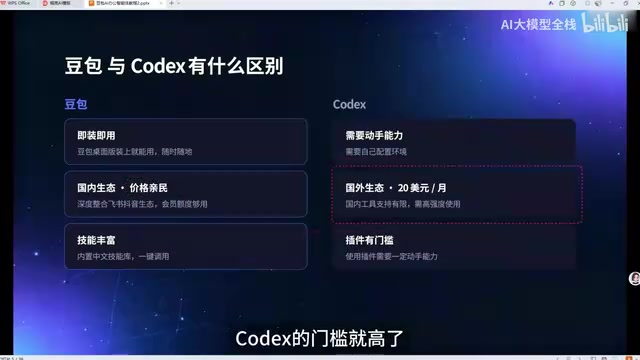
Fourth, one-click skill loading. Click "Skills" below the input box to use them, and there's also a built-in Chinese skill marketplace for one-click loading of common capabilities. The tutorial also mentions that Doubao supports cloud computers—a virtual computer is always online in the cloud, so even when you're out using the mobile app, you can assign tasks to your home computer, and cloud tasks continue running even after the computer is shut down. This phone-remote-control-computer experience is a scenario many overseas agents have yet to cover.
Codex was originally a code generation model released by OpenAI, later evolving into a programming agent product for developers, positioned toward professional development scenarios requiring command-line operations, API key configuration, and runtime environment setup. Such overseas agent products generally have two hidden barriers: first, network access restrictions—domestic users often need additional network configuration; second, ecosystem fragmentation—their tool integrations mostly revolve around overseas services like GitHub and Slack, with little native support for domestic office suites like Feishu, DingTalk, and WPS. Therefore, when evaluating "which agent to choose," you can't just look at model capability itself—you also need to factor in network accessibility, account systems, payment methods, and office software integration. For non-technical office workers, these engineering-side factors often determine usability more directly than model benchmark scores.
Course System: 28 Knowledge Points, from Beginner to Industry Application
This course, which the creator spent about three months refining, is divided into four major sections—Beginner, Case Studies, Advanced, and Industry—with 28 knowledge points in total. Learners with zero programming background and zero AI experience can follow along with hands-on practice, gradually handing repetitive and tedious work over to AI.
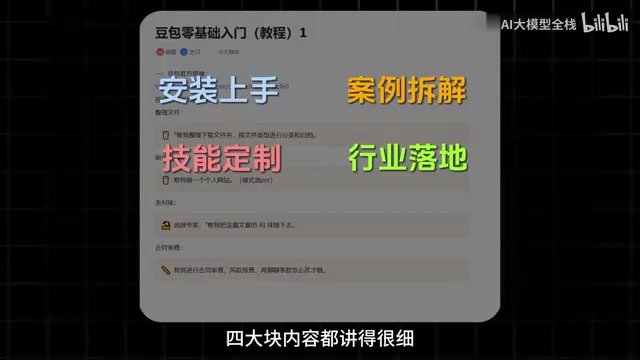
The accompanying Doubao user manual covers four major modules—installation and getting started, case breakdowns, performance customization, and industry application—along with common skills and ready-to-use hands-on materials. The creator emphasizes that the course goal is to let learners "hire" a digital employee at the lowest cost, upgrading the way they use AI from asking questions to giving commands.
Advanced Direction: Workflow Automation and the Skill Ecosystem
The tutorial lists workflow automation as the core of the advanced section, but leaves the specific building methods for subsequent lessons. From the available information, Doubao's capability boundary has expanded from single-task execution to connector integration, skill marketplace invocation, and persistent cloud operation. For readers who want to systematically master agent building, it's recommended to proceed step by step along the path of "installation → single-task execution → connector configuration → skill combination → workflow orchestration."
At the end, the creator reveals that the next lesson will start from installation, using the most straightforward approach to make Doubao truly empower work.
Workflow Automation refers to chaining multiple independent tasks together according to trigger conditions and sequence, allowing an agent to orchestrate once and reuse many times. Common forms include: scheduled triggers (e.g., automatically summarizing the week's documents every Friday), event triggers (e.g., automatically extracting key points into a table upon receiving a new email), and conditional branches (e.g., different processing paths for different file types). In the agent context, workflows are usually composed of "skills" as atomic units—each skill encapsulates a specific type of operation, and the workflow handles scheduling order and data passing. Its difference from traditional RPA (Robotic Process Automation) is that agents can handle unstructured input (natural language, vague instructions) and reason through exceptions on their own, rather than relying on pre-hardcoded fixed rules. Mastering workflow orchestration is the key step from "issuing single commands" to "long-term delegation."
One-line Summary
Doubao upgrades from a chat tool to an AI Agent that can operate computers; the tutorial details its advantages and learning path.
Paragraph Summary
Through a side-by-side folder operation demonstration, the article reveals the essential difference between ordinary chat AI, which can only give suggestions, and Doubao's work task mode, which can directly execute local file operations—and from there introduces the concept of AI Agent. The tutorial then argues from four dimensions why one should choose Doubao over Codex: works right after installation, seamless integration with the domestic office ecosystem, friendly pricing, and one-click skill loading, with special mention of cloud computer support for remotely assigning tasks from a phone. The article also introduces a course system divided into four major sections—Beginner, Case Studies, Advanced, and Industry—with 28 knowledge points in total, noting that the advanced core is workflow automation and the skill ecosystem, and recommending proceeding step by step along the path of installation, single-task, connectors, skill combination, and workflow orchestration.
Related articles

How Did Da Vinci Prove the Sun Is Hot? A Neglected Chapter in Science History
How did da Vinci use a concave mirror experiment to overturn Aristotle's cold sun theory? This article traces this neglected chapter in science history, revealing the embryo of scientific thinking in the 15th century and da Vinci's cold observations on solar heat and the nature of life.
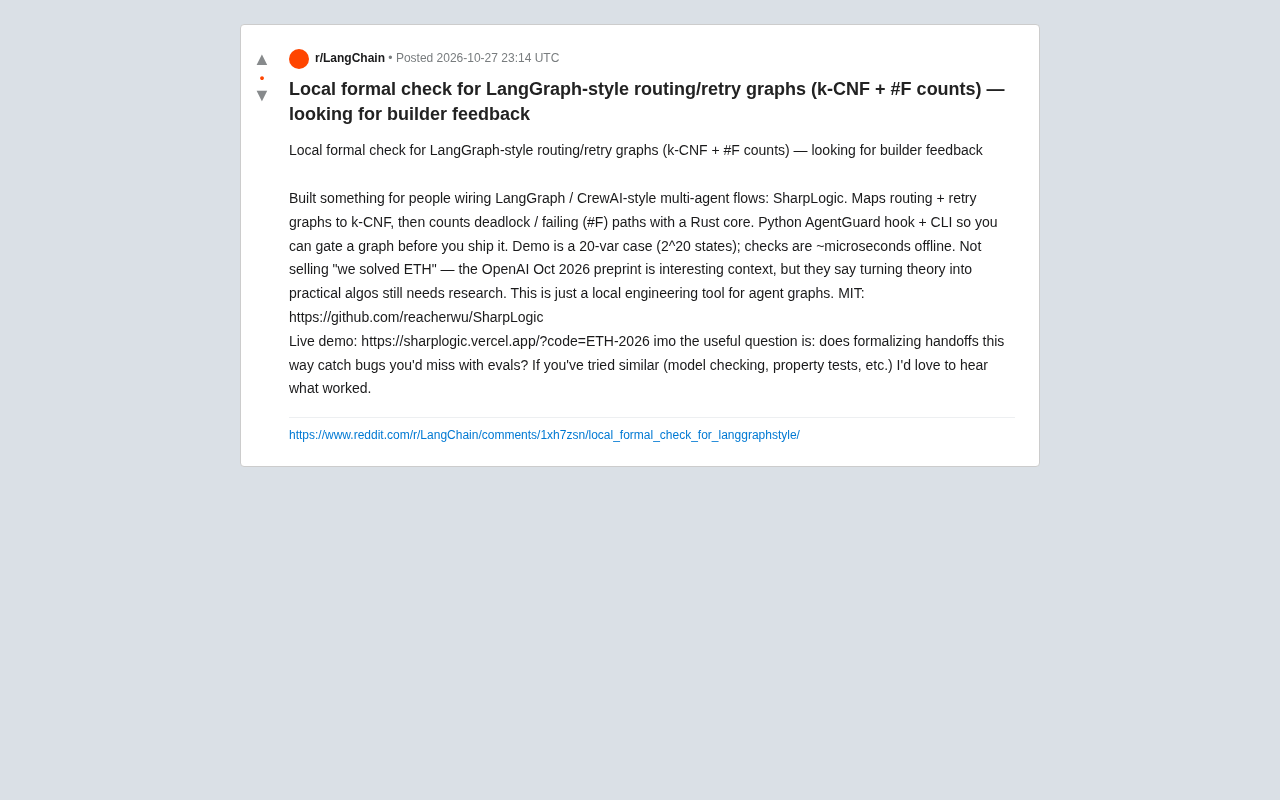
SharpLogic: Formalizing Bug Detection for LangGraph Routing Graphs with k-CNF
SharpLogic, an open-source project, maps LangGraph-style multi-agent routing and retry graphs to k-CNF, using a Rust kernel to count deadlocks and failing paths (#F counting), offering a Python AgentGuard hook and CLI for pre-release formal gate checks. This article analyzes its principles, its complementary relationship with evals, and the community's concern about modeling costs.
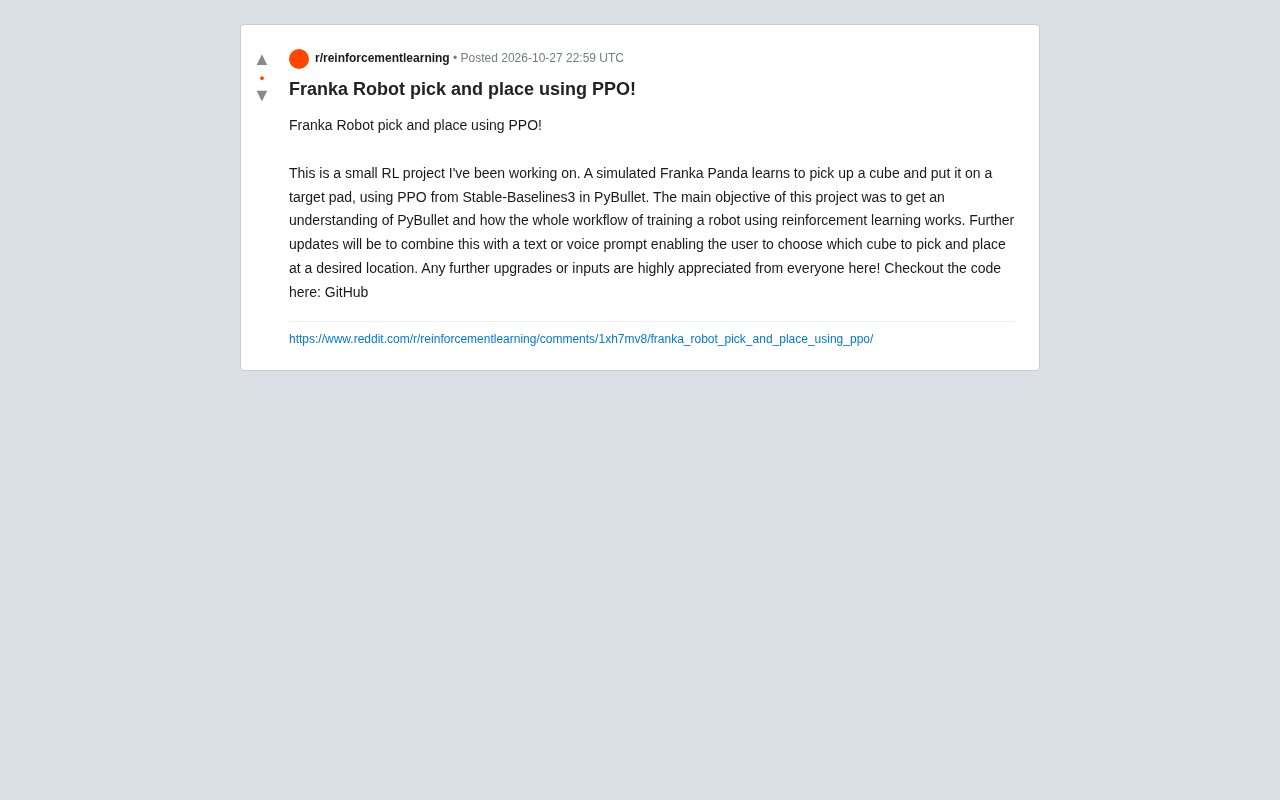
PPO Training of a Franka Robotic Arm for Pick-and-Place: A Reinforcement Learning Starter Project
A reinforcement learning project using PPO to train a Franka Panda robotic arm for pick-and-place in PyBullet, covering tech stack choices, task design challenges, and future text/voice command interaction plans—a good reference for beginners.