Doubao AI Beginner's Guide: 5 Practical Use Cases for Complete Beginners

A beginner's guide to Doubao AI covering 5 key use cases and practical prompt engineering tips.
This article, based on a Bilibili tutorial, introduces ByteDance's Doubao AI assistant — its positioning, registration, and five core use cases: Q&A, professional writing, creative writing, language learning, and image generation. It breaks down prompt engineering techniques, showing how specifying role, context, and constraints dramatically improves output quality. It also warns readers about hallucination risks in legal and financial domains.
What Is Doubao AI: Overview and How to Register
Among domestic AI assistants in China, Doubao has consistently ranked near the top in user numbers. In his tutorial, Bilibili creator "Hailo Teacher" mentioned that Doubao has approximately 340 million users and nearly 60 million monthly active users, describing it as "the world's second-largest AI and China's top AI." It's worth noting that this ranking comes from the video author and the methodology isn't specified, so treat it as a reference rather than an authoritative statistic. That said, Doubao's popularity among everyday users in China is genuinely high.
Dobao is an AI conversational product developed by ByteDance. The original video describes it as a tool built entirely by a domestic team, with its underlying model originally based on ByteDance's "Skylark" (云雀) large language model. For beginners, its biggest advantage is low barrier to entry and multiple access points:
- Web version: Go to doubao.com in your browser, or search "豆包AI" in any search engine
- Mobile: Search "豆包" in the Apple App Store or major Android app stores
- Registration: Sign up using a mainland China phone number to receive a verification code; login via Douyin account or Apple ID is also supported

The tutorial author highlights Doubao's core strength as being "ready to use, right away." It requires no complex configuration, has no network access barriers, and covers common needs including Q&A, writing, translation, image generation, and voice conversation. For anyone new to AI, this all-in-one experience is far easier to stick with than learning multiple tools simultaneously.
Use Case 1: Asking Questions and Getting Information — Including Personal and Legal Matters
Using Doubao as an "All-Knowing Friend"
Q&A is Doubao's most fundamental feature. You can ask it directly about history, science, technology, and everyday knowledge. The tutorial demonstrates a particularly relatable emotional scenario: the user sets up a situation where they're a "mature older guy" who has worked for over a decade, dating a girlfriend who just graduated from college and tends to "throw little tantrums." They ask Doubao, from their own perspective, for advice on both making her happy and helping her grow.
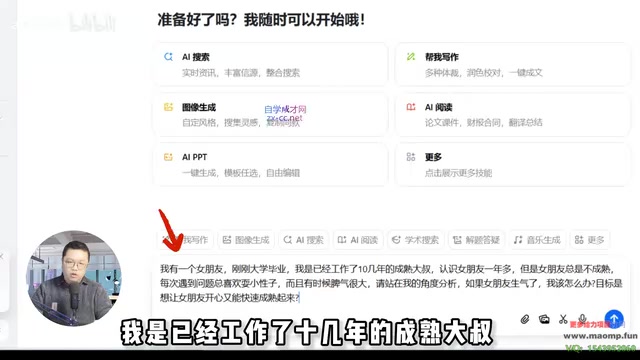
Dobao produced quite a few suggestions, and the author candidly admitted some of them were things he "as a straightforward guy would never have thought of." This example illustrates a key practical technique: provide context, perspective, and goals when asking a question, and the response will be noticeably more targeted. "Who am I, what's my situation, and what do I want to achieve" — these three elements apply to almost every conversational scenario.
Professional Domain Queries: A Lost-and-Found Legal Example
The tutorial also tested a legal question: "If I find 5,000 yuan on the street with no identifying markings, is there any legal risk in spending it?" According to the author's demonstration, Doubao cited specific legal provisions in its explanation and ultimately advised handing the money over to the police. Beyond legal matters, the author suggests Doubao can also help with finance, photography, marketing, and job hunting.
One important caveat: AI responses on legal and financial topics are best used for getting an initial understanding of an issue and clarifying your thinking. For actual disputes or decisions involving significant amounts of money, you should still verify the original statutory text or consult a licensed professional. Large language models can make errors when citing legal provisions — this is what's commonly called "hallucination."
A note on "hallucination": Hallucination is a technical term in the large language model field. It refers to when a model generates content that is factually incorrect but stated with great confidence, as if it were authoritative. This is a shared technical limitation across all major LLMs today. The root cause is that these models are fundamentally generating "text that looks plausible" based on statistical patterns — they're not retrieving clauses from a structured legal or medical database. In a legal context, for example, a model might cite a statute that doesn't actually exist or has been amended, using the same confident tone it would use for a real citation. This is why AI responses in professional domains are better treated as a "thinking tool" than as an authoritative source.
Use Case 2: Professional Writing — Contracts and Brand Copywriting
Drafting a Used Car Purchase Agreement
For working professionals, document writing may be Doubao's most valuable application. The original video mentions that Doubao can help write reports, summaries, contracts, and speeches, and can also assist with PPT generation, Excel work, and coding.
The contract prompt demonstrated in the tutorial was: "I want to buy a used car. Please help me draft a used car purchase agreement from a professional legal perspective, with content that minimizes unnecessary financial and legal risks for me." Within seconds, a fully structured contract was generated.
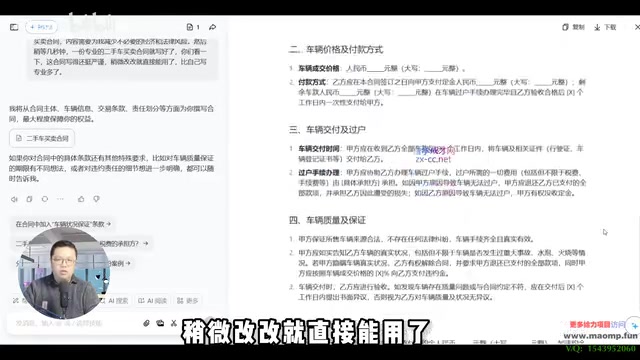
The author's assessment: "With a few tweaks it's basically ready to use — way more professional than anything I'd write myself." This prompt works well because it simultaneously specifies a professional perspective (legal angle) and a party's interest (reducing risk for the buyer). Based on this, the AI will lean toward protecting the questioner on clauses involving vehicle condition defects, breach of liability, and title transfer procedures. Before signing any actual agreement, it's still advisable to verify vehicle details, amounts, and delivery terms line by line.
Why specifying both "professional perspective" and "party's interest" matters: These two elements work together to shape the AI's output strategy. "Professional perspective" prompts the model to apply legal language and standard contract structure conventions, while "party's interest" effectively sets a review direction — the model will tend to include buyer-protective language on things like vehicle condition descriptions, penalty clauses, and transfer deadlines, rather than producing a version that's completely neutral to both sides. This approach is far more effective than simply asking to "write a contract," because it communicates the user's actual needs rather than just the surface-level task. The same logic applies to other document scenarios — for example, specifying "from the employee's perspective" when drafting an employment contract, or noting "we are the service provider" when drawing up a partnership agreement.
Brand Copywriting Outline
Another example involves marketing strategy. Entering "I'm a planner at an advertising agency. Please help me design an outline for brand copy in the furniture industry" quickly produced a framework. The right way to use AI for this kind of task is to let it build the skeleton first, then have a human fill in the brand tone and specific selling points — far more efficient than starting from scratch.
Use Case 3: Creative Writing, Voice Narration, and Image Generation
Writing a Fairy Tale for Young Children
For creative writing, the tutorial's prompt was: "I'm a children's fairy tale writer. Please help me write a 300-character story suitable for four-year-olds, with a warm and heartwarming tone." Doubao produced a story called Little Rabbit Makes Friends, in which a rabbit gets rejected by a monkey for being rude and gradually learns how to get along with others.
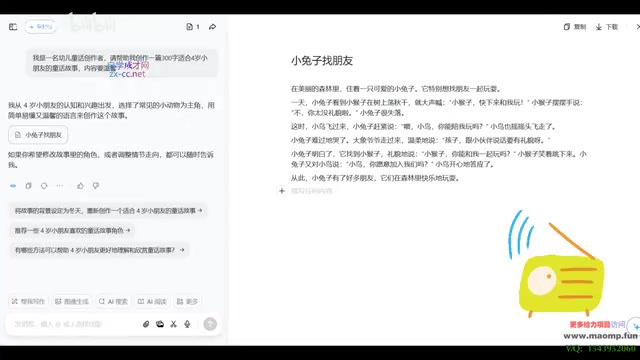
This prompt specified word count, target audience age, and emotional tone — three constraints that kept the output's length and language difficulty appropriately matched to the requirements. The author also suggested using Doubao's voice narration feature to read the story aloud to children, making it a ready-to-use bedtime story.
Language Learning and Image Generation
Dobao can also serve as a language practice partner, helping users improve grammar, expand vocabulary, and practice expression. It also supports generating images and illustrations through conversation. In the tutorial, entering "Generate a realistic portrait of a beautiful woman" quickly produced a photorealistic image.
When using image generation features, be mindful that AI-generated portraits should not be passed off as real people, nor used in contexts that could mislead others. This is an increasingly important compliance issue in AI content use.
Tips for Beginners: From Using It to Using It Well
Based on the cases covered in this tutorial, here are a few recommendations for new users:
- Assign a role: Start with "I am a ×× professional" or "Please approach this from the perspective of ××" to get more expert-level responses
- Provide context: Describe your specific situation to avoid generic, vague answers
- Set constraints: Specify word count, audience, style, and objectives
- Follow up in multiple turns: If the first result isn't satisfying, directly point out what needs to change and ask it to keep refining
- Always verify: Always do your own secondary verification for high-stakes content in areas like law, healthcare, and finance
From this tutorial, it's clear that Doubao is positioned as a "mass-market AI assistant." Rather than chasing complex professional features, it focuses on making high-frequency needs — Q&A, writing, creative work, and image generation — smooth and accessible. For anyone who hasn't tried AI yet, starting with Doubao and putting it to work on real everyday problems is a low-friction path into the world of AI.
Background: The Basics of Prompt Engineering
Assigning a role and providing background context when prompting AI is fundamentally a technique known as Prompt Engineering. When generating a response, large language models assess the input context to determine what level of expertise and what tone to use. The more specific the background information provided, the more the model can narrow down the range of possible responses, producing output that better fits the actual need. The three elements — "who I am, what my situation is, and what I want to achieve" — correspond to three dimensions that language models use when processing a task: identity constraints (which knowledge domain to draw from), situational constraints (bounding the problem's conditions), and goal constraints (clarifying the output direction). Even without any technical background, structuring your questions around this framework will produce noticeably better results in practice.
Related articles

Chain of Thought Isn't Just for AI: How Humans Can Use CoT to Improve Thinking Quality
Chain of Thought isn't just a prompt trick for large models. Starting from a Hacker News discussion, this article analyzes why CoT works for human thinking too, breaks down actionable ways to transfer it, and highlights the key differences between human CoT and machine CoT.
Cloudflare Teams Up with OpenAI: Closi…
Cloudflare Teams Up with OpenAI: Closing the Loop from Vulnerability Discovery to Defense with AI
Cloudflare uses OpenAI Daybreak to investigate security vulnerabilities and generate reviewable remediation plans, while developers use Codex to boost coding efficiency and quality.

Orca Multi-Agent Orchestration in Practice: A Guide to Parallel Collaboration with Claude and Codex
Orca is Stable AI's free open-source agent workbench supporting 34 agents like Claude Code and Codex in parallel. Learn its Git worktree isolation, multi-model orchestration, and mobile management.