Doubao Work Agent in Action: The AI Productivity Assistant Every College Student Should Be Using

Doubao Work's Agent mode lets college students delegate course prep, PPT structuring, paper planning, and job matching to AI.
This article introduces the Agent capabilities in Doubao's upgraded "Work" mode: rather than feeding AI questions step by step, users simply describe their end goal and let it plan, organize, and execute. Using common college student scenarios, it demonstrates four use cases — turning course slides into study frameworks, scaffolding PPT structures for presentations, converting references and notes into paper outlines, and matching résumés against job JDs for recruiting season. The key insight is that the tool's value lies not in new features, but in a fundamental shift in how you use it: delegate the repetitive, organizational work to AI, and save your own energy for judgment and creativity.
Many people still use Doubao primarily for chatting, looking things up, or asking quick questions — but it's long since outgrown the role of a simple Q&A tool. The upgraded Doubao Work introduces a new Agent capability: instead of breaking your problem into pieces and feeding it one question at a time, you simply describe your end goal and let it understand your needs, organize information, and invoke the right tools to move the task forward. For college students, this shift means the tedious back-to-school workload can be handed off to AI in a far more systematic way.
From Q&A Tool to Task Assistant: What Agent Mode Actually Changes
The traditional way of using AI is "think of a question, ask it" — you're still the one driving every step. Agent mode is fundamentally different: it works more like an assistant capable of completing an entire task. You describe what you want to achieve, and it handles the goal comprehension, information synthesis, and structural scaffolding — taking care of the repetitive middle work for you.
This distinction seems subtle, but the experience is completely different in practice. An ordinary summarization tool just compresses file content; an Agent reorganizes information around your actual goal. When using it, remember to switch to "Work" mode and load your local files — that's the prerequisite for unlocking its full capability.
The concept of an Agent (intelligent agent) originates from the field of artificial intelligence. It refers to a system that can perceive its environment, autonomously formulate plans, and execute multi-step actions to achieve a goal. Unlike the "single-turn Q&A" approach of traditional large language models, Agent mode introduces a "plan → tool call → execute → reflect" loop: it can automatically decompose a complex goal into subtasks, sequentially invoke external tools such as search, file reading, and code execution, and dynamically adjust subsequent steps based on intermediate results. This means users no longer need to act as "task schedulers," feeding the AI each sub-question step by step — they only need to describe the desired "end state" at the outset, and the AI will plan its own path to get there. Doubao Work's Agent capability is built on exactly this architecture: after uploading local files, it understands the relationship between the file content and the user's goal, rather than simply extracting or compressing text mechanically.
Organizing Course Materials: From Dozens of PPT Slides to a Study Framework
The first headache after the semester starts is usually the ever-growing pile of course materials. When a professor says "take a look at this after class," that can easily mean dozens of PPT slides, several PDFs, and a stack of reference documents. By the time exams roll around, the real challenge isn't a lack of materials — it's not knowing what actually matters.

In practice, you load your course slides, lecture materials, and references together, then give a clear instruction: "I need to prepare for this course exam. Please organize these materials, extract the core knowledge points, key chapters, and easily confused concepts, and generate a set of revision notes I can actually use." Doubao Work won't just compress the files — it understands that your goal is exam preparation and reorganizes the content around that objective, producing a ready-to-use study framework. This idea of "understand the goal first, then organize the content" is the core of what sets an Agent apart from an ordinary tool.
Building PPT Frameworks: Solving the "I Don't Know Where to Start" Problem
When working on a course presentation, most people don't get stuck on design — they get stuck on not knowing how to develop a topic once they have it.
This is where you can ask it to "design a PPT framework for a class presentation, planning the content for each slide, the key arguments, and the overall flow of the talk." It will build the overall structure based on your presentation goal — what background to introduce up front, which points to develop in the middle, and how to wrap up at the end. The most time-consuming part of making a PPT used to be that first step of having nowhere to begin. Now you let AI lay out the skeleton, then refine it with your own ideas — a noticeable efficiency gain. This reflects another value of the Agent approach: dramatically lowering the startup cost of going from zero to something.
Planning a Research Paper: Putting Information Organization First
A lot of university assignments share a common challenge — it's not that you lack materials, it's that you don't know how to turn information into your own line of thinking. Writing a course paper is the classic example: your computer is full of reference PDFs and reading notes, yet when you open Word, you still can't write the first sentence.
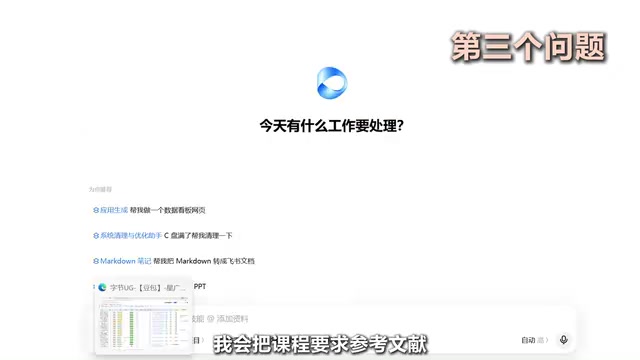
Hand your course requirements, reference papers, and reading notes to Doubao Work and ask it to "organize the research direction, core arguments, and article structure, then generate a paper outline." It will first map the relationships between your materials and help you clarify how the piece should unfold. It's worth emphasizing: the final paper still requires your own thinking and revision. But the upfront work of organizing information and building a framework can absolutely be delegated to AI — leaving the time you save for the parts that genuinely require human judgment and creativity.
Fall Recruiting: Analyzing Job-to-Candidate Fit
By the time campus recruiting season arrives, the volume of information to manage is even larger. Many students don't have a shortage of job listings — they just don't know what to prioritize preparing for. You scroll through recruiting apps every day, save anything that looks relevant, and end up with a collection full of JDs. When you finally sit down to prepare, the questions flood in: Is this role actually a good fit for me? How much of my energy does it deserve? What skills am I still missing?
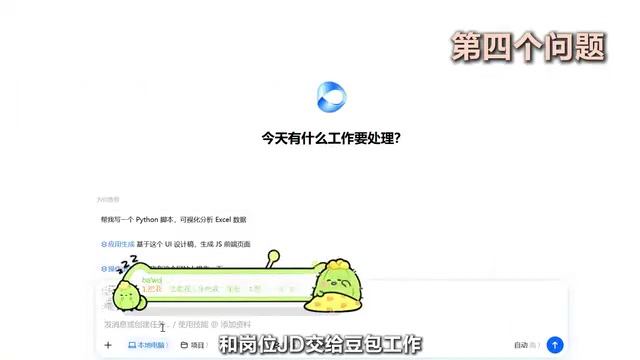
Submit your résumé and the job JD together to Doubao Work and ask it to analyze the fit — and you can convert vague anxiety into a clear preparation plan. This shift from "information overload" to "decision support" is where the Agent delivers real-world value.
A Job Description (JD) is a structured summary from the hiring company that outlines a position's responsibilities, requirements, and capability preferences — typically covering the job title, core duties, skill requirements, and education/experience thresholds. The real challenge job seekers face during campus recruiting is that JD wording varies significantly across companies even for the same role, making it hard to quickly assess how well you fit. Submitting both your résumé and a JD to AI for a fit analysis is essentially asking the model to perform a "bidirectional parse" — extracting capability tags from your résumé, comparing them against the JD's requirements item by item, and outputting your strengths, gaps, and areas to build up. This is far more efficient than manual comparison, especially when applying to multiple positions simultaneously. It lets you prioritize and focus your limited preparation time on the roles where you have the highest fit and the most addressable gaps.
The Real Change Is in How You Use It
After working through all of these scenarios, the biggest change in the upgraded Doubao Work isn't that it gained a few new features — it's that the fundamental mode of use has shifted. From organizing course materials and building PPT frameworks to planning papers and analyzing recruiting opportunities, tasks that used to start from zero can now begin with AI untangling the complex information for you.
If you're still treating Doubao purely as a chat tool, you're leaving a lot of its capability on the table. The point of Agent mode is that it doesn't just answer your questions — it helps you solve problems. Hand off the repetitive labor, and keep for yourself the parts that genuinely require your judgment and creativity. For college students juggling coursework and job hunting, this is probably the most practical way to use it right now.
Related articles

DeepCell: One-Click AI Generation of Documents, Spreadsheets, and Slides
DeepCell tops Product Hunt with one-click generation of documents, spreadsheets, and slides, using the .deepcell format for linked updates, designed for System 2 tasks like modeling and sales reviews.

Doneas: 15-Minute Daily Accountability Calls That Keep Indie Developers From Procrastinating
Doneas is a daily accountability tool for indie developers: plan tasks on Monday, join a 15-minute call with five builders each day, and log deliveries on a public progress page. This article analyzes its core mechanics, effectiveness, and potential issues around retention and matching.

Fastlane 2.0: Fully Automated AI Ad Campaigns, From Creative to Optimization
Fastlane 2.0 is an AI ad automation tool: enter your website and it learns your brand, generates video and image ads, and runs and optimizes them on Meta, TikTok, Instagram, and YouTube.