DrawDB: A Detailed Review of the Free Open-Source Visual Database Design Tool

DrawDB is a free open-source browser-based ER diagram editor and SQL generator for visual database design.
DrawDB is an open-source visual database design tool that runs entirely in the browser, offering drag-and-drop ER diagram creation, bidirectional SQL conversion, and support for multiple database dialects including MySQL, PostgreSQL, and SQLite. With over 38,700 GitHub Stars, it fills the gap between expensive commercial tools and overly complex alternatives, making it ideal for small teams, independent developers, educators, and legacy system analysis.
The Pain Points of Database Design and a New Alternative
For developers and database engineers, database design is often one of the most overlooked yet critically important steps during the project launch phase. Traditional modeling tools are either expensive (such as commercial versions of Navicat or DBeaver Pro) or complex to operate with a steep learning curve. DrawDB, an open-source project that has rapidly gained popularity on GitHub, is redefining the online database design experience with three key attributes: "free, simple, and intuitive."
As of now, DrawDB has garnered over 38,700 Stars on GitHub, with 3,164 Forks, and is gaining 331 new Stars per week—momentum that continues to climb. This growth trajectory clearly demonstrates that it has struck a chord with a genuine need in the developer community.
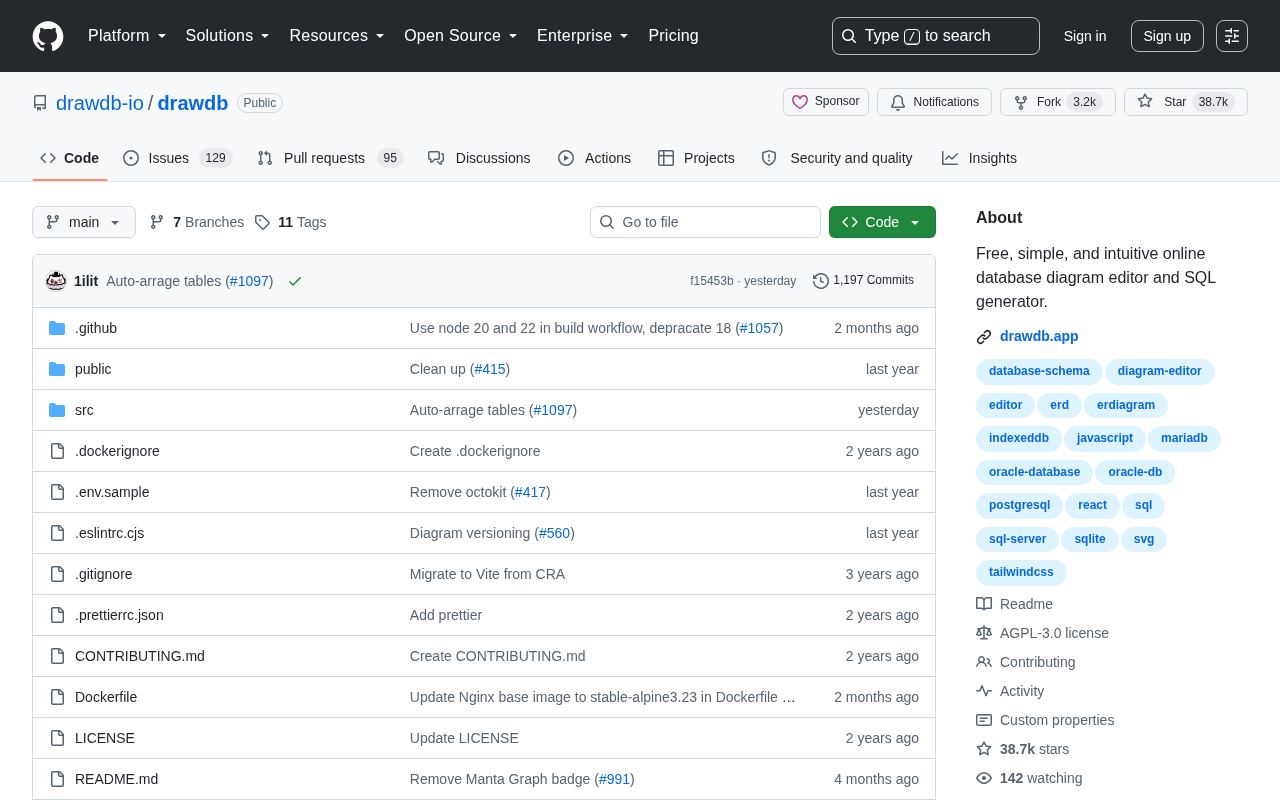
What is DrawDB: An Online Database ER Diagram Editor
DrawDB is an online database Entity-Relationship Diagram (ER Diagram) editor and SQL generator. It runs entirely in the browser, requiring no client software installation—just open the webpage and start designing your database structure.
It's worth explaining the technical background of ER diagrams here. The Entity-Relationship Diagram is a conceptual database modeling method proposed by computer scientist Peter Chen in 1976. It describes the logical structure of real-world data through three core elements: Entities, Attributes, and Relationships. ER diagrams serve as a critical abstraction step before physical database design, helping teams clarify data associations and constraints without getting into implementation details. Common notations include Chen notation, Crow's Foot notation, and UML class diagram notation. Among these, Crow's Foot notation is widely used in industry due to its intuitive relationship representation—and this is precisely the graphical notation DrawDB adopts.
The project is developed in JavaScript, emphasizing lightweight design and ease of use. Its core functionality can be understood from three perspectives:
Visual Database Modeling
Users can create tables, define fields, and set primary/foreign key relationships through drag-and-drop operations—the entire process is intuitive and clear. Compared to writing SQL CREATE TABLE statements by hand, visual operations significantly reduce the cost of understanding and maintaining database structures, making it especially suitable for alignment and communication during team collaboration.
Visual database modeling tools have undergone an important evolution from the desktop era to the cloud era. In the early days, ERWin and PowerDesigner were the standard for enterprise modeling, but their licensing fees of tens of thousands of dollars kept individual developers at bay. After the 2000s, MySQL Workbench offered free visual modeling capabilities, but was limited to the MySQL ecosystem. In recent years, web-based modeling tools have emerged, leveraging Canvas API or SVG for graphic rendering combined with frontend frameworks like React/Vue for interaction, enabling cross-platform use without installation. DrawDB is a prime example of this trend—its purely browser-based architecture means all computation and rendering happens on the client side, which inherently guarantees data privacy and security at the technical level.
Bidirectional SQL Conversion
DrawDB can not only export visual designs as executable SQL CREATE TABLE scripts but also supports importing existing SQL files to reverse-engineer ER diagrams. This means whether you're designing a new database from scratch or trying to untangle the complex table structure of a legacy system, you can get started quickly. This bidirectional conversion capability is what sets it apart from ordinary diagramming tools.
From a technical implementation perspective, the challenge of bidirectional conversion lies in SQL Parsing. DrawDB needs to implement a parser that can understand DDL syntax across different databases, transforming text-based SQL statements into an Abstract Syntax Tree (AST), which is then mapped to visual elements. The reverse process requires serializing entity and relationship information from the diagram into standard CREATE TABLE statements according to the target database's syntax rules, while correctly handling constraints, indexes, and foreign key references.
Zero Cost and Privacy-Friendly
As an open-source tool, DrawDB is completely free and supports local private deployment. For enterprises and individuals who prioritize data privacy, the ability to run it in their own environment and avoid uploading sensitive database structures to third-party servers is a significant advantage. In today's increasingly strict data compliance environment (such as GDPR and China's Data Security Law), database structures themselves may involve trade secrets—table names and field naming conventions often hint at business logic and data asset organization. Therefore, the ability to run locally provides substantial compliance value for enterprise users.

Why DrawDB Rose to Popularity So Quickly
Precisely Meeting Lightweight Database Design Needs
In an era of increasingly bloated database tools, many developers simply need a clean tool that can quickly draw ER diagrams and generate SQL, rather than feature-heavy software with steep learning curves. DrawDB fills exactly this gap—it's lightweight enough, fast enough, and focused enough. This embodies the Unix philosophy of "do one thing well," which in today's landscape of over-integrated tools actually creates a differentiated competitive advantage.
Continuous Push from the Open-Source Community
Behind the 38,000+ Stars and 3,000+ Forks lies an active community of contributors. The open-source model enables DrawDB to iterate rapidly while allowing users to customize it for their own needs. For teams looking to integrate database design capabilities into their own platforms, this customizability is extremely attractive.
It's worth noting that while GitHub Star count is an important indicator of project attention, a healthy open-source project also needs to be evaluated on other dimensions: Issue response time, PR merge efficiency, release frequency, and contributor diversity. DrawDB's 3,164 Forks means a large number of developers are customizing it, which validates its code architecture's extensibility while providing a steady stream of feature feedback and code contributions to the main project—creating a virtuous community flywheel effect.
Support for Multiple Database Dialects
Modern projects often involve multiple database systems, from MySQL and PostgreSQL to SQLite and beyond. DrawDB's support for mainstream database dialects allows it to adapt to projects with different technology stacks, further expanding its applicable scenarios.
The concept of "database dialects" deserves deeper understanding here. Although SQL has ANSI/ISO standards, each major database vendor introduces their own extended syntax and proprietary features on top of standard SQL. For example, MySQL uses AUTO_INCREMENT for auto-incrementing primary keys, PostgreSQL uses SERIAL or IDENTITY, and SQLite achieves auto-increment through INTEGER PRIMARY KEY. In terms of data types, PostgreSQL supports rich types like JSONB and arrays, while earlier versions of MySQL had limited JSON support. For a database design tool, supporting multiple dialects means the generated DDL statements can be executed directly on the target database without manual syntax conversion—this is particularly important in microservice architectures where different services use different databases.
Use Cases and Practical Recommendations for DrawDB
DrawDB is particularly well-suited for the following types of users:
- Small to medium teams and independent developers: Those who need to quickly prototype a database without paying for expensive commercial tools. In agile development workflows, database design often requires frequent iteration, and DrawDB's lightweight nature allows each modification to be completed quickly and shared with team members.
- Technical teaching and documentation: Visual ER diagrams are ideal for teaching demonstrations and technical documentation illustrations. In database theory courses, letting students visually see the relationships between tables is far easier to understand than reading SQL statements, and the generated SQL can also serve as lab materials.
- Legacy system analysis: By importing existing SQL, you can quickly understand the overall structure of an unfamiliar database. This is especially common in technical debt remediation and system refactoring projects—when a system that has evolved over many years contains hundreds of tables, a visual global view is the first step to understanding the system.
It's important to note that as a lightweight database design tool, DrawDB does not cover advanced operational features such as database management, data manipulation, or performance monitoring. Its positioning remains firmly focused on the "design" phase, so it cannot fully replace comprehensive database management platforms like Navicat or DataGrip. The sensible approach is to use it as an efficient tool during the design phase, complementing other operational tools—for example, using DrawDB for modeling and DDL generation in the early project stages, then switching to DataGrip for daily data queries and performance tuning.
Conclusion
DrawDB's popularity is no accident. With its clear positioning of "free, simple, and intuitive," it addresses the core pain points developers face during database design. Driven by the open-source community, this tool's capabilities continue to improve. For any developer who needs to do database modeling, DrawDB deserves a place in your toolbox—whether for quick prototype validation or team collaboration, it delivers tangible efficiency gains.
From a broader perspective, DrawDB's success also reflects a trend in development tools: as web technologies mature, more and more professional tools that once required desktop clients are migrating to the browser, while the open-source model ensures these tools can reach developers worldwide with zero barriers to entry. Looking ahead, database design tools will likely integrate deeply with AI capabilities—for example, automatically generating initial ER diagrams from business requirement descriptions, or intelligently recommending index and normalization optimization suggestions.
If you're looking for a database design tool that's ready to use out of the box and completely free, it's worth trying out this open-source project that has earned the endorsement of tens of thousands of developers.
Related articles

@ai-sdk/vue 3.0.306 Patch Release Syncs with [email protected] Update
@ai-sdk/vue 3.0.306 released, synced with [email protected]. A routine patch release for the Vercel AI SDK ecosystem with no public API changes; the Vue adapter layer stays version-aligned with the core package.

Gemini 4 Argon API Launches: The Era of Million-Token Output Begins
Google launches Gemini 4 Argon with sparse MoE architecture, up to 1M output tokens, and a 68.90% Vals Index score, available across API, AI Studio, and the Gemini app.

DukaanAI: Turning Product Photos into Inventory Lists with Open-Source AI
DukaanAI is an AI inventory tool for small retailers that turns product photos into inventory entries using the open-source Gemma 3 model, with local inference, editable fields, and CSV export.