Dreamer V1 Deep Dive: World Models and Learning in Imagination

A Reddit-shared Dreamer V1 tutorial with PyTorch code, mapping architecture, formulas, and implementation item by item.
A recent Reddit share provides an illustrated Dreamer V1 tutorial and companion PyTorch implementation, mapping world model architecture, math, and code item by item. Dreamer V1's core idea is learning a compact latent world model first, then training the policy on imagined trajectories for better sample efficiency. The world model comprises representation, transition, and reward/observation prediction components, with the loss balancing reconstruction, KL, and reward terms. Policy training is typically done on a frozen model, risking model exploitation. Each formula links to specific code lines, making it a great starting point for understanding the Dreamer series.
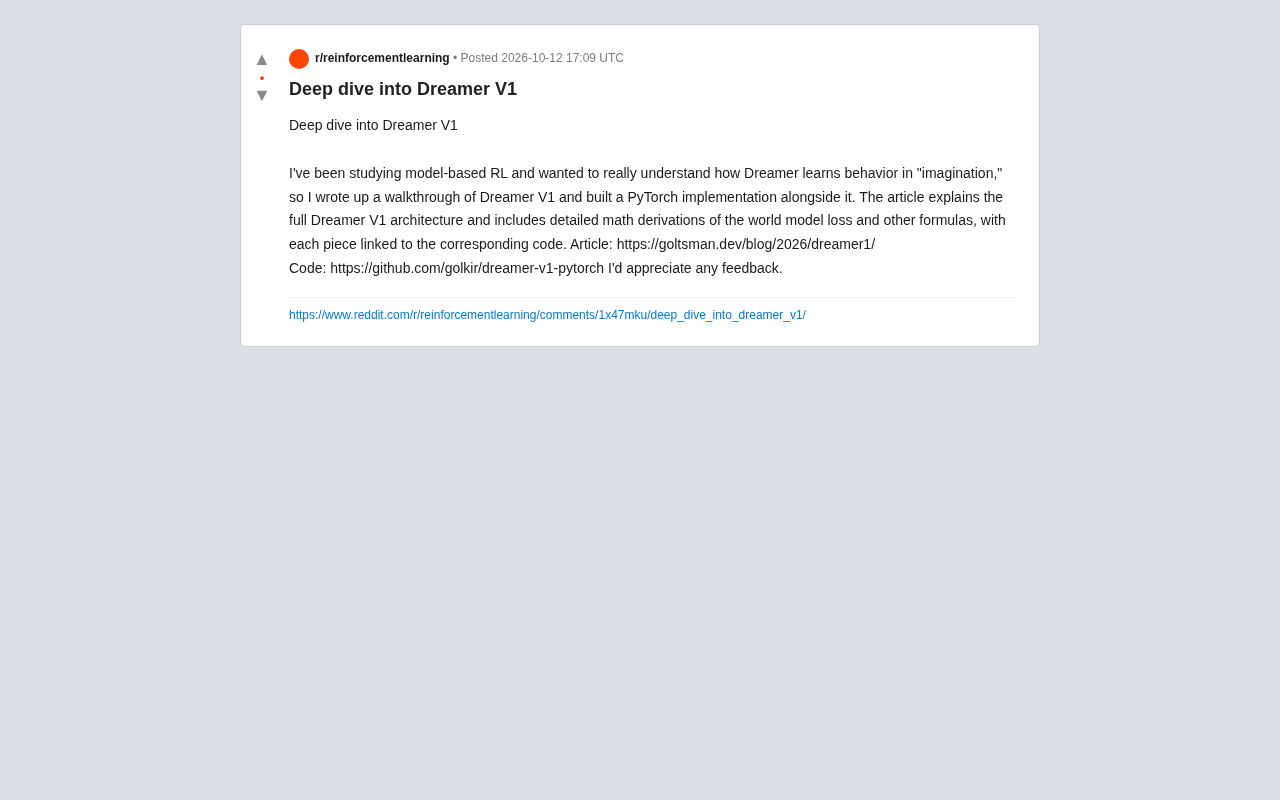
Model-Based RL has long been seen as a key path to improving sample efficiency, but most open-source implementations either skip the mathematical derivations or disconnect the code from the theory. A recent Reddit share provides a rare complete resource: the author wrote an illustrated tutorial on Dreamer V1, accompanied by a PyTorch implementation that maps architecture, formulas, and code item by item.
Why Dreamer V1 Is Worth Revisiting
Dreamer V1's core claim is straightforward: an agent doesn't need to repeatedly trial-and-error in the real environment. Instead, it can first learn a compact world model, then "imagine" future trajectories in that model's latent space to train its policy. This approach splits the RL problem into two stages—first solve prediction, then solve control.
Compared to model-free methods, its sample efficiency advantage comes from compressing and reusing observations; compared to earlier pixel-reconstruction-based models, it predicts directly in latent states, avoiding wasting capacity on irrelevant details. Understanding this layer of design philosophy is a prerequisite for grasping the evolution of the subsequent Dreamer series.
Model-Based RL differs from model-free methods primarily in whether it explicitly learns environment dynamics. Model-free methods like DQN and PPO directly estimate value functions or policy gradients from samples collected through environment interaction, and typically have lower sample efficiency. Model-based methods first learn an environment model (i.e., a world model), then use it for planning or generating virtual experience. Dreamer belongs to the "latent space" branch of the latter—it doesn't model in the raw observation space, but predicts the future in a compressed latent state space. The mathematical foundations of this idea trace back to hidden Markov models and variational inference, and Dreamer V1 combines this with deep RL through the Recurrent State Space Model (RSSM).
The Three Pieces of the World Model
Representation Model: Compressing Observations into Latent Space
The representation model extracts a deterministic state component from the current observation, which together with the stochastic state component forms the complete latent state. In the article, the author maps each mathematical step to its corresponding PyTorch module, making it easy for readers to verify tensor shapes as they follow along.
Transition Model: Predicting the Future in Latent Space
The transition model predicts the prior distribution of the next timestep based on the previous latent state and action. It is the key to making "imagination" possible: given only an action sequence, it can roll out an entire trajectory in latent space without decoding back to pixels.
Reward and Observation Prediction: Providing Supervision Signals for Imagination
The reward prediction head provides return estimates for imagined trajectories, while the observation prediction head ensures the latent state doesn't lose the information needed for reconstruction. Together they constrain the world model so that it is both useful for control and doesn't degenerate into a meaningless encoding.
Recurrent State Space Model (RSSM) is the backbone architecture of Dreamer V1's world model. It consists of a deterministic recurrent path (GRU) and a stochastic path (latent variables): the deterministic state $h_t$ is updated via RNN from the previous $h_{t-1}$ and action $a_{t-1}$, while the stochastic state $z_t$ is sampled from a prior distribution parameterized by $h_t$. This hybrid design balances long-range memory (carried by $h_t$) with multimodal uncertainty representation (carried by $z_t$). The representation model, transition model, reward and observation prediction heads are all built on top of the RSSM, corresponding respectively to posterior inference, prior prediction, and supervision signal generation.
Loss Function and Gradient Propagation
One of the author's major contributions is providing a detailed mathematical derivation of the world model loss, pointing out the trade-offs among the various loss terms. The reconstruction term, KL divergence term, and reward prediction term aren't simply added together—their weights directly affect the usability of the latent space.
The article links each formula to its corresponding code line. This practice is uncommon in RL tutorials, but it greatly reduces the gap of "understanding the formula but unable to write the code." For readers who wish to reproduce or modify Dreamer, this correspondence is more valuable than the conclusions themselves.
In Dreamer V1's loss function, the KL divergence term constrains the distance between the posterior distribution $q(z_t|h_t,o_t)$ and the prior distribution $p(z_t|h_t)$. If the KL weight is too large, the posterior is forced to approach the prior, causing latent variables to lose observation information (information loss); if the weight is too small, the posterior and prior diverge excessively, and the transition model cannot generate meaningful imagined trajectories from the prior (posterior collapse). Dreamer employs a "KL balancing" trick, applying different gradient directions to the posterior and prior, allowing them to converge toward each other dynamically without collapsing. The reconstruction term typically uses MSE or negative log-likelihood, the reward prediction term uses cross-entropy or MSE, and the three are weighted and summed to form the total loss.
Training Behavior in Imagination
Policy learning takes place on latent trajectories rolled out by the world model. The Actor selects actions based on imagined states, the Critic estimates the value of those states, and gradients flow back through the world model—but the world model itself is usually frozen at this stage to prevent imagination distribution drift from destabilizing training.
This two-stage pipeline of "first learn the model, then learn the policy" explains why Dreamer can achieve considerable performance with fewer real interactions. It also exposes an inherent risk: errors in the world model can be exploited by the policy, leading to overfitting on model flaws.
Actor-Critic is the standard framework for Dreamer's policy learning. The Actor (policy network) outputs an action distribution based on the imagined latent state $s_t$, and the Critic (value network) estimates the value of that state. Gradients flow back through the world model's latent trajectories, but world model parameters are usually frozen to avoid policy optimization signals contaminating the world model's learning objective. This "freeze the world model" approach borrows from the separation of planning and learning: first learn a reliable environment simulator, then optimize the policy on it. The benefit of freezing is training stability; the cost is that if the world model itself is biased, the policy overfits to that bias—the phenomenon known as "model exploitation."
Key Points in Reproduction Practice
- The stochastic component of the latent state needs appropriate KL constraints—too strong and it loses information, too weak and posterior collapse occurs
- The length of imagined trajectories and batch size jointly determine gradient quality, and both need tuning per task
- Freezing the world model when training the policy is common practice but not the only option; joint training requires more careful scheduling
The author's open-source PyTorch implementation covers all the above components, with code structure consistent with the article, making it easy for readers to verify their understanding section by section. This dual-track format of "article + code" is quite friendly for self-studying model-based RL.
Laying the Groundwork for Subsequent Research
Dreamer V1 established the basic paradigm of "latent space imagination + world model," and subsequent work improved on discrete latent representations, multimodal prediction, and longer-horizon imagination. Reading V1 thoroughly before examining these evolutions makes it easier to distinguish which are paradigm innovations and which are engineering optimizations.
If you're just getting started with model-based RL, this resource provides a complete chain from formulas to code and is worth reading line by line.
One-line Summary
A Reddit-shared illustrated Dreamer V1 tutorial with PyTorch implementation, mapping architecture, formulas, and code item by item—a complete resource for learning model-based RL.
Paragraph Summary
A recent Reddit share features an illustrated Dreamer V1 tutorial with a companion PyTorch implementation that maps the world model architecture, mathematical derivations, and code item by item. The article notes that Dreamer V1's core idea is to first learn a compact world model in latent space, then train the policy on imagined trajectories, significantly improving sample efficiency. The world model consists of a representation model, transition model, and reward/observation prediction heads, and the loss function requires balancing weights among reconstruction, KL divergence, and reward prediction terms. Policy training typically occurs on a frozen world model, risking exploitation of model errors. The author links each formula to specific code lines, reducing the gap from theory to implementation and making it suitable as a foundation for understanding the evolution of the subsequent Dreamer series.
Related articles

Felix Rieseberg Personal Homepage
Felix Rieseberg's personal homepage sparks attention on Hacker News. This article covers the Slack engineer's technical background, the rise and fall of nativefier, and the value of a developer homepage as a tech calling card.

@ai-sdk/vue 3.0.306 Patch Release Syncs with [email protected] Update
@ai-sdk/vue 3.0.306 released, synced with [email protected]. A routine patch release for the Vercel AI SDK ecosystem with no public API changes; the Vue adapter layer stays version-aligned with the core package.

Gemini 4 Argon API Launches: The Era of Million-Token Output Begins
Google launches Gemini 4 Argon with sparse MoE architecture, up to 1M output tokens, and a 68.90% Vals Index score, available across API, AI Studio, and the Gemini app.