DriveAnswer Benchmark: Evaluating Evidence Sufficiency in Autonomous Driving VLMs
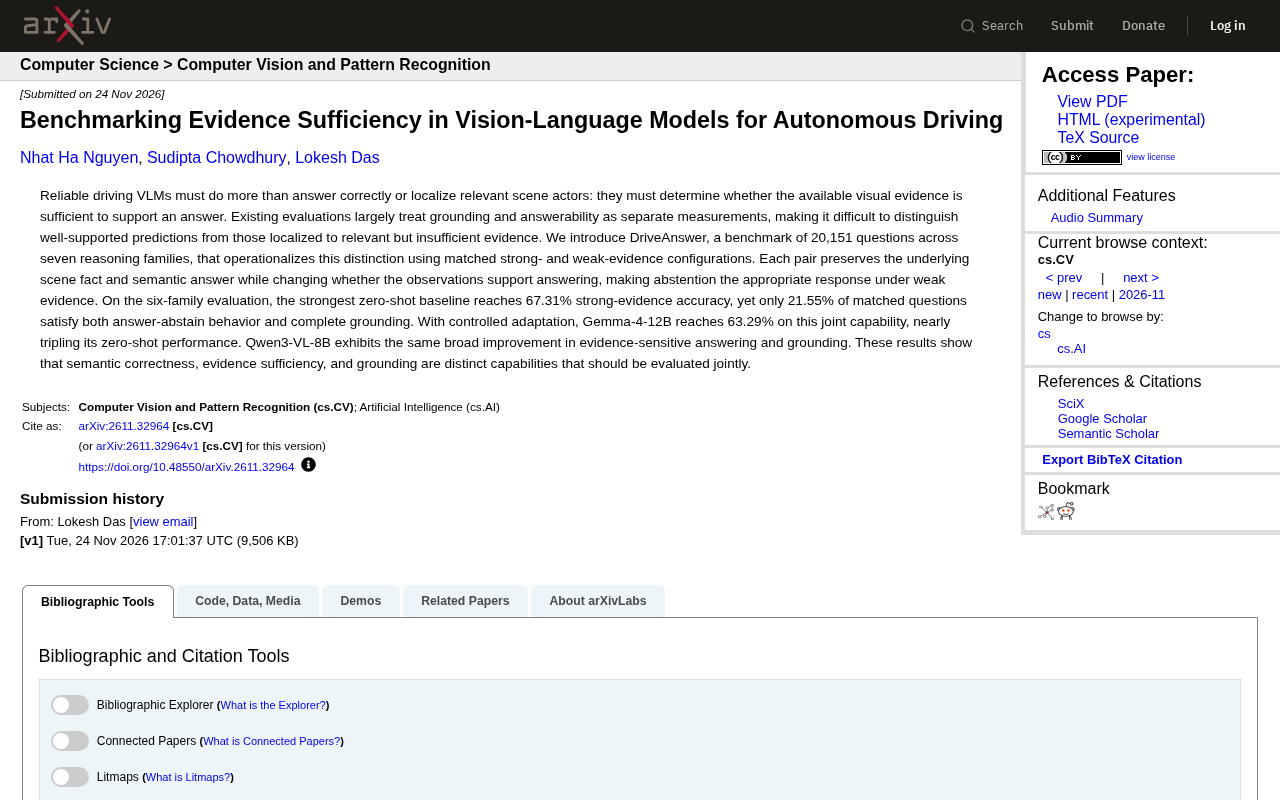
DriveAnswer uses a strong/weak evidence paired benchmark to reveal that correct answers do not equal sufficient evidence in autonomous driving VLMs.
The paper identifies a blind spot in autonomous driving VLM evaluation: answer correctness, evidence sufficiency, and visual grounding are independent capabilities, yet existing benchmarks evaluate them in isolation. It proposes DriveAnswer with 20,151 questions across seven reasoning families, using strong/weak evidence pairs where the same semantic answer should be given under strong evidence and abstained from under weak evidence. Results show the strongest zero-shot baseline achieves 67.31% strong-evidence accuracy but only 21.55% joint capability on matched questions; after controlled adaptation, Gemma-4-12B reaches 63.29%.
Autonomous driving vision-language models (VLMs) have long faced a blind spot in evaluation: does a model truly "understand" the scene just because it can answer questions correctly and localize relevant objects? A new paper points out that answer correctness, evidence sufficiency, and visual grounding are three independent capabilities, and existing benchmarks evaluate them in isolation—making it difficult to distinguish "predictions backed by sufficient evidence" from "predictions that merely localize relevant but insufficient objects." To address this, the researchers propose the DriveAnswer benchmark, which attempts to incorporate the dimension of "whether the evidence is sufficient to support the answer" into evaluation.
Core Issue: Correct Answers Do Not Equal Sufficient Evidence
In autonomous driving scenarios, VLMs need to judge whether the available visual evidence is sufficient to support a given answer—not merely produce a correct response or draw bounding boxes around relevant vehicles and pedestrians. The paper notes that most existing evaluations treat grounding and answerability as two independent metrics, making it hard to distinguish two types of predictions: those backed by sufficient evidence, and those that localize relevant objects but lack sufficient evidence to support the answer.
This distinction is especially critical in safety-critical driving scenarios. If a model insists on answering when evidence is insufficient—even if the answer happens to be correct—it reveals an unreliable reasoning process. The ideal behavior should be abstention under weak evidence, rather than relying on lucky guesses.
Grounding in the VLM context refers to the model's ability to map textual descriptions or reasoning targets to specific regions in an image (e.g., bounding boxes, masks), typically producing spatially directed judgments like "the pedestrian is in the lower-left corner of the frame." It follows a different pathway from question answering: QA focuses on semantically correct answers, while grounding focuses on spatial identification, and the intermediate representations they rely on do not fully overlap. As a result, a model may answer correctly but box the wrong object, or localize the right object but provide an answer lacking sufficient visual cues. What DriveAnswer emphasizes is precisely the misalignment between grounding and answer evidence sufficiency, rather than mere localization accuracy.
Answerability refers to whether, under given observation conditions, a question has a determinate answer supported by visual evidence. It is orthogonal to "whether the answer is correct": a question can be answerable and answered correctly, answerable but answered incorrectly, or should be judged unanswerable when evidence is insufficient. Explicitly modeling answerability is the prerequisite for teaching models to distinguish "I see enough information" from "I can only guess," and is also the foundation for evaluating abstention mechanisms.
DriveAnswer Design: Pairing Strong and Weak Evidence
DriveAnswer contains 20,151 questions spanning seven reasoning families. Its core design is "matched strong-evidence and weak-evidence configurations": each pair of questions preserves the same underlying scene facts and semantic answers, changing only whether the observation is sufficient to support an answer. In other words, the same question should be answered under the strong-evidence version and abstained from under the weak-evidence version, while the semantic answer remains consistent across both.
This paired design separates "evidence sufficiency" from answer correctness, enabling evaluation to directly test whether models possess evidence-sensitive judgment. The researchers conducted tests on six evaluation families, focusing on the joint capability of simultaneously satisfying "correct answer-abstain behavior" and "complete grounding."
Abstention refers to the model actively choosing not to give a determinate answer when evidence is insufficient, the question exceeds the determinable scope, or confidence is low—rather than forcing an output. In safety-critical scenarios, abstention is an expected default behavior: the cost of an incorrect answer is often far higher than not answering. The key to evaluating abstention capability lies in constructing counterexamples that "should be abstained from"; otherwise, a model can inflate accuracy by always answering. DriveAnswer's weak-evidence configurations are precisely such counterexamples, requiring the model to identify evidence gaps and stop while keeping the semantic answer unchanged—transforming abstention from a passive fallback into a measurable, active judgment.
Evaluation Results: Joint Capability Remains a Weakness
The results show that the strongest zero-shot baseline achieves 67.31% accuracy on strong evidence, but on matched questions, only 21.55% simultaneously satisfy the answer-abstain behavior and complete grounding requirements. This gap indicates that even when models can answer correctly when evidence is present, their ability to abstain when evidence is insufficient and to accurately localize when evidence is present remains quite weak.
After controlled adaptation, Gemma-4-12B reaches 63.29% on this joint capability—nearly three times its zero-shot performance. Qwen3-VL-8B also shows similar broad improvements in evidence-sensitive answering and grounding. This demonstrates that joint capability can be significantly improved through targeted training, rather than being a natural byproduct of model scale.
Zero-shot refers to evaluating a model directly using capabilities acquired from pre-training, without any fine-tuning or example prompting on the target task data. Zero-shot baselines reflect a model's out-of-the-box generalization level and are therefore often used as a reference for benchmark difficulty. In contrast, controlled adaptation involves adjusting the model with specific data or training signals before evaluation, to determine whether a capability can be acquired through targeted training. In this paper, Gemma-4-12B's improvement from approximately 21.55% zero-shot joint capability to 63.29% is achieved through controlled adaptation—a comparison showing that joint capability does not emerge naturally with model scale but requires dedicated data and training design to elicit.
Implications for Autonomous Driving VLM Evaluation
The paper's conclusions point directly at evaluation methodology: semantic correctness, evidence sufficiency, and visual grounding are three independent capabilities that should be evaluated jointly. Reporting only answer accuracy or grounding metrics masks the risk of models forcing answers when evidence is insufficient.
For autonomous driving systems, this finding means that pre-deployment evaluation needs to incorporate tests of abstention mechanisms and evidence sensitivity. DriveAnswer's paired paradigm offers an actionable approach: by constructing strong/weak evidence contrasts, it directly measures whether a model "knows when to stop when evidence is insufficient." This is closer to the reliability requirements of real driving scenarios than simply pursuing higher answer accuracy.
Conclusion
DriveAnswer turns "evidence sufficiency" from an implicit assumption into an explicit evaluation dimension, revealing a significant gap in current VLMs' joint capabilities. As vision-language models accelerate into the autonomous driving stack, benchmarks emphasizing abstention and evidence sensitivity may become an essential complement for measuring model reliability.
One-line Summary
DriveAnswer uses a strong/weak evidence paired benchmark to reveal that correct answers do not equal sufficient evidence in autonomous driving VLMs.
Paragraph Summary
The paper identifies a blind spot in autonomous driving VLM evaluation: answer correctness, evidence sufficiency, and visual grounding are three independent capabilities, and existing benchmarks evaluate them in isolation, making it difficult to distinguish predictions backed by sufficient evidence from those that merely localize relevant objects. To address this, the researchers propose the DriveAnswer benchmark, containing 20,151 questions across seven reasoning families, using a strong/weak evidence paired design—under the same scene facts and semantic answers, only whether the observation is sufficient to support an answer changes: strong evidence should be answered, weak evidence should be abstained from. Evaluation shows the strongest zero-shot baseline achieves 67.31% strong-evidence accuracy, but only 21.55% of matched questions simultaneously satisfy correct answer-abstain behavior and complete grounding; after controlled adaptation, Gemma-4-12B reaches 63.29% joint capability, nearly three times its zero-shot performance. The conclusion is that the three capabilities should be evaluated jointly, with tests of abstention and evidence sensitivity incorporated.
Related articles

Vibe Coding Full-Stack in Practice: How One Person Builds a Commercial-Grade Product with AI
An analysis of the Bilibili course Vibe Coding Full-Stack in Practice: how one person uses AI to complete requirements analysis, frontend/backend development, MySQL databases, cloud deployment, multi-platform Mini Program execution, and AI-driven operations promotion—mastering one-person-company AI engineering product development.
Hijacking a US Treasury Subdomain for $3: The Overlooked Vulnerability
An attacker can take over a US Treasury subdomain for just $3. This article explains how subdomain takeover works, the special risks facing government domains, and how organizations can close this low-cost security gap through asset discovery and DNS cleanup.

LoomKV: Lossless KV Cache Compression Extending from GPU Memory to SSD
LoomKV proposes lossless KV cache compression using head-wise calibrated two-level 3-bit codebooks to compress BF16 high bytes, operating on both external storage and the GPU KV pool. Tier mode delivers 2.7-3.6x effective throughput near the LRU cliff; pool mode holds 1.31-1.34x more GPU tokens, bit-identical to the original tier.