Drops: Discover New Music Through Friends' Musical Moments — HARMAN's Social Music Experiment

HARMAN launches social music app Drops, letting users discover music through interpersonal trust via 10-30 second snippets and stories.
HARMAN (JBL's parent company) has launched Drops, a social music app that redefines music discovery through "people" rather than algorithms. Users clip 10-30 second "Drops" from songs with lyrics, cover art, and personal stories to share. Others discover new music by browsing these snippets, follow trusted tastemakers, and save to Droplists. The product addresses the tension between private music consumption and active socializing by lowering the sharing barrier and packaging recommendations as stories. As a hardware maker's software play, Drops reflects HARMAN's intent to build an audio content ecosystem. Currently at 74 votes on Product Hunt, its network effects remain uncertain.
In an era where algorithmic recommendations dominate music discovery, HARMAN (the company behind JBL) has launched a social music app called Drops, attempting to redefine how we encounter new music through "people" rather than "playlists." The product recently ranked 9th on Product Hunt with 74 votes for the day. While the vote count isn't staggering, the product thinking behind it is worth examining.
When Music Discovery Returns to the "Human" Dimension
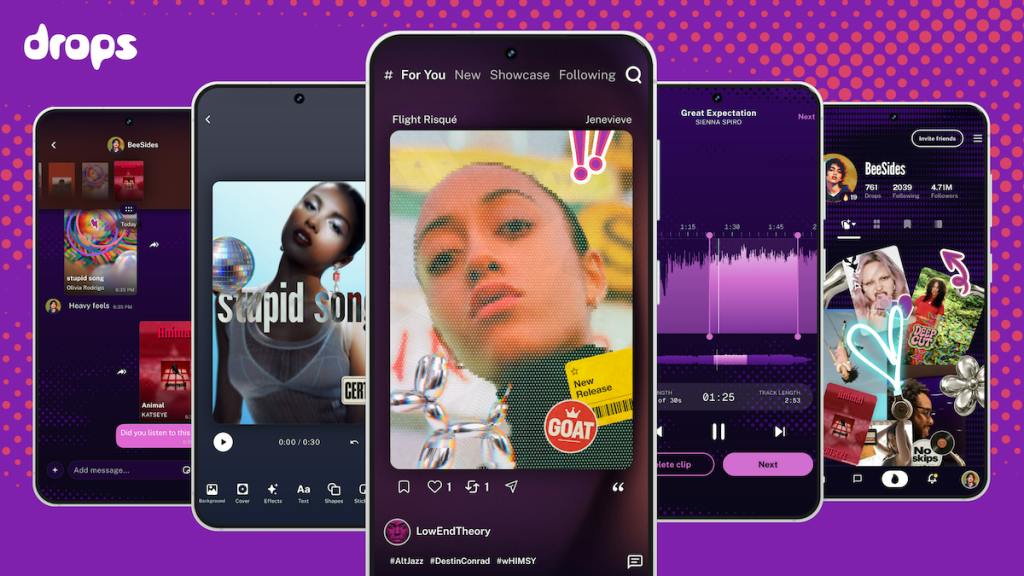
The core mechanism of Drops is simple: users clip 10 to 30-second "moments" (Drops) from songs they love, attaching lyrics, cover art, and a personal story explaining why this moment deserves to be shared. Other users can browse these snippets to discover new artists, follow people whose taste they trust, react to selections, and save favorite songs to "Droplists."
The interesting thing about this design is that it captures a frequently overlooked aspect of the music experience — the emotional impact of specific moments. A chorus, a line of lyrics, an interlude often triggers resonance more than the entire track. Drops turns these moments into social currency.
The name "Drop" itself carries a double meaning: it refers both to the "drop" in music (the energy-exploding section in electronic dance music) and hints at the act of "dropping" a snippet. In music terminology, a drop typically refers to the part of a song where rhythm and bass suddenly intensify and emotion reaches its peak — a key moment in DJ culture for energizing the dance floor. The Drops app borrows this term, calling user-clipped 10-30 second segments "Drops," echoing both the highlight moments of music and suggesting the lightweight, instantaneous nature of the sharing behavior. This naming strategy gives the product a natural connection to music culture, making it easy to resonate with target users.
The Old Problems of Social Music and New Solutions
Social music is not a new concept. From early Last.fm to later music social platforms, attempts to build social networks around music have been numerous, but few have succeeded. The core contradiction lies in the fact that music consumption is essentially private and accompaniment-based, while social interaction requires active expression and engagement.
Drops' solution is to lower the sharing threshold to an extremely small unit — no need to write lengthy reviews, just select a snippet under 30 seconds and add a line about "why." This lightweight form of expression transforms "sharing music" from the domain of professional critics into something ordinary users can easily participate in.
According to the Product Hunt page description, each Drop combines music, lyrics, artwork, and personal story. This multi-layered presentation essentially packages "recommendations" in "stories," giving the music discovery process emotional and interpersonal warmth.
Last.fm was a pioneer in social music, automatically recording users' listening behavior through its "Scrobble" mechanism and generating personal music profiles and recommendations based on listening data. However, Last.fm's social interaction revolved mainly around data statistics, lacking dimensions of active expression and emotional exchange, and ultimately failed to form a highly active community. Later music social products like Ping (launched by Apple) and Heard also attempted to combine social and music, but most failed due to insufficient sharing motivation or poor integration with streaming services. These cases show that simply recording or sharing song links struggles to inspire sustained interaction, while Drops' approach of "snippet + story" transforms sharing into a low-barrier creative act, potentially avoiding the pitfalls of its predecessors.
HARMAN's Software Ambitions
Drops comes from HARMAN, a company known for hardware (especially JBL audio equipment). This background is worth pondering. A hardware manufacturer making social software seems like a big leap on the surface, but in the context of the audio industry's broader trends, it makes sense: as hardware differentiation becomes increasingly difficult, the software ecosystem around audio content becomes a new competitive dimension.
If Drops can build a user community, HARMAN would gain a direct channel to reach music enthusiasts, which has potential value for user stickiness and brand rejuvenation of its headphones and speakers. Of course, Drops currently has only 74 votes and 1 comment, with community activity still in its early stages — whether it can form network effects remains unknown.
HARMAN International is a US-headquartered audio electronics company with numerous well-known audio brands including JBL, AKG, Harman Kardon, and Mark Levinson, while also providing audio solutions for automotive, professional performance, and consumer markets. In 2017, HARMAN was acquired by Samsung Electronics for approximately $8 billion, becoming an independently operated subsidiary of Samsung. In recent years, HARMAN has continued to expand in software and services, including in-vehicle infotainment systems, IoT audio platforms, and cloud services. The launch of Drops can be seen as an attempt to extend into the content ecosystem, aimed at enhancing the added value of hardware products through software and exploring new revenue models such as subscriptions or ad support.
The "Trust" Logic of Music Discovery
Drops emphasizes "following people whose taste you trust," which is essentially countering the homogenization problem of algorithmic recommendations. Algorithms excel at recommending similar content based on your historical behavior but easily fall into information cocoons; interpersonal trust-based recommendations, while potentially narrower in coverage, can bring more unexpected discoveries.
Whether this model can succeed depends on two key factors: first, whether it can attract enough music lovers willing to share; second, whether recommendation quality can be sustained. The 10-30 second snippet limit is a clever design — it lowers the creative cost while forcing users to select truly impactful moments.
Conclusion
Drops is currently just an early-stage product, but the question it raises is worth considering: in an era where algorithms understand us better and better, do we still need to discover music through "people"? HARMAN's answer is yes. Whether users will accept this answer remains to be tested by time.
One-line Summary
HARMAN launches social music app Drops, letting users discover music through interpersonal trust via 10-30 second snippets and stories.
Paragraph Summary
HARMAN (JBL's parent company) has launched a social music app called Drops, attempting to redefine music discovery through "people" rather than algorithms. Users clip 10-30 second "Drops" from songs, attaching lyrics, cover art, and personal stories to share. Other users discover new music by browsing these snippets, follow people with trustworthy taste, and save to Droplists. The product aims to solve the long-standing contradiction in social music between private consumption and active socializing, lowering expression costs through an extremely low-barrier sharing unit and packaging recommendations in "stories." As a hardware manufacturer's software attempt, Drops carries HARMAN's intention to build an audio content ecosystem and enhance user stickiness. Currently, the product has only 74 votes on Product Hunt with low community activity, and whether network effects can form remains to be seen.
Related articles

Anthropic's IPO: Is a $1.4 Trillion Valuation AI's Future or the Peak of a Bubble?
Anthropic is about to list on Nasdaq with a valuation of up to $1.4 trillion, potentially raising over $60 billion to become the second-largest IPO in history. This article breaks down its revenue, the truth behind its hundred-billion-dollar book loss, compute costs, control design, and lock-up pressure, and analyzes the IPO's chain effects on the AI sector.

Anthropic Races Toward Nasdaq: Ticker ANT, Can a Trillion-Dollar Valuation Hold?
Anthropic files its S1 for a Nasdaq IPO under ticker ANT, led by Goldman Sachs and Morgan Stanley. We break down revenue, massive compute lease commitments, founder voting control, and the valuation debate.

How Anthropic Uses a Four-Layer Narrative to Prop Up a $2 Trillion Valuation
Anthropic's estimated $2 trillion valuation: a breakdown of its positioning theory and four-layer narrative — civilization-level fear, identity, product, and business — and how founder essays, technical docs, and opinion leaders support the AI safety guardian valuation story.