Dropstone CLI: A Self-Learning Terminal Coding Agent

Dropstone CLI's core selling point is cross-session memory, aiming to make coding agents remember every user correction.
Dropstone CLI is a terminal coding agent ranked #10 on Product Hunt, featuring cross-session learning — after a user corrects an error once, the agent retains it in future sessions. It offers three model tiers (Fast, Pro, Heavy), command permission levels, skill extensions, custom agents, parallel sub-agents, and MCP tool access. GitHub integration enables auto-opening pull requests from issues. The free tier includes planning. However, key details about how cross-session learning works remain undisclosed.
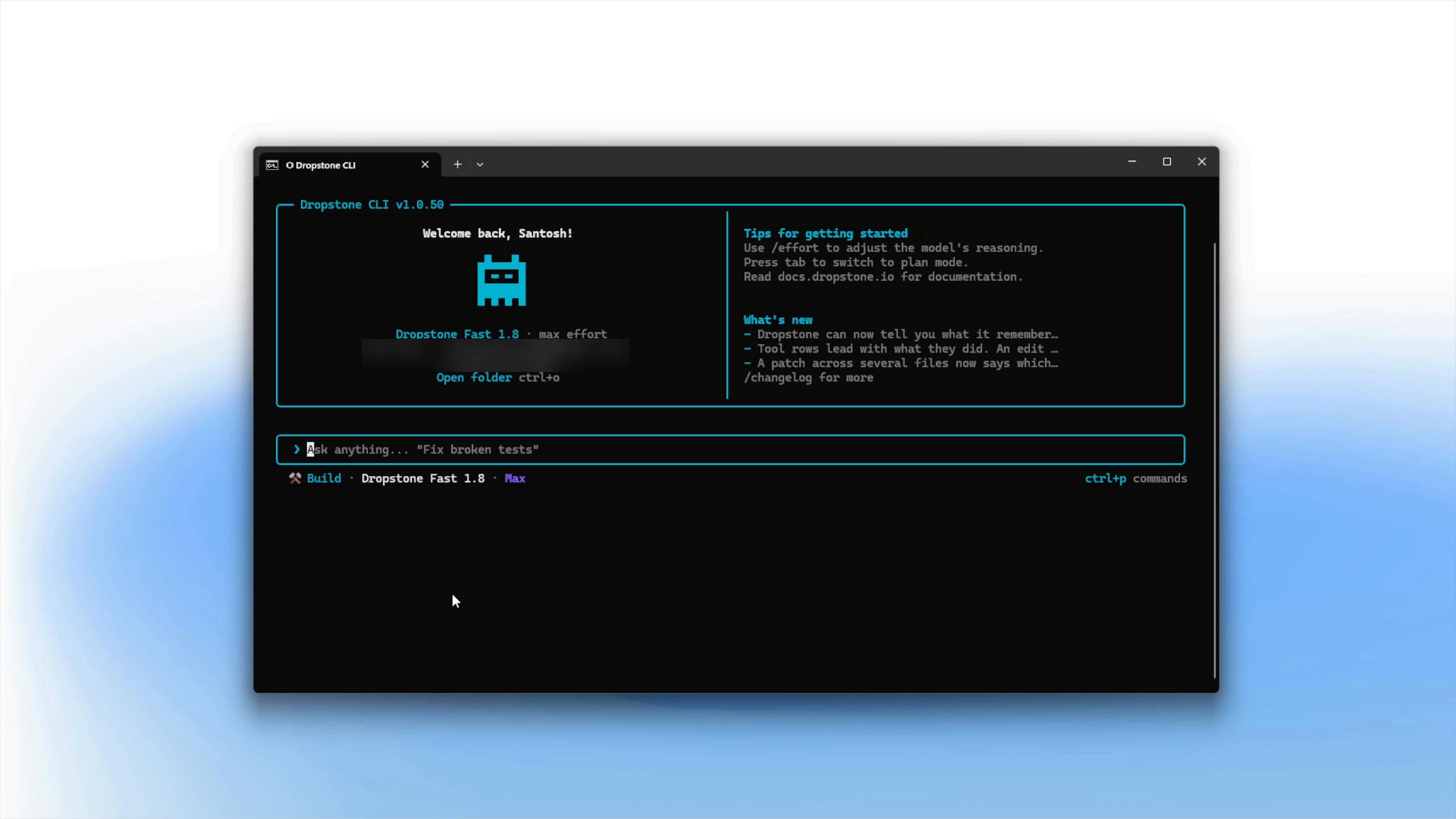
In today's fiercely competitive AI coding tools landscape, most products compete on model capabilities or completion speed. But Dropstone CLI, ranked #10 on Product Hunt, has chosen a different path — making the coding agent remember every correction you make. Positioned as a "self-learning coding agent," this terminal tool attempts to solve a long-overlooked pain point: what you teach AI, it forgets next time.
From "One-Off Conversations" to "Cross-Session Memory"
Dropstone CLI's core selling point is stated plainly: "Correct it once and it keeps the lesson across sessions." This means when you point out an error — such as how a project's test command should be written, or that a certain code style doesn't conform to team standards — that correction is retained, rather than disappearing when the conversation window closes.
This design approach hits a real dilemma in current coding agents. Whether it's a CLI tool in the terminal or an assistant inside an editor, most products' "learning" only happens within a single session's context window. Developers repeatedly correcting the same types of issues are essentially doing wasted work. Dropstone moves "learning" down from the model level to the tool level, solving the memory problem through product mechanisms rather than fine-tuning — a pragmatic engineering choice.
Context window is the maximum number of tokens a large language model can process in a single inference, determining how much information the model "sees" in one conversation. Current mainstream models' context windows range from tens of thousands to millions of tokens, but no matter how large the window, once the session ends, the information within it is no longer retained by the model. This is precisely the root cause of coding agents "repeatedly making the same mistakes": the developer's correction in the previous session only existed in that now-closed context window, and when a new session begins, the model faces a blank slate. Common industry approaches to solving this problem include fine-tuning (retraining the model with correction data — costly and time-consuming) and RAG (Retrieval-Augmented Generation, storing historical corrections in a vector database and retrieving them for injection during sessions). Dropstone's choice to do memory management at the tool level is essentially closer to an engineering implementation of the latter, though the specific mechanism used remains unclear.
Multiple Model Tiers and Controllable Execution Boundaries
Dropstone offers three model tiers: Fast, Pro, and Heavy, corresponding to different task complexities and cost considerations. This tiered strategy isn't novel, but it's bound together with a "plan first, then execute" workflow, forming a relatively complete operational chain: the agent first reads the repository, understands the structure, formulates a plan, then edits across files, runs commands and tests, and only claims completion after confirming everything is correct.
More noteworthy is the command permission design. Users can set which commands execute directly, which require confirmation first, and which are completely forbidden. For teams integrating AI agents into real engineering environments, this may be a more critical decision factor than model capability — nobody wants an autonomous agent running commands unrestrained in a production repository.
An Extensible Agent Ecosystem
Dropstone supports adding skills, custom agents, parallel sub-agents, and MCP tools. Parallel sub-agents mean complex tasks can be decomposed and handled by multiple agents simultaneously, consistent with the current trend of multi-agent collaboration. MCP (Model Context Protocol) integration allows the tool to call external data sources and services, expanding the agent's capability boundaries.
GitHub integration is another highlight: by leaving a comment under an issue, the agent can automatically open a pull request. This pushes the coding agent from "local assistant" to "workflow participant." However, currently available public information doesn't explain the specific implementation details and reliability of this integration.
MCP (Model Context Protocol) is a protocol standard proposed and open-sourced by Anthropic in late 2024, aimed at establishing a unified communication interface between AI models and external tools and data sources. Before MCP, every AI coding tool needed to develop its own connectors for databases, APIs, file systems, and other external resources, leading to duplicated effort and ecosystem fragmentation. MCP's approach is similar to the USB-C protocol — replacing diverse proprietary solutions with a single standard interface. In the coding agent context specifically, MCP servers can expose capabilities such as code repository queries, document retrieval, and CI/CD status checks, with agents calling these services through standardized request formats. For tools like Dropstone, MCP integration means being able to quickly expand the data range and operation types accessible to the agent without adapting to each external service individually — which is the core reason current coding agent tools broadly embrace MCP.
Free Strategy and Information Gaps
Dropstone includes planning functionality in every plan, including the free version. For a new tool, putting core planning capabilities in the free tier is a reasonable means of building user trust.
Frankly, publicly available information about this product is quite limited — the data of 80 upvotes and 2 comments also indicates it's still at an early stage. How exactly "cross-session learning" is implemented (whether it stores correction records, generates rule files, or uses some other mechanism), where the boundaries of learning effectiveness lie, and which specific models each tier corresponds to — these key questions aren't answered on the product page. For a tool that touts "self-learning," the degree to which the learning mechanism is a black box directly determines whether users can build trust.
Dropstone CLI represents an interesting product direction: not pursuing a stronger base model, but making the agent more "obedient" through memory mechanisms and workflow control. Whether this path succeeds depends on whether its implementation of "learning" is transparent and reliable enough.
One-line Summary
Dropstone CLI's core selling point is cross-session memory, attempting to make the coding agent remember every user correction.
Paragraph Summary
Dropstone CLI is a terminal coding agent tool ranked #10 on Product Hunt, featuring "cross-session learning" — after a user corrects an error once, the agent retains that experience in subsequent sessions rather than forgetting it when the conversation window closes. The product offers Fast, Pro, and Heavy model tiers, supports command execution permission levels (execute directly/ask first/forbidden), and integrates skill extensions, custom agents, parallel sub-agents, and MCP tool access. GitHub integration allows the agent to automatically open a pull request after leaving a comment under an issue. The free version includes planning functionality. However, publicly available information about the product is currently limited — the specific implementation mechanism of cross-session learning, the boundaries of learning effectiveness, and the specific models corresponding to each tier are all undisclosed. These information gaps are key obstacles to building user trust for a tool that touts "self-learning."
Related articles

How Big Can Stars Really Get? The Physical Limits of the Largest Stars
Red supergiants are the largest stars by volume, with radii up to 2,000 times the Sun, engulfing the inner solar system. But there is no precise upper limit on stellar size—models predict up to 15,000 solar radii. The most massive blue stars are far smaller than red supergiants—biggest and heaviest are two different things.

Apple HomeView Smart Display Full Feature Breakdown: Wall-Mount or Desktop, $299
Apple launches HomeView, a $299 smart display with wall-mount and desktop options, 12MP camera for facial recognition, smart home control, music playback, and recipe step-by-step cooking. Full breakdown of watch faces, apps, privacy, and cooking integration.

Where Did the Promised New Studio Go? Craft Computing Answers After Five Years
Craft Computing's host responds to viewer questions: the new studio promised five years ago was shelved as construction costs soared from $30,000 to $75,000, and was replaced by a 168-square-foot garage conversion.