dsh-purge Community Edition: The Armor-Breaking Patch Tool for DeepSeek Harness

dsh-purge: a community-maintained local DeepSeek Harness patch tool emphasizing visibility and rollback.
dsh-purge is a local tool that runs on the user's machine and provides host patches for DeepSeek Harness, including 86 host patches and a 25-layer state self-check mechanism. Originally created by developer "Xiaoyang," the repository was once deleted and is now independently maintained by the community under the MIT license. The namesake GitHub repository has 5,630 stars, the highest among similar projects. The tool sets out four design principles: local-first, fully visible, rollback anytime, and don't decide for you—addressing the two major concerns of privacy and security, and controllability. It provides commands such as self-check, diagnose, backup, rollback, preset, and probe covering the full patch lifecycle, and can be used with DSH Quest Studio. The article also notes that patch stability depends on host version adaptation and recommends backing up first, self-checking next, and then applying.
In today's increasingly complex AI development toolchain, a local patch tool called dsh-purge is gaining attention on GitHub. Designed specifically for DeepSeek Harness, this tool carries forward its original development philosophy through community maintenance and has now become the most-starred project in its namesake repository.
What Is dsh-purge?
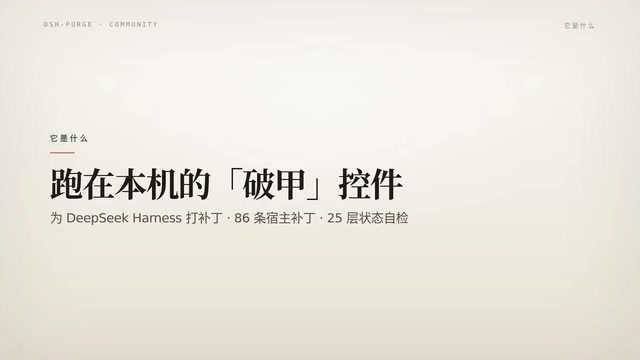
dsh-purge is a patch tool that runs on the user's local machine, with its core function being to provide host patch support for DeepSeekAd Harness. According to the Bilibili video introduction, the tool includes 86 host patches and a 25-layer state self-check mechanism, and offers a full page of settings options in the left sidebar.
In terms of positioning, it is more like an "enhancement layer" for DeepSeek Harness—it does not change the host's core logic but instead optimizes the user experience through patching. This design approach is fundamentally different from traditional forks or source code modifications, allowing users to gain additional functionality without breaking the original environment.
From Personal Project to Community Maintenance
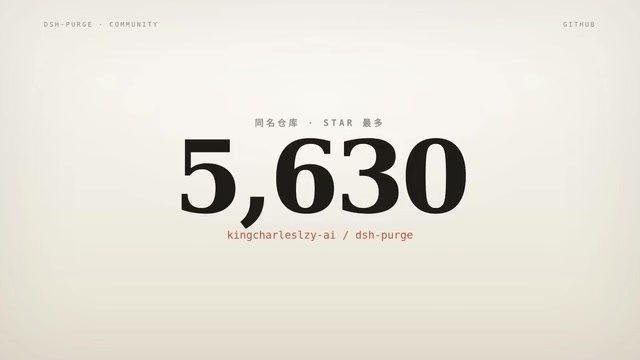
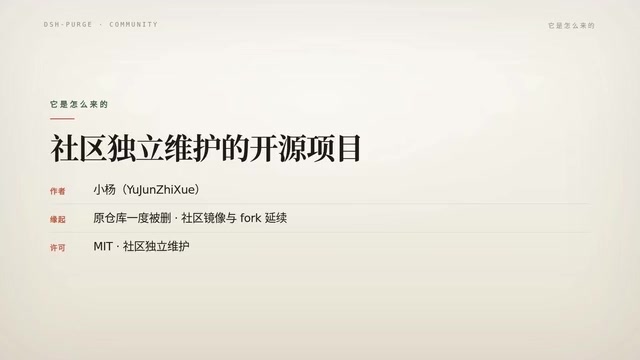
dsh-purge was originally created by developer "Xiaoyang," but the repository was once deleted. Today the project is independently maintained by the community under the MIT open-source license, hosted in the namesake GitHub repository. According to the video, the repository currently has 5,630 stars, placing it in a leading position among similar projects.
This winding development history reflects a typical phenomenon in open-source communities: individual projects may be interrupted for various reasons, but as long as there is real demand and an active user base, the community can often carry the work forward. The choice of the MIT license also provides a legal foundation for this continuity, allowing anyone to freely use, modify, and distribute the code.
The MIT License is a permissive open-source license drafted by the Massachusetts Institute of Technology in the 1980s for the X Window System project. It only requires users to retain the copyright notice and license notice when distributing the software; it does not restrict commercial use, modification, or redistribution, nor does it require derivative works to be open-sourced under the same license (in contrast to GPL's copyleft). Because of these minimal constraints, MIT has become one of the most widely adopted licenses on GitHub. For a community-continued project like dsh-purge, the MIT license means any developer can fork, patch, and republish it, and the original author's departure poses no legal obstacle—an important prerequisite for the project's independent continuation by the community after the repository was deleted.
Four Design Principles
dsh-purge explicitly sets out four design principles that form the tool's core philosophy:
- Local-first: All operations are completed locally without relying on cloud services, and user data never leaves the machine
- Fully visible: Patch installation, operation, and state changes are transparent to users, with no hidden operations
- Rollback anytime: Any modification can be undone, reducing the risk of trying new features
- Don't decide for you: The tool offers options rather than imposing behavior, preserving user control
These four principles address two core concerns developers have about utility software: privacy and security, and controllability. In an era where more and more people care about data sovereignty, the design philosophies of "local-first" and "fully visible" have real-world significance.
Data sovereignty refers to the right of individuals or organizations to control the data they generate and store, including the right to decide where data is stored, who can access it, and how it is used. In the context of AI toolchains, this concept often stands in contrast to practices such as cloud inference, telemetry reporting, and account binding. dsh-purge's "local-first" principle is an engineering response to data sovereignty: patches and state checks are all executed locally, and sensitive configurations and runtime data never leave the user's device, thereby avoiding risks arising from changes in third-party service policies or data breaches. For developers handling private code repositories or compliance-constrained data, this localized design is often more appealing than feature richness.
Common Commands and Companion Tools
dsh-purge provides a set of common commands for managing the patch lifecycle:
self-check: Run a self-check to verify the current statediagnose: Diagnose problems and locate anomaliesbackup: Back up the current configurationrollback: Roll back to a previous statepreset: Apply preset configurationsprobe: Probe environment information
These commands cover the complete workflow from installation to maintenance. The paired use of backup and rollback is especially important—back up before trying a new patch, and quickly restore if problems arise, which is consistent with the "rollback anytime" design principle.
The video also mentions that dsh-purge can be used together with DSH Quest Studio to perform model modifications in a local environment or an authorized environment. The stated goal is "less interruption, more continuity"—that is, reducing the attention cost caused by switching tools so developers can focus more on core work.
Idempotency is a key property in patch and configuration management tools, meaning that performing the same operation multiple times has the same effect as performing it once. For dsh-purge, if commands such as preset and backup are idempotent, users can safely run them repeatedly without accumulating unexpected patch states or overwriting valid backups. The value of self-check and diagnose also partly comes from this: they can re-verify at any time whether the current state matches expectations, rather than relying on the user to remember the last operation. When designing patch tools, idempotency and the "rollback anytime" principle usually appear together, jointly reducing the cognitive burden of repeated experimentation.
Use Cases and Caveats
In terms of functional positioning, dsh-purge is suitable for the following scenarios: extending functionality without modifying DeepSeek Harness source code, developers who want to maintain local data isolation, and experimental environments that require frequent configuration switching and quick rollback.
It should be noted that, as a patch tool, dsh-purge's stability depends on adaptation to the host version. Although the 86 host patches and 25-layer state self-check provide fairly comprehensive coverage, when DeepSeek Harness itself undergoes major updates, the patches may need corresponding adjustments. The advantage of the community maintenance model is responsiveness, but it also means users need to keep an eye on the project's latest developments.
For developers who want to try it, it is recommended to first back up the environment using the backup command, then run self-check and diagnose to understand the current state, and finally choose preset or manually apply patches as needed. The entire process follows the principles of "local-first, fully visible," and if problems arise, simply rollback at any time.
Related articles

Michael Nielsen Takes Down His Classic Neural Network Textbook, Sparking Community Discussion
Michael Nielsen's classic free textbook Neural Networks and Deep Learning has been taken offline, sparking discussion on Hacker News about the reasons and impact.

Inside the AI Training Data Market: The Trade-off Between Exclusivity and Discounts
G2i founder Gabe Greenberg reveals the dual-track pricing of the AI training data market: labs pay a premium for exclusive data or accept discounts that allow others to buy it.

SessionGraph: Unifying All Coding Agent Sessions in One Interactive Graph
SessionGraph aggregates coding agent sessions into an interactive graph, helping developers review, debug, and manage AI coding workflows across sessions. This article examines its positioning, value, and open questions.