Dual Sparsity in Refusal Mechanisms: How Transformers Build Their Safety Guardrails

New research shows LLM refusal behavior is driven by dual-layer sparse mechanisms across a small subset of components and dimensions.
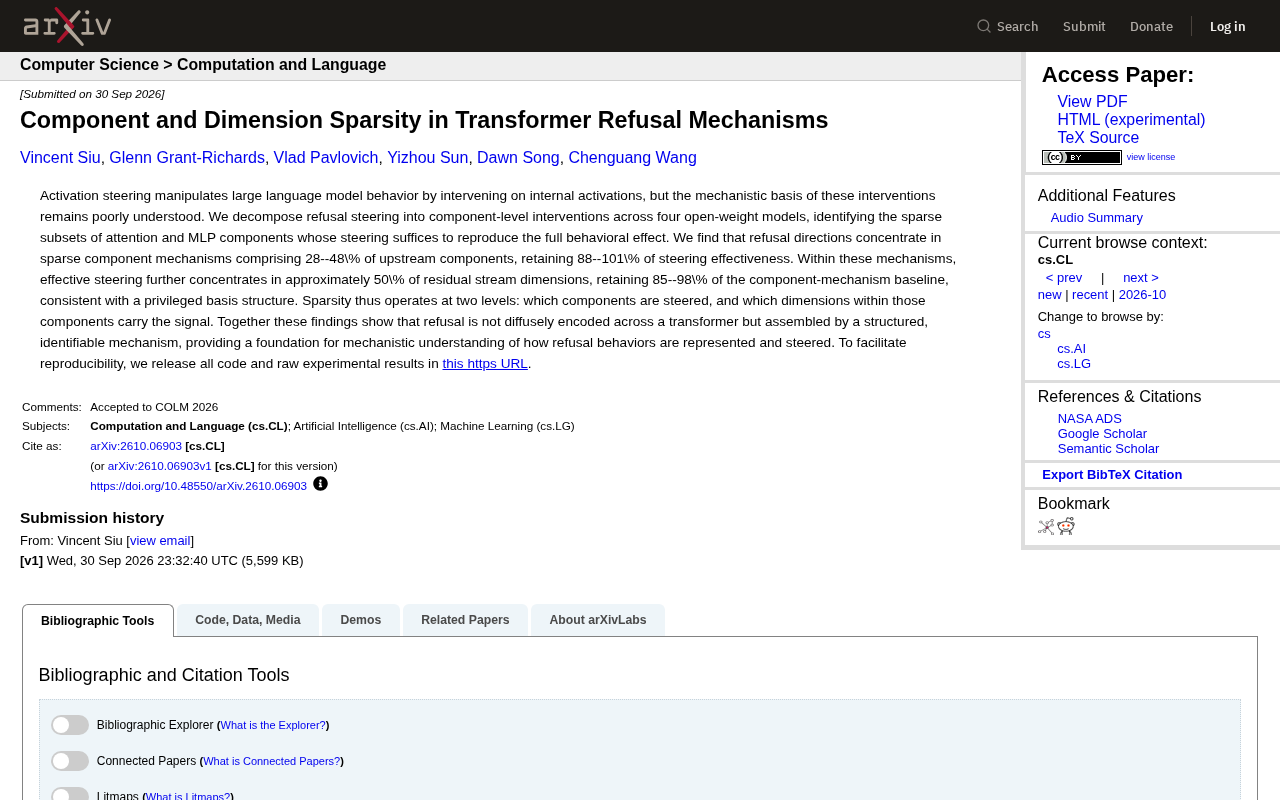
A new study (arXiv:2610.06903) using Activation Steering systematically deconstructs the refusal mechanism in large language models, finding it is not diffusely encoded across the network but concentrated in a sparse set of structured components. Across four open-weight models, just 28%–48% of upstream components retain 88%–101% of the full refusal steering effect; within those components, only ~50% of residual stream dimensions carry 85%–98% of the signal — consistent with a privileged basis structure. This dual sparsity at the component and dimension levels means the model's safety guardrails have a precisely localizable physical basis, offering a clear entry point for mechanistic interpretability, jailbreak analysis, and targeted safety interventions.
The "refusal" behavior of large language models — where a model recognizes a harmful request and declines to respond — has long been treated as an impenetrable black box. A new study published on arXiv (arXiv:2610.06903) uses Activation Steering to decompose the refusal mechanism down to the component level, revealing a critical finding: refusal is not diffusely encoded across the entire Transformer network, but is instead assembled from a structured, identifiable set of sparse mechanisms.
Background: Activation Steering and Refusal Mechanisms
Activation Steering is a technique for controlling LLM behavior by intervening in the model's internal activations. Researchers can inject vectors in specific directions into the model's residual stream to amplify or suppress certain behavioral tendencies. Refusal behavior is one of the most closely studied targets — it directly relates to a model's safety alignment.
Yet despite the practical effectiveness of such interventions, the underlying mechanistic basis has remained opaque. We know we can "steer" a model to refuse a request, but we don't know which parts of the network this steering actually acts on, or how it works. This study sets out to answer: where exactly is the refusal signal hiding in the model?
The residual stream is the core information channel in the Transformer architecture. In a standard Transformer, each layer's attention heads and MLP modules interact with the residual stream in a "read-process-write" fashion: they read information from the residual stream, perform their computations, and add the results back to the same vector. This additive accumulation structure makes the residual stream a global information bus running through the entire network — the residual stream vector at each position is progressively built up layer by layer, ultimately determining the model's output distribution. This is precisely why Activation Steering chooses to inject external vectors into the residual stream: doing so is equivalent to intervening at the main trunk where information converges, with influence propagating through subsequent layers and being amplified by downstream components. Understanding this architectural role of the residual stream is a prerequisite for understanding why this research can precisely manipulate refusal behavior through "directional injection."
Component-Level Sparsity: A Small Subset Carries the Full Effect
The research team decomposed refusal steering into component-level interventions across four open-weight models, examining the contributions of attention and MLP components one by one. The core finding: the refusal direction is highly concentrated in a small fraction of components.
Concretely, a sparse subset comprising just 28%–48% of upstream components was sufficient to retain 88%–101% of the full steering effect. In other words, intervening on fewer than half of the components can almost entirely reproduce the model's refusal behavior. This implies that the vast majority of components contribute almost nothing to the refusal mechanism — the components that actually "pull the trigger" form a far leaner subset than previously imagined.
This finding has direct implications for understanding model behavior: if the components that refusal depends on are sparse and localizable, then safety-focused analysis and intervention have a clear entry point, rather than requiring an aimless search across the entire network.
Dimension-Level Sparsity: Evidence for Privileged Basis Structure
The study's second layer of findings is even more granular. Within the effective component mechanisms identified above, the steering effect is further concentrated in approximately 50% of the residual stream's dimensions — and this subset retains 85%–98% of the component-level baseline effect.
This means sparsity exists simultaneously at two levels: the first is "which components are steered," and the second is "which dimensions within those components carry the signal." The researchers argue that this phenomenon is consistent with a privileged basis structure — that is, certain specific dimensions in the residual stream play a preferential role in representing the refusal signal, rather than information being uniformly distributed across all dimensions.
This observation echoes a long-standing debate in interpretability research: do the internal representations of neural networks have natural, alignable coordinate axes? The dual sparsity of the refusal mechanism provides concrete empirical support for this hypothesis.
The concept of a privileged basis originates in neural network interpretability research, and is closely associated with work from the Anthropic team. In general, neural network internal representations are thought to be "rotationally invariant" — meaning information can be equivalently expressed in any rotated coordinate system, with no direction being inherently more "special" than another. However, certain network architectures (such as MLP layers with ReLU activations, or models trained through specific procedures) can break this rotational symmetry, causing standard coordinate axis directions (i.e., one-hot directions) to correspond to interpretable features — these are called a "privileged basis." This study's finding that refusal signals concentrate in roughly 50% of fixed residual stream dimensions is a classic signature of privileged basis structure: the signal is not diffusely spread across all directions, but is preferentially encoded along certain coordinate axes, making dimension-by-dimension analysis a viable research path.
Implications for Mechanistic Interpretability Research
The value of this work lies in grounding an abstract safety behavior in concrete, localizable, and quantifiable structure. Previously, there was a tendency to assume that complex behaviors in deep networks are "distributed" encodings — difficult to precisely decompose. This research demonstrates that, at least for refusal, the behavior is assembled from structured, identifiable mechanisms.
This provides a firm foothold for mechanistic interpretability. Once researchers can precisely localize the components and dimensions where the refusal signal resides, they can conduct more targeted investigations into model safety alignment, potential jailbreak vulnerabilities, and how to adjust safety boundaries without degrading the model's overall capabilities.
To ensure reproducibility, the research team has made all code and raw experimental results publicly available, hosted on GitHub (wang-research-lab/Refusal_Mechanisms), enabling subsequent researchers to verify and build upon these findings.
Mechanistic interpretability is a subfield of interpretability research whose goal is to reverse-engineer neural network behavior into concrete, understandable algorithms or circuits. Unlike behavioral interpretability, which focuses on input-output relationships, mechanistic interpretability attempts to go inside the network and identify "which neurons/attention heads/weight matrices are performing what computations." Representative works include the complete circuit reconstruction of the indirect object identification (IOI) task in GPT-2, and the discovery of modular arithmetic circuits in arithmetic operations. The study of refusal mechanisms follows this same approach: once a safety behavior can be grounded in specific components and dimensions, one can further ask what internal algorithms those components are executing, and at exactly which step adversarial jailbreak attacks manage to circumvent this machinery.
Conclusion
Based on systematic analysis across four open-weight models, the refusal mechanism exhibits a clear two-level sparse structure: a small number of components are sufficient to drive the complete behavior, and within those components, only roughly half of the dimensions actually carry the signal. This finding not only deepens our understanding of how safety behaviors are constructed inside large language models, but also lays a methodological foundation for future fine-grained safety interventions and interpretability research. When a model's safety guardrails are no longer a black box, targeted hardening and auditing finally become genuinely possible.
Related articles

Costco Tech Price Guessing: Are Monitors, Keyboards, Mice, and Bose Speakers Worth It?
A YouTube blogger guesses prices of Costco tech products: 2K 180Hz monitor, Logitech keyboard and mouse, Bose speaker, and CyberPower UPS, revealing warehouse-store selection and brand premium.

AT&T Partners with OpenAI to Build AI Legal Workflow: An Intelligent Transformation of 150 Years of Experience
AT&T and OpenAI launch Legal Edge to rebuild legal services with AI: a shared knowledge layer, natural language intake, and decision-making kept with lawyers.

How Does ChatGPT Work Turn Notes into AI Training Packages?
RealPage's Director of AI Enablement Austin Bram shares how he uses ChatGPT Work to quickly transform personal notes and source materials into complete AI training enablement packages, providing personalized, consistent AI education for different teams and roles and improving employees' AI application capabilities.