How Does ChatGPT Work Turn Notes into AI Training Packages?

RealPage uses ChatGPT Work to quickly transform personal notes into personalized AI training enablement packages.
The article introduces the practice of Austin Bram, Director of AI Enablement at RealPage: he needs to continuously create personalized AI training materials for different teams, roles, and skill levels, and the traditional approach involves a lot of repetitive work and is inefficient. With ChatGPT Work, he directly transforms his ideas, notes, and source materials into complete enablement packages, forming an automated "input–transformation–output" workflow. The article points out that this model solves the pain point of "tailoring to each individual" in enterprise AI training, saving time while improving content consistency; however, human judgment and domain knowledge remain the starting point, and AI is responsible for organizing, expanding, and formatting. For enterprises, the implication is to establish dedicated AI enablement roles, build a source material library, and turn AI training into a reproducible production process.
In today's world where AI tools are increasingly widespread, how enterprises can efficiently transform scattered notes, ideas, and materials into actionable training content has become a key challenge in AI enablement. Austin Bram, Director of AI Enablement at RealPage, shared his practice: using ChatGPT Work to rapidly package personal notes and source materials into complete AI training solutions, thereby providing more relevant and consistent AI education for different teams and roles. Although this case is brief, it reveals the real value of AI in workflows—not replacing thinking, but accelerating the organization and distribution of knowledge.
From Notes to Training Packages: The Workflow of an AI Enablement Director
According to a video shared by RealPage on YouTube, Austin Bram's daily work is to help team members understand how to use AI in practical ways to improve their daily work. This means he needs to continuously create personalized training materials for different teams, different roles, and different skill levels. In the traditional approach, this often involves a great deal of repetitive work: organizing notes, designing course structures, creating presentation slides, and so on. Austin uses ChatGPT Work to directly transform his ideas, notes, and source materials into complete enablement packages.

The core of this workflow lies in the automation of "input–transformation–output." Users only need to provide raw materials, and ChatGPT Work can generate structured training content. Austin emphasized that this helps him provide more relevant and consistent AI education, enabling RealPage members to use AI more effectively and create better outcomes for customers and the business.
Why Personalized Training Needs AI Acceleration
The pain point of enterprise AI training lies in "tailoring to each individual." Different departments (such as sales, customer service, and engineering) have vastly different needs for AI, and within the same department, employees with different levels of experience also need content at different depths. Austin mentioned that he "continuously creates personalized training materials," which implies the inefficiency of doing it manually. The value of ChatGPT Work lies in quickly adapting general materials to specific scenarios—for example, rewriting an AI prompt guide into a case collection tailored to the customer service team.

This acceleration not only saves time but also improves content consistency. When training materials are generated from the same set of source materials and a standardized process, the core information received by different teams will not deviate—this is especially important for large enterprises.
"Enablement package" is a common concept in the field of corporate learning and development, usually referring to a complete set of directly deliverable training resources designed for a certain position or competency goal, generally including learning objective descriptions, explanatory materials, presentation outlines, case studies or practice tasks, assessment questions, and follow-up practice guidance. Its core features are "ready to use" and "goal alignment": the content is organized around the capabilities required for a specific role, rather than a pile of scattered knowledge points. In AI training scenarios, enablement packages also need to reflect elements such as prompt templates, tool operation steps, and risk precautions. Understanding this concept helps grasp the output form of Austin's workflow—ChatGPT Work does not merely generate a document, but reorganizes notes into a structurally complete teaching unit that can be distributed directly.
The Practical Role of ChatGPT Work in Building Enablement Packages
The specific operation Austin described is: using ChatGPT Work to "transform my ideas, notes, and source materials into complete enablement packages." The "enablement packages" here may include training documents, presentation outlines, practice tasks, and assessment questions. Although the video does not show the specific interface, it can be inferred that ChatGPT Work supports multi-turn conversations and file uploads, and can understand context and generate structured output.

It is worth noting that Austin does not regard AI as a fully automated tool, but emphasizes "my ideas" as the starting point. This means that human judgment and domain knowledge remain central, and AI is responsible for organizing, expanding, and formatting. For practitioners in other AI enablement roles, this model can be directly borrowed: first accumulate high-quality source notes, then use AI to generate customized training materials in batches.
"Source material" refers to high-quality input that is screened and accumulated by humans before AI generation, such as personal work notes, internal cases, product documentation, best practice checklists, and past training feedback. Its relationship with AI-generated content is similar to "raw materials and processed products": the model is responsible for organizing, expanding, and formatting, but the accuracy and scenario relevance of the content depend on the quality of the source materials. The value of building a source material library lies in reusability and consistency—the same batch of source materials, combined with different generation instructions, can quickly produce variants for different roles such as sales, customer service, and engineering, while ensuring that the core information does not drift. This also explains why Austin emphasizes that "my ideas" are the starting point: source materials carry domain judgment and are the key constraint that prevents AI output from being vague or distorted.
Implications for Enterprises: AI Education Needs a "Reproducible Production Process"
The RealPage case shows that AI training should not be a one-off lecture or document, but a reproducible production process. Through ChatGPT Work, Austin established an assembly line from notes to training packages, enabling AI education to cover different roles at scale. The result is "more relevant and consistent AI education," ultimately pointing to better customer outcomes and business performance.

For enterprises hoping to improve employees' AI capabilities, three points can be borrowed: first, establish a dedicated AI enablement role responsible for content production; second, build a source material library (notes, cases, best practices) as input for AI generation; third, use tools such as ChatGPT Work to achieve rapid iteration of training materials. It should be noted that this case comes from a single enterprise's practice, and its effects may be influenced by organizational size and culture, but the workflow logic is universal.
Conclusion
Although Austin Bram's sharing is brief, it clearly demonstrates the implementation path of ChatGPT Work in enterprise AI training: starting from personal notes, using AI as an accelerator, and producing personalized enablement packages as output. In today's world where AI tools are increasingly homogenized, the real difference lies in how tools are embedded into specific workflows. RealPage's practice provides a reusable template that is worth referencing for AI enablement practitioners.
Related articles
Transitioning from Traditional Development to LLM Application Development: Avoiding the Three Hurdles 90% of Courses Don't Teach
Traditional backend developers transitioning to LLM application development face three real hurdles—model capability boundaries, requirement judgment, and effect evaluation—not math. This article breaks down the core engineering skills 90% of courses don't teach and offers a practical transition path.
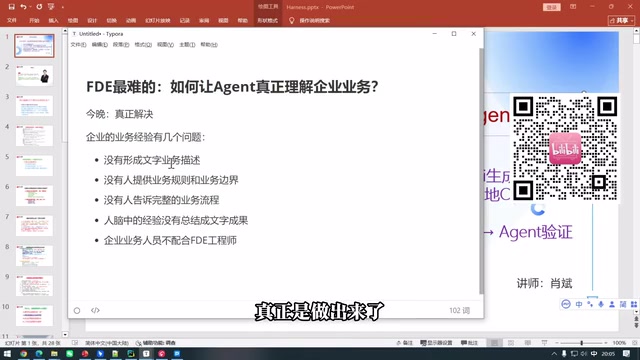
LLM WIKI in Practice: Making Agents Truly Understand Enterprise Business — Building a Troubleshooting Agent from Scratch
Inaccurate agent responses stem from a lack of business understanding. Based on a real order customer service troubleshooting agent case, this article explains how LLM WIKI builds a business knowledge base from codebases, uses incremental updates, and connects to agents via MCP server to achieve business understanding and troubleshooting with zero documentation.

A Computer Science PhD's Take: AI Career Planning for New Graduates — Algorithm vs. Application Development
A CS PhD advises new graduates on AI careers: try algorithm roles first but don't fixate; application development has more openings. Focus on LLM fine-tuning/deployment and agent frameworks (MetaGPT, LangChain), and watch AI + industry implementation to broaden job paths.