Duet: The Next Evolution of Chatbot Interaction
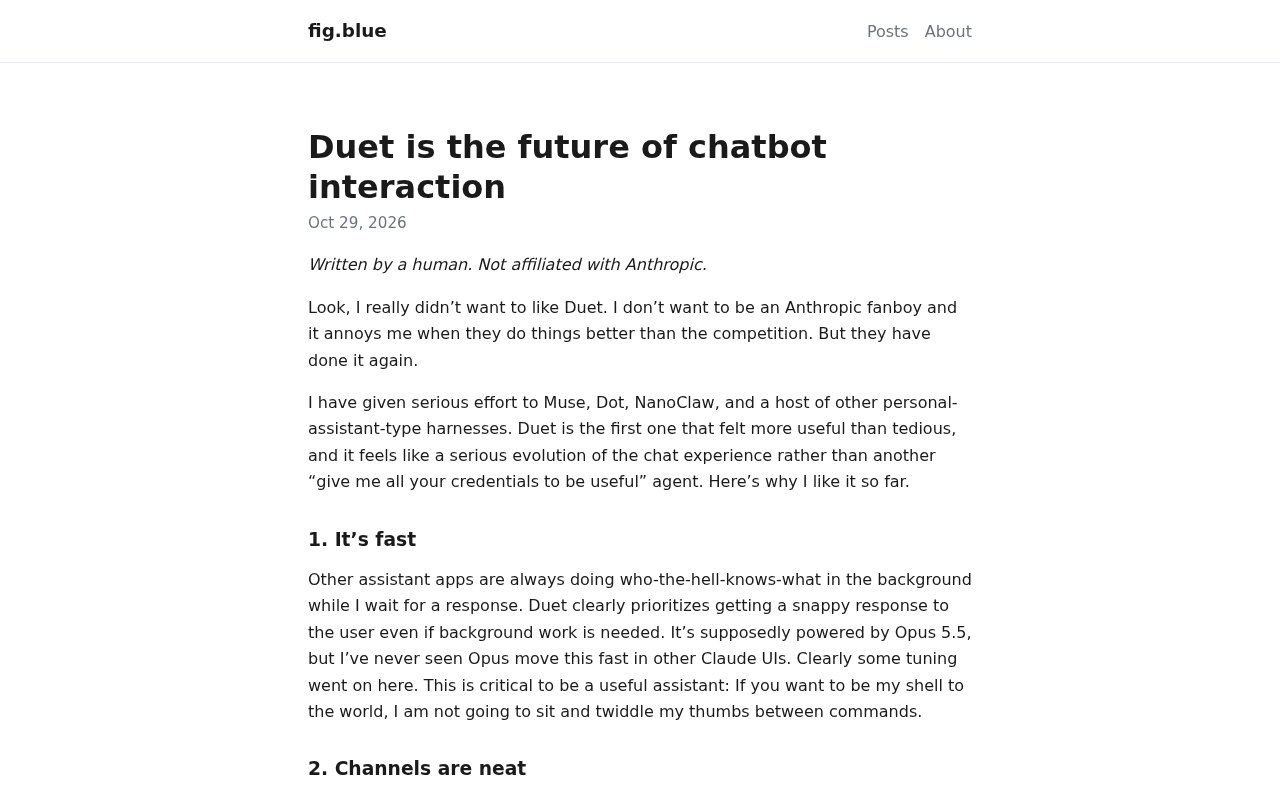
The focus of chatbot competition is shifting from model capability to interaction structure, and Duet-style paired interaction may be the breakthrough direction.
Based on a low-engagement Hacker News discussion, the article argues that the bottleneck of chatbots has shifted from generation capability to collaboration capability, and that interaction structure, rather than the model itself, will become the key differentiator. The "paired" interaction represented by Duet differs from the traditional "command—response" model by emphasizing three core features: bilaterally visible working state, dynamic role switching, and a shared-context workspace. The article argues that this shift captures the trend of product competition moving from model parameters to user experience, but implementation still requires solving issues such as permissions and privacy, interruption timing, and state synchronization costs. Because the original source material is limited, the specific form of Duet remains unclear, and the conclusion is more a directional inference than a verified solution.
Chatbots are already deeply embedded in workflows, but their interaction model remains stuck at the primitive stage of "single-turn Q&A"—the user inputs, the model replies, the user inputs again, the model replies again. A discussion on Hacker News titled "Duet is the future of chatbot interaction" (13 points, no comments yet) puts forward a judgment worth taking seriously: the competitiveness of future chatbots lies not in the model itself, but in the interaction structure. The "dual-line/paired" interaction model represented by Duet may be the key direction for breaking through the current conversational impasse.
From "Q&A" to "Pairing": A Shift in Interaction Paradigm
Current mainstream chatbot products are essentially "command—response" systems. The user bears almost all of the structural work: breaking down tasks, organizing context, judging output quality, and deciding the next follow-up question. The model is only responsible for a single generation, and the continuity of the interaction depends entirely on the user's memory and patience.
The Duet framing redefines this relationship as "pairing"—not a human issuing commands to a machine, but a human and a machine advancing in parallel on the same task plane. The deeper logic behind this idea is that the bottleneck of chatbots has shifted from "generation capability" to "collaboration capability." When model output quality converges, whoever makes the flow of information between human and machine smoother will gain the advantage.
This judgment has a real basis. In multi-turn conversations, users often need to repeatedly paste background information, repeatedly correct the same mistake, and manually maintain context coherence. These friction costs do not come from insufficient model capability, but from unreasonable interaction structure design.
Multi-turn Dialogue is a foundational concept for understanding this article. It refers to continuous multiple interactions between a user and a system, where each round of input builds on the previous conversation history. Unlike single-turn Q&A, multi-turn dialogue requires the system to have context-tracking capability—able to recognize references, ellipsis, and topic shifts. Although current mainstream chatbots support multi-turn dialogue, most still implement it through "history concatenation": pasting all previous messages into the prompt and letting the model extract relevant information on its own. As the number of conversation turns increases, this approach leads to context bloat, dilution of key information, and the need for users to manually maintain coherence. The "unreasonable interaction structure" referred to in this article largely stems from the fact that the technical implementation of multi-turn dialogue remains in a state of passive accumulation rather than active organization.
Core Features of the Duet Model
Based on the direction indicated by this discussion, the differences between Duet-style interaction and existing products are mainly reflected at three levels.
Bilaterally Visible Working State
Traditional chatbots are a "black box" to users: users only see the final reply, not how the model understands the task or weighs information during generation. Paired interaction requires both parties' working states to be visible to each other—users can see what the model is processing, and the model can continuously perceive the user's adjustments to intermediate results.
The direct benefit of this visibility is lower correction costs. Users do not have to wait until the complete reply is generated before pointing out problems; they can intervene at process checkpoints and avoid discarding an entire output.
Dynamic Switching of Roles
In a paired relationship, leadership is not fixed. Sometimes the user provides direction and the model fills in details; sometimes the model proposes a plan and the user makes judgments. The value of Duet lies in making this switching natural, rather than requiring the user to initiate instructions every round. This is especially important for complex tasks—writing, debugging, and analysis scenarios are rarely linear; they are more often back-and-forth revisions.
Context as a Shared Workspace
In existing products, context is "conversation history," whereas in paired interaction, context is closer to a "shared workspace." The difference is that conversation history is passively accumulated, while a shared workspace is actively organized. The user and the model jointly maintain a structured state, rather than relying on the model to extract key points from a lengthy conversation on its own.
Context Window is the upper limit of text length that a large model can process in a single pass, usually measured in tokens. Early models had context windows of only a few thousand tokens; today's leading models have expanded to hundreds of thousands or even millions of tokens. The expansion of the context window is often mistakenly believed to automatically solve the coherence problem in multi-turn dialogue, but this is not the case in practice: the larger the window, the more difficult it may become for the model to precisely retrieve relevant information from lengthy history, and the cost increases accordingly. This article emphasizes a "shared workspace" rather than "conversation history" precisely because of this limitation—rather than relying on the model to extract key points from a large window on its own, it is better for humans and machines to jointly maintain a structured, concise state representation. This reduces dependence on the context window and also lowers the risk of information omission.
Why It Is Worth Paying Attention to Now
This discussion did not score highly on Hacker News (13 points) and has no comments, indicating that it has not yet entered the mainstream view. But precisely because of this, it is more like a signal given in advance than a verified conclusion.
From the perspective of product evolution, competition among chatbots is shifting from "model parameters" to "the refinement of user experience." Differences among leading products in multi-turn dialogue, context management, and tool calling already determine user retention more than basic generation capability. The paired interaction represented by Duet precisely hits the core of this shift: turning interaction from "humans adapting to machines" into "machines adapting to the human work rhythm."
It should be noted that this source material itself contains limited information; apart from the title and score, it does not elaborate on specific product forms, technical implementation, or user data. Whether Duet is a specific product, a design philosophy, or a general term used by the community for a direction of interaction is not explained in the original content. Therefore, the above analysis is more an inference about the direction indicated by the title than an evaluation of any implemented solution.
Key Issues in Practice
If paired interaction is to be truly implemented, several issues cannot be avoided.
The boundary of permissions and trust. Bilateral visibility means the model needs access to the content and intermediate state the user is editing, which requires more fine-grained control mechanisms in privacy-sensitive scenarios.
Designing the timing of interruptions. If users intervene too frequently, the model's coherence is disrupted; if they intervene too little, the meaning of pairing is lost. When to allow interruptions and how to restore context afterward are hard problems in product design.
The cost of state synchronization. A shared workspace requires the user and the model to reach a common understanding of the same state, which imposes higher demands on the model's instruction-following and state-tracking capabilities than single-turn Q&A.
There are currently no publicly available mature answers to these questions. Duet holds as a directional judgment, but moving from concept to a usable product still requires extensive refinement of interaction details.
Instruction Following and State Tracking are two hard capabilities that paired interaction demands of models. Instruction following means the model accurately understands and executes constraints given by the user in natural language, including format, scope, negative instructions, and so on; state tracking requires the model to continuously maintain an internal representation of task progress, confirmed facts, and pending items during continuous interaction. In single-turn Q&A, the requirements for these two capabilities are relatively loose; but in the shared workspace model, the model must reliably synchronize every adjustment the user makes to intermediate results, otherwise the shared state will quickly become distorted. Current models still exhibit phenomena such as "forgetting early constraints" or "confusing corrected content" in long conversations, which is precisely the technical root of the high cost of state synchronization.
Conclusion
The next leap for chatbots will most likely not come from a single-point breakthrough in model capability, but from a redesign of interaction structure. The paired interaction proposed by Duet shifts the focus from "what machines can generate" to "how humans and machines work together," and this shift in perspective is valuable in itself. The source material is limited, and the conclusion needs further verification, but the direction is worth tracking.
One-line Summary
The focus of chatbot competition is shifting from model capability to interaction structure, and Duet-style paired interaction may be the direction that breaks the deadlock.
Paragraph Summary
Based on a low-engagement discussion on Hacker News, the article argues that the bottleneck of chatbots has shifted from generation capability to collaboration capability, and that interaction structure, rather than the model itself, will become the key differentiator. The "paired" interaction represented by Duet differs from the traditional "command—response" model by emphasizing three core features: bilaterally visible working state, dynamic role switching, and a shared-context workspace. The article argues that this shift captures the trend of product competition moving from model parameters to user experience, but implementation still requires solving issues such as permissions and privacy, interruption timing, and state synchronization costs. Because the original source material is limited, the specific form of Duet remains unclear, and the conclusion is more a directional inference than a verified solution.
Related articles

AI Comic Drama with WorkBuddy from Scratch: A Step-by-Step Skill Pack Installation Guide
Learn how to create AI comic dramas with WorkBuddy from scratch. This guide covers installation, Skill pack import and invocation, plus a script generation demo with manual revision tips to get you through the first step from script to storyboard.

WorkBuddy Agent Runs the Entire GEO Database Mining Pipeline with a Single Prompt
WorkBuddy agent automates GEO database mining: from data search and curation to batch correction, differential analysis, co-expression networks, feature gene screening, and immune infiltration—a single prompt generates a complete bioinformatics report, greatly lowering the barrier to bioinformatics analysis.

PC Memory Wasted? Hacker News Debates Centralized Data Centers
Hacker News users argue that personal computer memory is wasted and should be centralized in data centers, sparking debate on centralized vs. distributed computing resource allocation. This article analyzes the logic behind the claim, the costs of centralization, and new tensions in memory resource allocation in the AI era.