Duplicate Label Blunder in an AI Product's UI: Why Detail Quality Can't Be Overlooked
A duplicated model name in an AI product's UI reveals deeper quality control challenges in fast-moving AI development.
A Reddit user spotted Claude Sonnet 5 listed twice in an AI product's model access list, sparking community discussion. This article analyzes how rapid iteration pressure and poor configuration management lead to such errors, and offers practical advice — from configuration-driven architecture to CI/CD validation and visual regression testing — to help AI product teams maintain detail quality without sacrificing speed.
A Minor UI Mistake That Sparked a Heated Discussion
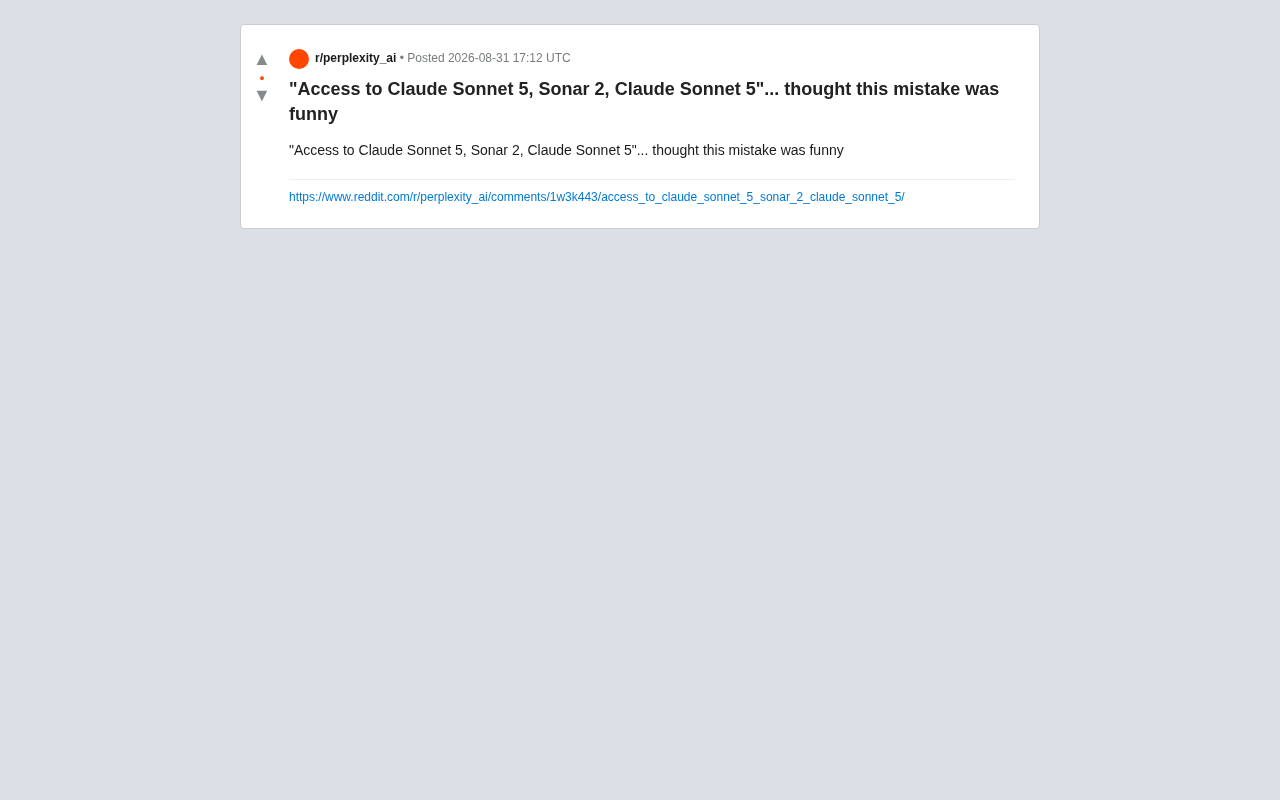
Recently, a Reddit user shared a product interface screenshot that quickly ignited community discussion. In the screenshot, an AI product's model access permissions list contained an obvious duplication: "Access to Claude Sonnet 5, Sonar 2, Claude Sonnet 5" — the same model name Claude Sonnet 5 was listed twice.
The user quipped in their post: "thought this mistake was funny." While it may seem like a trivial text duplication, it reflects a quality control problem that's pervasive across AI products during rapid iteration cycles.
Why Do Duplicate Labels Happen?
The Pressure of Rapid Iteration in AI Products
In the current generative AI boom, major platforms are integrating new models, updating subscription plans, or adjusting permission descriptions almost every few weeks. Model integration platforms, for example, often need to simultaneously incorporate capabilities from multiple providers — Anthropic (the Claude series), OpenAI, and proprietary search models (like Sonar).
It's worth elaborating on the fact that these integrated models each have distinctly different technical characteristics and interface specifications. Claude Sonnet 5 is a large language model from Anthropic, positioned as the balanced mid-tier offering in the Claude series. Anthropic uses a three-tier naming system: Haiku (lightweight and fast), Sonnet (balanced), and Opus (flagship), each representing different performance-cost tradeoffs. Sonar, on the other hand, is a search-augmented model from Perplexity, whose core feature is deeply fusing real-time web retrieval capabilities with an LLM's generative power — enabling it to cite up-to-date web sources in its responses. This is fundamentally different from pure generative models like Claude. Different providers' models vary significantly in authentication methods, API specifications, rate limits, context window sizes, and more. This multi-source, heterogeneous integration landscape makes model metadata management exceptionally complex. Any model version upgrade or new model onboarding can involve coordinated updates across multiple subsystems — frontend display, backend routing, permission control, and billing.
Under such an intense update cadence, product teams often rely on manually maintained configuration lists or copy templates. When a new model goes live, an old model is retired, or a version number changes, copy-paste errors become easy to make — such as accidentally entering the same item twice, exactly as we saw with the duplicated "Claude Sonnet 5."
Configuration-Driven vs. Hardcoded Approaches
From a technical perspective, this type of duplication typically stems from inadequate configuration management. If the model list is hardcoded into the frontend interface rather than dynamically generated from a unified backend configuration or data source, manual editing mistakes become nearly impossible to catch automatically. Conversely, with a configuration-driven approach plus deduplication validation, such low-level errors could be intercepted at build time.
Configuration-driven development is an architectural paradigm widely adopted in modern software engineering. Its core idea is to extract frequently changing parts of business logic — such as model lists, feature flags, and permission definitions — into external configuration files or databases, rather than hardcoding them in source code. In practice, common configuration management tools include HashiCorp Consul, Spring Cloud Config, and configuration center services provided by major cloud platforms. The benefit of a configuration-driven approach is that updating configurations doesn't require recompiling and redeploying code. At the same time, validation rules (such as uniqueness constraints, format checks, and enumeration whitelists) can be uniformly applied at the configuration layer, architecturally preventing human errors from propagating to production. For AI platforms that need to frequently add or remove models, the importance of this architectural choice is self-evident.
Big Lessons Behind a Small Mistake
Details Determine User Trust
For AI products, users have exceptionally high expectations of "intelligence." A product that can't even avoid duplicating model names on its interface inevitably raises doubts about its overall rigor — if they can't proofread static copy, could similar issues lurk in core model invocation or billing logic?
While this was merely a harmless display error, it serves as a reminder to all product teams: while racing to ship new features, maintaining baseline quality is equally important. User trust in a product is often built on these seemingly insignificant details.
Practical Takeaways for AI Product Teams
For developers and teams building AI applications, this case offers several practical insights:
- Dynamic generation over manual maintenance: Model and feature lists should be auto-rendered from a unified data source whenever possible, minimizing manual editing. Specifically, you can maintain a Model Registry on the backend and have the frontend dynamically fetch the current list of available models via API at render time, rather than hardcoding model names in HTML templates or frontend components.
- Add deduplication and validation logic: Incorporating simple deduplication and spell-check mechanisms at the presentation layer or in the build pipeline can effectively catch these errors. For example, automated scripts can be added to the CI/CD pipeline to check all user-facing copy for duplicate entries or formatting anomalies.
- Establish a pre-release UI review process: Even copy-level changes should be included in code review or testing workflows. Many mature product teams conduct Visual Regression Testing before releases, automatically detecting abnormal UI changes through screenshot comparisons.
- Value the community feedback loop: As this case demonstrates, users are often the sharpest "testers." Responding and fixing issues quickly signals that the team takes product quality seriously. Establishing automated workflows that route community feedback to internal tickets can significantly shorten the fix cycle for such issues.
Conclusion
"Claude Sonnet 5" appearing twice is, in itself, just a lighthearted community talking point. But through this small UI slip-up, we can see the quality-versus-speed balancing act that AI products universally face during periods of rapid growth.
In an era where model capabilities evolve by the day, those who can maintain iteration speed while upholding attention to detail are the ones most likely to earn users' long-term trust. For any AI product aspiring to go the distance, this is perhaps a reminder worth revisiting again and again.
Related articles

Workbuddy for Absolute Beginners: How a Desktop AI Agent Fits Into Real Workflows
A beginner's guide to the Workbuddy desktop AI agent: installation, claiming credits, file management, and building automated workflows—compared with CodeX for fit and cost, helping professionals shift from AI question-askers to AI managers.

OpenAI's New Agent Stack: Computer Use, Decisions API, and Ultra-Fast Workflows
OpenAI Dev Day unveiled a new agent stack: Computer Use outperforms humans, Decisions API delivers ultra-low-latency classification via Luna, Agents API opens the same Computer Use capabilities, and GPT-6.1 Sol costs only one-seventh of Astra. Core updates, benchmark data, and developer insights.

Liang Wenfeng Open-Sources DeepInfo Inference Framework, Takes On U.S. Ban
DeepSeek open-sources its DeepInfo inference framework after its models, featuring GPU/CPU cross-pipelining, small-model prediction with large-model verification, and full Huawei Ascend and NVIDIA chip support—facing the U.S. federal ban head-on. This article analyzes its significance for AI deployment and open-source strategy.