Durable Actors: An Open-Source Alternative to Durable Objects with Configurable Compute

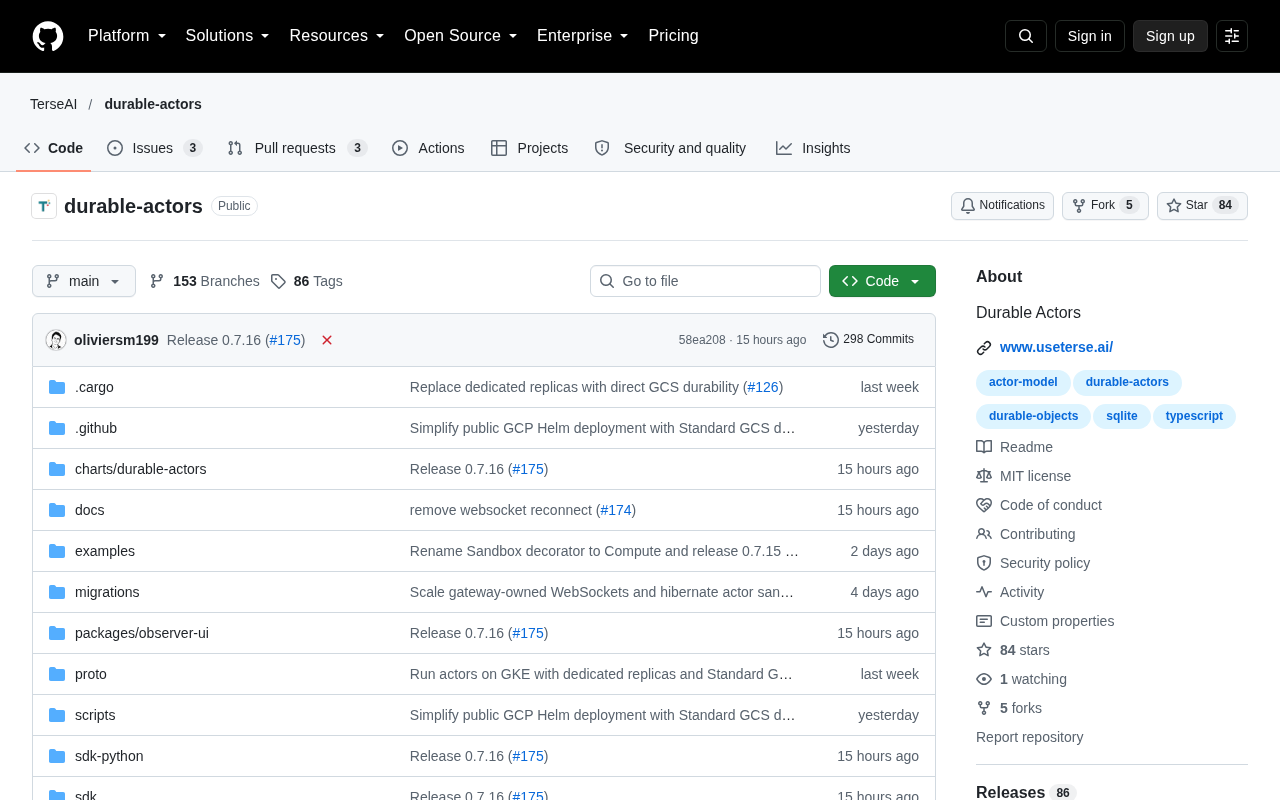
Durable Actors is an open-source, configurable-compute alternative to Cloudflare Durable Objects, but still in very early stages.
Durable Actors is an open-source project that replicates the "stateful Actor + persistent storage" programming model of Cloudflare Durable Objects while allowing developers to configure compute resources on their own infrastructure. Based on the classic Actor model, each instance has a unique identity, serial single-threaded processing, and persistent state — ideal for scenarios like real-time collaboration, rate limiting, and distributed locks. Compared to Cloudflare's closed platform with its CPU/memory limits and per-request billing, this open-source approach offers greater compute flexibility and cost predictability. However, with only 5 points and no comments on HN, the project is at an extremely early stage — consistency guarantees, operational complexity (self-hosting requires managing instance scheduling and state migration), and ecosystem maturity all remain unproven.
What Is Durable Actors
On Hacker News' Show HN section, an open-source project called Durable Actors has caught developers' attention. Its positioning is clear: it aims to be an alternative to Cloudflare's Durable Objects, delivered as open source with configurable compute.
For readers unfamiliar with the background, it's worth first understanding what Durable Objects offer. Cloudflare's Durable Objects is a programming model that binds "stateful computation" with "persistent storage" within a single instance. Each object is an "Actor" with a unique identity, single-threaded execution, and its own persistent state. This model is naturally suited for coordination scenarios requiring strong consistency — such as real-time collaboration, chat rooms, game sessions, rate limiters, and distributed locks.
Durable Actors attempts to liberate this concept from Cloudflare's closed ecosystem, enabling developers to run similar abstractions on their own infrastructure while retaining full control over the underlying compute resources.
Why the Actor Model Matters
The Actor model is not a new concept — it dates back to the 1970s, with Erlang, Akka, and Orleans serving as canonical implementations. The core idea is that each Actor encapsulates its own state and communicates with others exclusively through message passing, thereby avoiding the concurrency complexity that comes with shared memory.
Traditional concurrency: multi-threading + shared memory + locks → high risk of race conditions and deadlocks
Actor model: single-instance serial message processing → naturally isolated state
The innovation of Durable Objects lies in combining the Actor model with "persistence" — an Actor not only holds state in memory but can also persist that state to disk. Even after an instance is reclaimed, it can fully recover when reactivated. This addresses the pain point of ephemeral state in traditional Actor systems, and makes it better suited for the serverless era's on-demand spin-up and teardown execution model.
It's also worth noting that Erlang/OTP's GenServer, Microsoft Research's Orleans (the Virtual Actor model), and the JVM ecosystem's Akka differ in important ways in their design philosophies. The "Virtual Actor" concept introduced by Orleans is the closest to Durable Objects: the lifecycle of an Actor is managed by the runtime, callers don't need to worry about whether an instance is alive, and the runtime will automatically activate it when needed and deactivate it when idle. This differs from traditional Akka, where Actors must be explicitly created and supervised. Durable Objects is essentially a cloud-native realization of the "Virtual Actor" pattern: each object has a globally unique string ID, which can be used to address it directly; the platform routes requests to the correct instance across the global edge network, and developers are entirely shielded from physical placement and lifecycle management. Understanding this lineage helps evaluate where Durable Actors fits within the existing ecosystem, and how it competes with or complements mature solutions like Orleans.
"Configurable Compute" Is the Key Differentiator
Compared to Cloudflare's offering, Durable Actors' most prominent selling point is configurable compute. Cloudflare Durable Objects run on the Workers platform, constrained by its CPU time limits, memory caps, and edge runtime environment — developers have no freedom to specify instance compute specs.
Being open source with configurable compute means:
- Escape vendor lock-in: Deploy on your own cloud, private data center, or any Kubernetes cluster
- Tune resources on demand: Allocate more CPU/memory for compute-intensive Actors, rather than being constrained by platform-imposed limits
- Predictable costs: Avoid the unpredictable billing of edge platforms' per-request pricing model under high load
For teams that embrace the Durable Objects programming paradigm but cannot accept being locked into a single cloud vendor, this kind of open-source alternative provides a realistic migration path.
An Honest Look at the Current Stage
It's important to be candid: the project currently has very limited traction on Hacker News — only 5 points and no comments at the time of writing. This indicates it is still in a very early stage, and key signals such as community validation, production use cases, and performance benchmarks have yet to accumulate.
For developers considering adoption, the following questions remain to be answered:
Consistency and Durability Guarantees
Can the open-source implementation provide single-instance serial consistency comparable to Cloudflare? What storage backend does state persistence rely on (e.g., SQLite, Postgres, or object storage)? What are the data guarantees during failover?
Cloudflare Durable Objects' consistency guarantees stem from two key design decisions: first, each object has only one active instance globally, with all requests routed to that instance — fundamentally eliminating concurrent write conflicts; second, the built-in transactional storage API (storage.transaction()) provides serializable read/write semantics, which combined with V8 Isolate's single-threaded execution model means developers rarely need to manage locks manually. Replicating this guarantee in an open-source implementation is a non-trivial engineering challenge — it requires solving the "single-instance leader election" problem across nodes (typically relying on distributed coordination services like etcd or ZooKeeper) and handling the state synchronization window during instance migration. If the implementation uses an eventually consistent storage backend, it may be unable to provide equivalent strong consistency semantics — which is a substantive functional downgrade for scenarios like rate limiters and distributed locks that demand strict consistency.
Operational Complexity
One of the greatest values of the Cloudflare solution is "zero ops" — developers don't need to think about instance scheduling or state migration. A self-hosted open-source version necessarily takes on this operational burden, and teams will need to weigh the trade-off between compute freedom and operational cost.
Ecosystem Maturity
Are there comprehensive SDKs, documentation, and monitoring tooling? Is there a smooth migration path from existing Durable Objects code? These factors will determine whether the project can move from concept to real-world adoption.
Overall Assessment
Durable Actors addresses a genuine need: a growing number of teams want the stateful serverless programming experience that Durable Objects offers, without being locked into a single cloud vendor. The combination of open source and configurable compute is directionally appealing.
However, given its early traction, it still has a significant way to go before reaching maturity. For those evaluating technology choices, it's currently best treated as a "promising candidate to watch" — added to an observation list rather than adopted at production scale, pending more community feedback and real-world case studies.
Related articles

Chain of Thought Isn't Just for AI: How Humans Can Use CoT to Improve Thinking Quality
Chain of Thought isn't just a prompt trick for large models. Starting from a Hacker News discussion, this article analyzes why CoT works for human thinking too, breaks down actionable ways to transfer it, and highlights the key differences between human CoT and machine CoT.
Cloudflare Teams Up with OpenAI: Closi…
Cloudflare Teams Up with OpenAI: Closing the Loop from Vulnerability Discovery to Defense with AI
Cloudflare uses OpenAI Daybreak to investigate security vulnerabilities and generate reviewable remediation plans, while developers use Codex to boost coding efficiency and quality.

Orca Multi-Agent Orchestration in Practice: A Guide to Parallel Collaboration with Claude and Codex
Orca is Stable AI's free open-source agent workbench supporting 34 agents like Claude Code and Codex in parallel. Learn its Git worktree isolation, multi-model orchestration, and mobile management.