Dwarf Fortress Creator's Sharp Critique: AI Hype Is Ruining the Game Industry
Dwarf Fortress creator says AI hype and layoff-happy CEOs are wrecking the game industry.
Dwarf Fortress co-creator Tarn Adams has sparked widespread discussion by criticizing the game industry's AI obsession and mass layoffs. Forced to rebrand his game AI work as "dwarf behavior" to avoid confusion with generative AI, Adams highlights how the term has been co-opted by capital interests. His critique exposes the tension between AI hype-driven layoffs and the creative work that actually powers great games.
When "AI" Becomes the Word You Can't Say
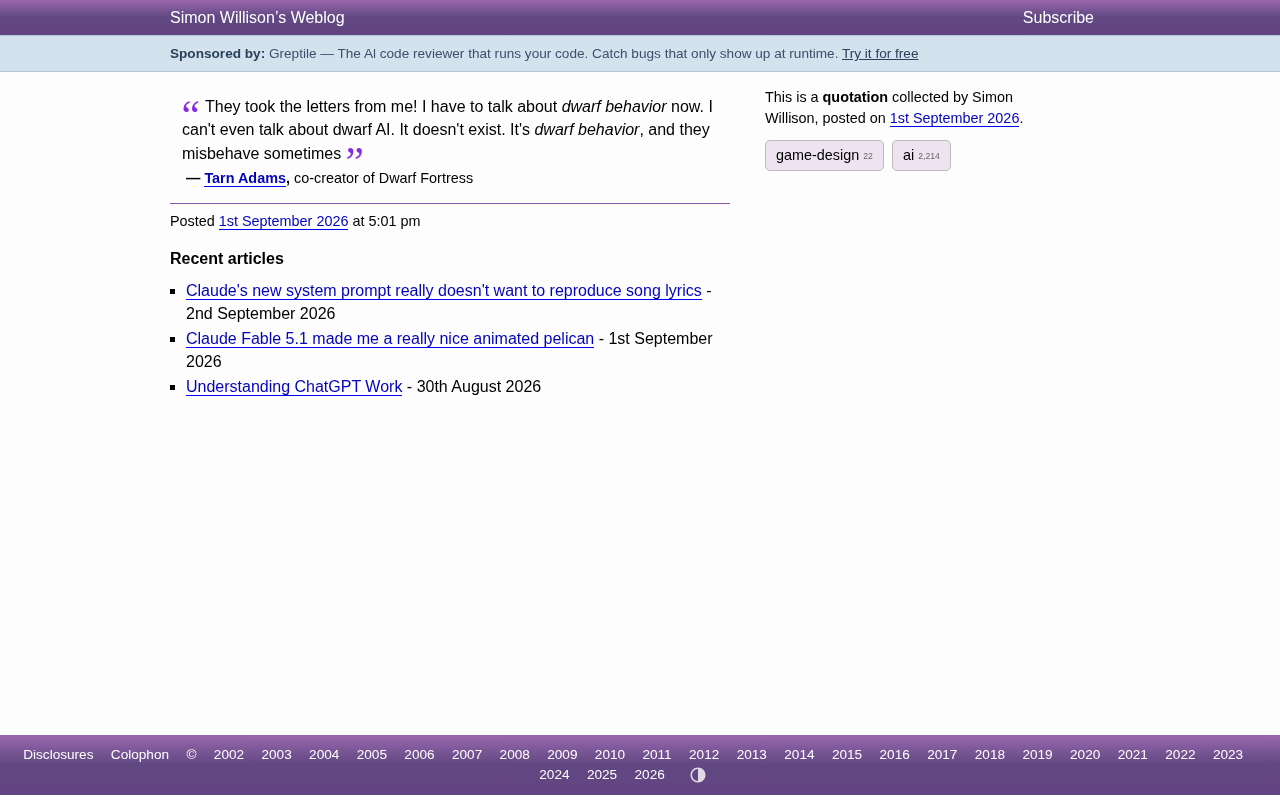
Dwarf Fortress co-creator Tarn Adams recently made remarks that resonated widely across the developer community. He half-jokingly said that you can't even use the word "AI" freely anymore:
"They took those letters away from me! I can only talk about dwarf behavior now. I can't even talk about dwarf AI, that doesn't exist. It's dwarf behavior, and they misbehave sometimes."
What sounds like a quip actually reflects a curious phenomenon across the game industry and the tech world at large: the term "AI" has been completely co-opted by large language models (LLMs) and generative AI. As a result, traditional game AI — the classic algorithms that control NPC behavior, pathfinding, and decision-making — has been forced to rebrand itself to avoid misunderstanding or getting swept up in the noise.
The Awkward Hijacking of Game AI Terminology
In game development, "AI" has always had a clear and humble meaning: it refers to the behavioral logic that makes game characters "come alive" — how enemies patrol, how allies follow, how ecosystems function.
The technical foundations of game AI: Game AI has fundamentally different goals from the general artificial intelligence pursued in academia. Early games relied primarily on finite state machines (FSM) — an enemy might simply toggle between a handful of states like "patrol," "chase," and "attack." From the 1990s onward, behavior trees became the mainstream approach, allowing designers to build hierarchical decision structures that gave NPCs more natural behavior patterns. Landmark titles like the Halo series and F.E.A.R. introduced Goal-Oriented Action Planning (GOAP), enabling AI to dynamically select action sequences based on the environment. The core philosophy behind these techniques is "controlled intelligence" — making characters appear smart while keeping player experience and computational performance manageable. It's essentially "carefully designed stupidity."
Dwarf Fortress is a quintessential example of this kind of complex emergent system — hundreds of dwarves each possess emotions, memories, desires, and quirks, and their collective "behavior" weaves countless unexpected stories. This ASCII-graphics game, developed by the Adams brothers since 2006, features one of the deepest simulation systems in gaming history: each dwarf has an independent personality and social network, liquids have temperature and viscosity properties, and combat damage is tracked down to every individual tooth. This "emergent design" philosophy — where simple rules interact to produce complex outcomes — stands in stark contrast to traditional scripted narratives and has become a symbol of the indie game creative spirit.
But after the generative AI explosion, the word "AI" became virtually synonymous with ChatGPT, Midjourney, and code generation. Adams's quip cuts right to the absurdity of this semantic drift: a developer who has worked on game AI for two decades now has to use "dwarf behavior" to avoid misunderstandings.
The Game Industry Is "a Mess Because of AI"
In an interview with PC Gamer, Adams didn't mince words. He stated bluntly that the game industry is "a mess because of AI and layoff-happy CEOs," and delivered one particularly memorable line:
"Everyone I know, their bosses are slowly going insane."
This slightly exaggerated statement points to a very real anxiety: as capital chases the efficiency promises of AI, game company leadership is making increasingly aggressive decisions. On one hand, they believe AI can replace large portions of the workforce, cut costs, and accelerate content production. On the other hand, the resulting mass layoffs are destroying the creative foundations of the industry.
The Deep Contradiction Between Industry Layoffs and AI Promises
Over the past two years, the game industry has experienced historically unprecedented waves of layoffs. Over 10,000 workers lost their jobs in 2023, and by the first three quarters of 2024, that number had already surpassed 13,000, affecting industry giants like Unity, Epic Games, Microsoft's gaming division, EA, and Take-Two. The causes are complex: over-expansion during the pandemic, investor pressure for short-term profitability in a high-interest-rate environment, and market fatigue during a console generation transition. But the generative AI narrative has significantly accelerated this trend — some executives believe AI can replace concept artists, level designers, QA testers, and other roles, leading to widespread "preemptive layoffs." Ironically, the positions being cut are precisely those requiring deep creative thinking and systemic understanding — the very areas where AI is least capable in the short term.
Adams's criticism comes from the perspective of indie developers and frontline creators — what he sees isn't technology bringing liberation, but management's shortsightedness and chaos driven by AI narratives. It's worth noting that Adams is no technology conservative. Dwarf Fortress itself is the product of extraordinarily complex systems simulation, with internal logic far more sophisticated than most commercial games. His frustration isn't directed at "making machines smarter" — it's aimed at the industry's transformation of "AI" into capital rhetoric and a pretext for layoffs.
AI Terminology Inflation, Seen Through "Dwarf Behavior"
Adams's complaint resonated so widely because it touches on a broader issue: the word AI is being overused to the point of rapid devaluation.
What Actually Counts as "AI"?
In academic and engineering contexts, AI is a broad field encompassing search algorithms, expert systems, machine learning, deep learning, and many other branches. NPC behavior trees and finite state machines in games are equally valid forms of classical AI. But in public and market discourse, "AI" has been reduced to little more than a synonym for "large language models" or "generative content."
The historical evolution of AI terminology: The term "artificial intelligence" was coined at the 1956 Dartmouth Conference and originally covered a wide range of areas including symbolic reasoning, expert systems, and search algorithms. It went through the expert systems boom of the 1980s, the "AI winter" of the 1990s, the rise of machine learning in the 2000s, and the deep learning revolution sparked in 2012. Every paradigm shift brought a corresponding shift in what the term meant. After ChatGPT's release in 2022, "AI" became nearly synonymous with LLMs and generative AI in public perception. This kind of semantic narrowing isn't uncommon in tech history — "computer" once referred specifically to a person who performed mathematical calculations, and "cloud computing" also went through a transformation from technical concept to marketing buzzword. But AI's case is unique in the breadth of its coverage and the weight of its emotional baggage. This battle over semantics is really a multi-layered struggle involving technological identity, professional dignity, and industry discourse power.
This narrowing of terminology has two consequences:
- Truly sophisticated traditional game AI work gets overlooked and diminished, as if only systems that can "chat" and "draw" deserve to be called AI
- Any product slapped with an "AI" label attracts capital and media hype, regardless of its actual technical merit
Adams's use of "dwarf behavior" as a substitute is really an act of linguistic resistance born of necessity — he's trying to rescue the game development values of attention to detail, emergence, and unpredictability from the diluted "AI" label.
Why Dwarf Fortress's Emergent Design Is So Precious
What makes Dwarf Fortress most captivating are the "accidental stories" born from the interaction between systems. A cat licks spilled ale off the floor, gets drunk, and triggers a chain of accidents. A dwarf falls into depression after losing a friend, eventually spiraling into the collapse of an entire fortress. None of these are scripted storylines — they're emergent outcomes driven by rules.
This design philosophy stands in sharp contrast to today's pursuit of "one-click generation" AI logic. It reminds us that truly vital game systems often come from designers' careful deliberation over underlying rules, not from simply throwing computing power and data at problems. The Adams brothers refused to commercialize for years, only releasing a paid Steam version in 2022 due to medical expenses. This commitment to creative purity is itself a rebellion against the logic of capital.
The Industry Reflection Behind a Single Quip
Tarn Adams's remarks may look like jokes on the surface, but underneath lies the clear-eyed observation of a veteran creator about the state of the industry. When "AI" devolves from a technical concept into a tool for capital narratives and layoffs, the first to get hurt are invariably the people doing genuinely creative work.
His "dwarf behavior" argument is both a humorous jab at AI terminology inflation and a call to return to the essence of creative work. Amid the AI frenzy sweeping the entire industry, perhaps the more important question we need to ask is: should technology serve creators, or replace them?
For the game industry, the answer should be obvious.
Related articles
AI Agent Cost Optimization in Practice: Engineering Wisdom That Saved $1 Million in One Hour
Databricks eliminated $1M/year in wasted AI Agent spend in just one hour. Learn the root causes of Agent cost overruns and key strategies like model tiering, context pruning, and caching.
How the FDA Is Building an AI-Ready Data Foundation on Databricks
Explore how the FDA leverages Databricks for Government to build a unified Lakehouse architecture and AI-ready data foundation while meeting federal security and compliance standards.
The Power of Security Collaboration: Why Vulnerability Discovery Cannot Do Without Human Intelligence
Explore how security collaboration outperforms tool dependency, the value of vulnerability stories, cross-team knowledge sharing practices, and building stronger defenses by investing in people and collaboration.