Dyna-2: A General-Purpose Physical Agent with Hour-Long Autonomy

Dyna-2 sets hour-long autonomy as its threshold, betting on World Action Models to drive general-purpose physical agents into deployment.
Dyna Robotics' Dyna-2 system centers on "hour-long autonomy," defining continuous hour-long operation without human intervention as the threshold for robots moving from demos to deployable products, addressing long-tail issues like accumulated error, environmental change, task switching, and exception recovery. Chief Scientist Jason Ma explains the company's bet on World Action Models — unifying world model prediction with end-to-end action control generation and using physical constraints as a core training signal. He sees the era of specialized robots narrowing as the window for general physical agents opens, but the biggest bottleneck is the lack of standardized long-horizon task evaluation, not algorithms.
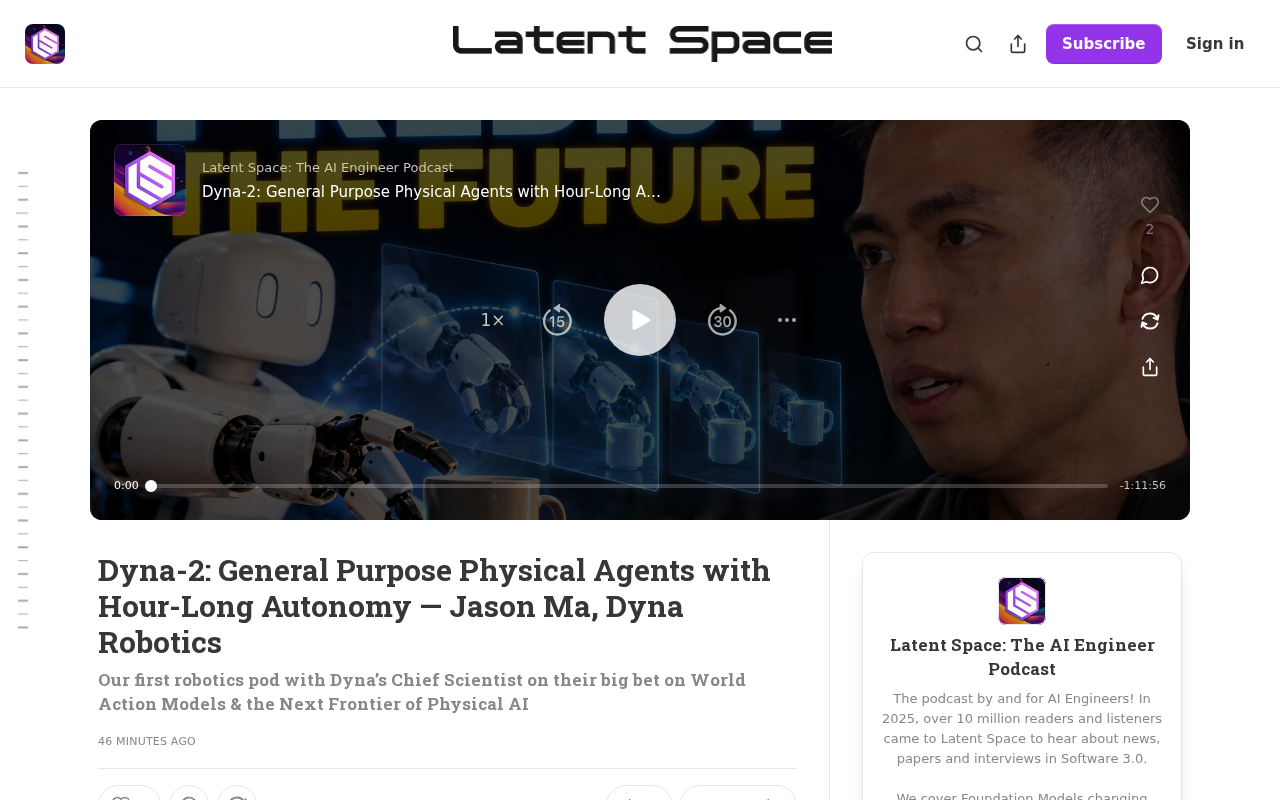
The robotics field is undergoing a leap from "demo-grade" to "production-grade," and Dyna Robotics' newly released Dyna-2 system is attempting to redefine the capability boundary of general-purpose physical agents through "hour-long autonomy." In a technical podcast episode, the company's Chief Scientist Jason Ma broke down in detail their technical bet on World Action Models and where physical AI is headed next.
Why "Hour-Long Autonomy" Is a Watershed
Over the past few years, robot demo videos have proliferated, but the vast majority of tasks wrap up within minutes. The real bottleneck preventing robots from leaving the lab and entering warehouses or homes isn't single-task success rate — it's stability under continuous, long-duration operation.
Dyna-2's core selling point is precisely "Hour-Long Autonomy" — continuously executing tasks in real environments for up to an hour without human intervention. That number may not sound impressive, but in the physical AI domain, it means the system must simultaneously solve a whole series of long-tail problems: accumulated error, environmental change, task switching, and exception recovery. In the conversation, Jason Ma emphasized that one hour isn't a marketing number — it's the "deployability threshold" they defined internally: below this duration, a robot's economic value cannot cover deployment and maintenance costs.
World Action Models: Dyna's Technical Bet
Dyna is placing its bet on a direction they call "World Action Models." The concept fuses two rapidly evolving technical threads of recent years: first, World Models — letting AI internally simulate environment dynamics and predict the consequences of actions; second, Action Models — directly generating robot control signals from perceptual input.
Jason Ma's explanation is that traditional robotics stacks split perception, planning, and control into independent modules, and errors at each stage get amplified level by level in long-horizon tasks. World Action Models attempt to use a unified predictive framework that lets robots "imagine the future while generating actions," thereby maintaining consistency across long-horizon tasks.
This approach aligns with the broader trend in embodied intelligence moving from "modular pipelines" to "end-to-end foundation models," but Dyna's differentiation lies in treating physical constraints as a core training signal for the model rather than bolting on a safety layer after the fact. This gives them better robustness in hour-scale tasks.
World Models are a class of models that let AI build internal representations of environment dynamics and use them to predict "if I take a certain action, what happens next." They were first proposed in the reinforcement learning field (such as the classic work by Ha & Schmidhuber in 2018), with the core idea being to let agents plan and trial-and-error within a learned "imagination space," thereby reducing dependence on real-environment interaction. In recent years, with advances in video generation models, world models have begun to possess stronger visual prediction capabilities, with representative works including the Genie and Dreamer series as well as various video prediction foundation models. For robots, the value of world models lies in their ability to transfer expensive, dangerous real-world trial-and-error into internal simulation — especially suited for look-ahead planning in long-horizon tasks.
Action Models, by contrast, focus on directly mapping perceptual input to robot control signals, with typical representatives being the vision-language-action models (VLAs) that have emerged in recent years, such as RT-2 and OpenVLA. These models typically use pretrained multimodal large models as backbones and are fine-tuned on robot data to directly output joint positions, end-effector trajectories, or discrete action tokens. Their advantage is end-to-end operation and good generalization, but their drawback is a lack of explicit future prediction capability, making them prone to "taking one step and seeing what happens" in tasks requiring multi-step reasoning. World Action Models attempt to combine the strengths of both: retaining the end-to-end generation capability of action models while introducing the prediction and planning mechanisms of world models.
The Next Stop for Physical AI: From Specialized to General
When asked about the future of physical AI, Jason Ma offered a clear judgment: the era of specialized robots is narrowing, and the window for general-purpose physical agents is opening.
His argument has two layers. The first is data: as the cost of teleoperation and simulation data collection declines, the data foundation for training a cross-task general policy is taking shape. The second is hardware: the rapid decline in robot body costs is making it economically viable for "one machine to do many jobs" — provided the software layer can support generality.
However, he also candidly acknowledged that the biggest challenge facing general-purpose physical agents isn't algorithms — it's evaluation. Language models have mature benchmarks, but evaluating long-horizon tasks in the physical world is extremely expensive and difficult to standardize. Dyna has internally built an hour-scale task evaluation system for this purpose, but Jason Ma believes the industry as a whole still lacks consensus evaluation standards.
The "evaluation" problem in embodied intelligence is thorny because physical-world tasks are inherently multidimensional. Language model benchmarks are typically static and reproducible (given an input, there's a deterministic output), whereas robot tasks involve continuous states, random environmental perturbations, object pose changes, sensor noise, and more — the same policy can perform drastically differently at different moments. Moreover, the cost of evaluating long-horizon tasks is extremely high: a single hour-scale test requires occupying a real robot, a physical site, and personnel, making it difficult to parallelize at scale the way benchmarks are run. This makes it hard for academia and industry to compare different systems using a unified standard, and it also means single metrics like "success rate" cannot reflect a system's true reliability under long-duration operation. Current directions the industry is exploring include standardized simulation evaluation platforms (such as SimplerEnv and RoboArena), real-environment task suites, and log-based long-horizon stability metrics — but consensus is still a ways off.
What It Means for Developers and the Industry
For developers focused on embodied intelligence, Dyna-2 sends several signals worth tracking. First, long-horizon autonomy is becoming a key metric distinguishing "demos" from "products" — when evaluating robot systems in the future, runtime duration may be more telling than single-task success rate. Second, World Action Models as a technical direction is attracting more and more teams, which could give rise to new model architectures and training paradigms.
At the end of the conversation, Jason Ma mentioned that Dyna's next focus is extending hour-long autonomy to more complex multi-step tasks and exploring cross-scenario generalization. The physical AI race is shifting from "can it do it" to "how long can it keep doing it."
One-line Summary
Dyna-2 sets hour-long autonomy as its threshold, betting on World Action Models to drive general-purpose physical agents into deployment.
Paragraph Summary
Dyna Robotics' newly released Dyna-2 system centers on "hour-long autonomy," defining continuous operation for an hour without human intervention as the threshold metric for robots transitioning from demos to deployable products — because this duration encompasses long-tail challenges like accumulated error, environmental change, task switching, and exception recovery. Chief Scientist Jason Ma articulated the company's technical bet on World Action Models: unifying the predictive power of world models with the end-to-end control generation of action models, using physical constraints as a core training signal to mitigate the error amplification of traditional modular pipelines in long-horizon tasks. He judges that the era of specialized robots is narrowing while the window for general-purpose physical agents is opening — but the biggest bottleneck isn't algorithms, it's the lack of a standardized long-horizon task evaluation system.
Related articles

Chain of Thought Isn't Just for AI: How Humans Can Use CoT to Improve Thinking Quality
Chain of Thought isn't just a prompt trick for large models. Starting from a Hacker News discussion, this article analyzes why CoT works for human thinking too, breaks down actionable ways to transfer it, and highlights the key differences between human CoT and machine CoT.
Cloudflare Teams Up with OpenAI: Closi…
Cloudflare Teams Up with OpenAI: Closing the Loop from Vulnerability Discovery to Defense with AI
Cloudflare uses OpenAI Daybreak to investigate security vulnerabilities and generate reviewable remediation plans, while developers use Codex to boost coding efficiency and quality.

Orca Multi-Agent Orchestration in Practice: A Guide to Parallel Collaboration with Claude and Codex
Orca is Stable AI's free open-source agent workbench supporting 34 agents like Claude Code and Codex in parallel. Learn its Git worktree isolation, multi-model orchestration, and mobile management.