DynThinker: Unifying Static 3D and Dynamic 4D Spatial Reasoning

Research reveals non-uniform interference between static 3D and dynamic 4D reasoning; DynThinker leverages this to build a unified, leading spatial intelligence model.
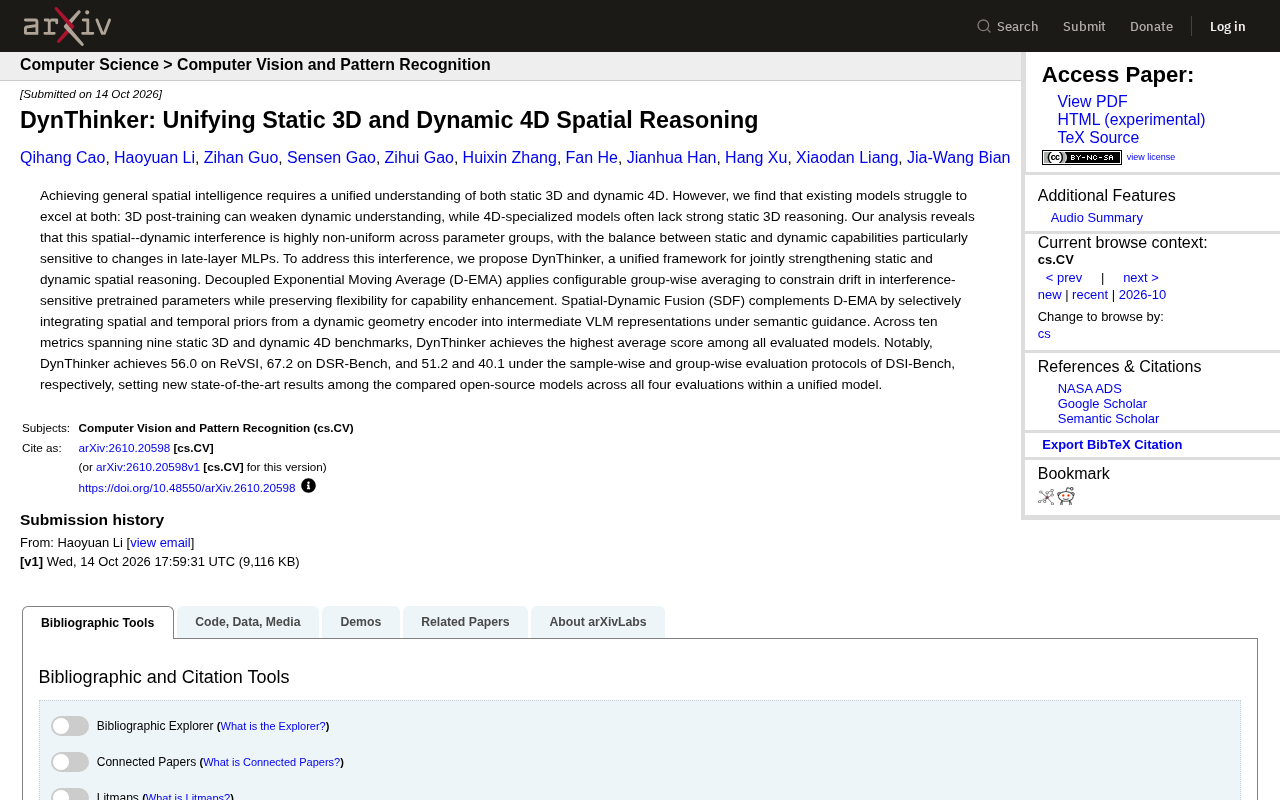
The article examines why static 3D understanding and dynamic 4D reasoning are hard to reconcile in spatial intelligence. The study identifies clear "spatial-dynamic interference": 3D post-training weakens dynamic abilities, while 4D-specialized models lack a solid static foundation. Parameter-level analysis shows interference is unevenly distributed, with late-layer MLP parameters especially sensitive to the balance. Researchers propose DynThinker, a unified framework with two complementary mechanisms: D-EMA applies grouped constraints to sensitive parameters to suppress drift while keeping others flexible, and SDF selectively fuses spatiotemporal priors from a dynamic geometry encoder into VLM intermediate layers under semantic guidance. The model achieves the highest average score across ten metrics over nine benchmarks, proving static and dynamic capabilities can lead simultaneously in one model.
The Dilemma of Spatial Intelligence: Why Static and Dynamic Are Hard to Reconcile
Enabling AI to truly understand three-dimensional space — and, on that basis, to grasp dynamic scenes that change over time — is a core goal in the field of spatial intelligence. Yet existing models tend to trade one dimension for the other. A recent study reveals the deeper reason behind this conflict.
According to the study's analysis, there is a pronounced "spatial-dynamic interference" phenomenon between static 3D spatial understanding and dynamic 4D scene reasoning. Specifically, post-training on 3D tasks weakens a model's ability to understand dynamic scenes, while models specialized in 4D reasoning often lack a solid foundation in static 3D spatial reasoning. This seesaw relationship has become a major obstacle on the path to general spatial intelligence.
What are static 3D and dynamic 4D spatial reasoning?
Static 3D spatial reasoning refers to a model's understanding and judgment of a three-dimensional scene at a single moment — for example, inferring the position, orientation, and size of objects, as well as the spatial relationships between them, from single-view or multi-view images. Common tasks include 3D visual grounding, spatial question answering, and scene layout prediction. It is concerned with "where."
Dynamic 4D spatial reasoning introduces the time dimension on top of this, requiring the model to understand how a scene evolves over time: how objects move, how trajectories extend, how occlusion relationships change, and the temporal ordering of events among multiple entities. It is concerned not only with spatial position, but also with "how things change."
4D is not a strictly mathematical fourth dimension, but rather an engineering shorthand for "3D space + time." Since dynamic reasoning must be built on a solid static spatial representation, the two capabilities naturally share parameter pathways — which is the structural root of why they interfere with each other.
Interference Is Not Uniformly Distributed: Late-Layer MLPs Are Key
The research team conducted a more detailed, parameter-level analysis of the interference phenomenon and reached a counterintuitive conclusion: spatial-dynamic interference is highly unevenly distributed across different parameter groups.
Not all weights affect the two capabilities to the same degree. Experiments show that the balance between static and dynamic capabilities is particularly sensitive to changes in the model's late-layer MLP (multilayer perceptron) parameters. This means that uniformly adjusting all parameters is likely to unintentionally harm one capability while improving the other. This finding provides a clear target for subsequent method design: rather than global fine-tuning, precisely constrain the interference-sensitive parameters.
This insight also explains why previous unified models struggled to succeed — traditional training strategies lacked consideration for the differing nature of parameter groups.
Why are late-layer MLPs particularly sensitive?
In mainstream vision-language models (VLMs), the MLP (multilayer perceptron) typically refers to the feedforward network in each Transformer layer responsible for position-wise nonlinear transformation, and its parameter count often accounts for more than half of the entire layer. Relatively speaking, attention modules focus more on cross-position relational modeling, while MLPs are responsible for semantic transformation and storage of already-aggregated features.
The late layers — the several layers near the output end — have highly semanticized representations that directly determine the final language generation output. Researchers generally believe that a large amount of task-related "knowledge" parameters are deposited here. When a model undergoes post-training on 3D tasks, these high-level semantic pathways are preferentially reshaped, thereby overwriting the representations that originally supported dynamic temporal reasoning. This is precisely the mechanism by which interference concentrates. In contrast, early layers handle more general visual features, and modifying them affects both types of tasks only mildly.
DynThinker's Two Core Mechanisms
To address the aforementioned interference problem, the researchers propose DynThinker, a unified framework designed to jointly strengthen static and dynamic spatial reasoning. Its core consists of two complementary components.
D-EMA: Adding an "Anchor" for Sensitive Parameters
Decoupled Exponential Moving Average (D-EMA) employs a configurable grouped averaging strategy that constrains interference-sensitive pre-trained parameters, suppressing their drift during training while preserving ample flexibility for other parameters to enhance capabilities. This "stabilize what should be stabilized, release what should be released" approach directly responds to the analysis conclusion that late-layer MLPs are highly sensitive.
Why can Exponential Moving Average (EMA) serve as an "anchor"?
EMA was originally a weight smoothing technique in training: it maintains a sliding-average copy of parameters, mixing the current weights with the historical average proportionally at each update. Because historical information is continuously retained, the EMA copy is insensitive to the noise and abrupt changes of single-step gradients and is often used as a more stable set of inference weights.
The key modification of D-EMA lies in "decoupling" and "grouping": rather than applying the same averaging strategy to all parameters, it divides parameters into different groups, applying stronger constraints to the interference-sensitive groups identified in the analysis (such as late-layer MLPs) while loosening or even removing constraints on other groups. In this way, sensitive parameters are anchored near their good pre-training starting point, avoiding excessive rewriting during 3D post-training, while insensitive parameters can still freely learn new capabilities. Essentially, it turns regularization from globally uniform into fine-grained control partitioned by function.
SDF: Fusing Spatiotemporal Priors Under Semantic Guidance
Spatial-Dynamic Fusion (SDF) complements D-EMA. It extracts spatial and temporal priors from a dynamic geometry encoder and, under semantic guidance, selectively integrates these priors into the intermediate-layer representations of the VLM (vision-language model). This selective fusion avoids the mutual interference caused by simple superposition, allowing static spatial information and dynamic temporal information to cooperate rather than conflict at the representation level.
Leading Across Ten Metrics: A New Benchmark for Unified Models
DynThinker was evaluated on ten metrics spanning nine static 3D and dynamic 4D benchmarks, achieving the highest average score among all compared models.
Several landmark results are worth noting: it reached 56.0 on ReVSI and 67.2 on DSR-Bench; under DSI-Bench's sample-wise and group-wise evaluation protocols, it achieved 51.2 and 40.1 respectively. The study points out that these four evaluation results were all achieved within a unified model, setting a new state of the art among the compared open-source models.
The significance of this result lies in the fact that it demonstrates static 3D and dynamic 4D capabilities can simultaneously reach leading levels within the same model, rather than requiring one to be sacrificed for the other.
Implications for Spatial Intelligence Research
The value of DynThinker lies not only in refreshing several benchmark scores, but also in providing a reusable methodological path.
Starting from parameter-level analysis to identify interference-sensitive regions, then addressing them with grouped constraints and selective fusion — this approach may be transferable to other scenarios involving coupled multiple capabilities. For researchers pursuing general spatial intelligence, "diagnose interference first, then intervene precisely" may be more efficient than simply scaling up data and compute. Of course, DynThinker's current performance is still based on its chosen benchmarks, and its generalization ability in more open and complex real-world scenarios remains to be further verified.
One-line Summary
Research reveals non-uniform interference between static 3D and dynamic 4D reasoning; DynThinker leverages this to achieve a unified and leading spatial intelligence model.
Paragraph Summary
The article addresses the difficulty of simultaneously handling static 3D understanding and dynamic 4D reasoning in spatial intelligence. The study points out a clear "spatial-dynamic interference": 3D post-training weakens dynamic capabilities, while 4D-specialized models lack a solid static foundation. Further parameter-level analysis finds that the interference distribution is uneven, with the model's late-layer MLP parameters being particularly sensitive to the balance between the two capabilities. To this end, the researchers propose a unified framework, DynThinker, comprising two complementary mechanisms: D-EMA applies grouped constraints to interference-sensitive parameters to suppress drift while preserving the flexibility of other parameters; SDF selectively integrates spatiotemporal priors from a dynamic geometry encoder into VLM intermediate-layer representations under semantic guidance. The model achieves the highest average score across ten metrics spanning nine benchmarks, proving that static and dynamic capabilities can lead simultaneously within a single model.
Related articles

Chain of Thought Isn't Just for AI: How Humans Can Use CoT to Improve Thinking Quality
Chain of Thought isn't just a prompt trick for large models. Starting from a Hacker News discussion, this article analyzes why CoT works for human thinking too, breaks down actionable ways to transfer it, and highlights the key differences between human CoT and machine CoT.
Cloudflare Teams Up with OpenAI: Closi…
Cloudflare Teams Up with OpenAI: Closing the Loop from Vulnerability Discovery to Defense with AI
Cloudflare uses OpenAI Daybreak to investigate security vulnerabilities and generate reviewable remediation plans, while developers use Codex to boost coding efficiency and quality.

Orca Multi-Agent Orchestration in Practice: A Guide to Parallel Collaboration with Claude and Codex
Orca is Stable AI's free open-source agent workbench supporting 34 agents like Claude Code and Codex in parallel. Learn its Git worktree isolation, multi-model orchestration, and mobile management.