Dyson CameraJet Smart Toothbrush: Built-in Camera + Water Flosser — Brush and Floss at the Same Time
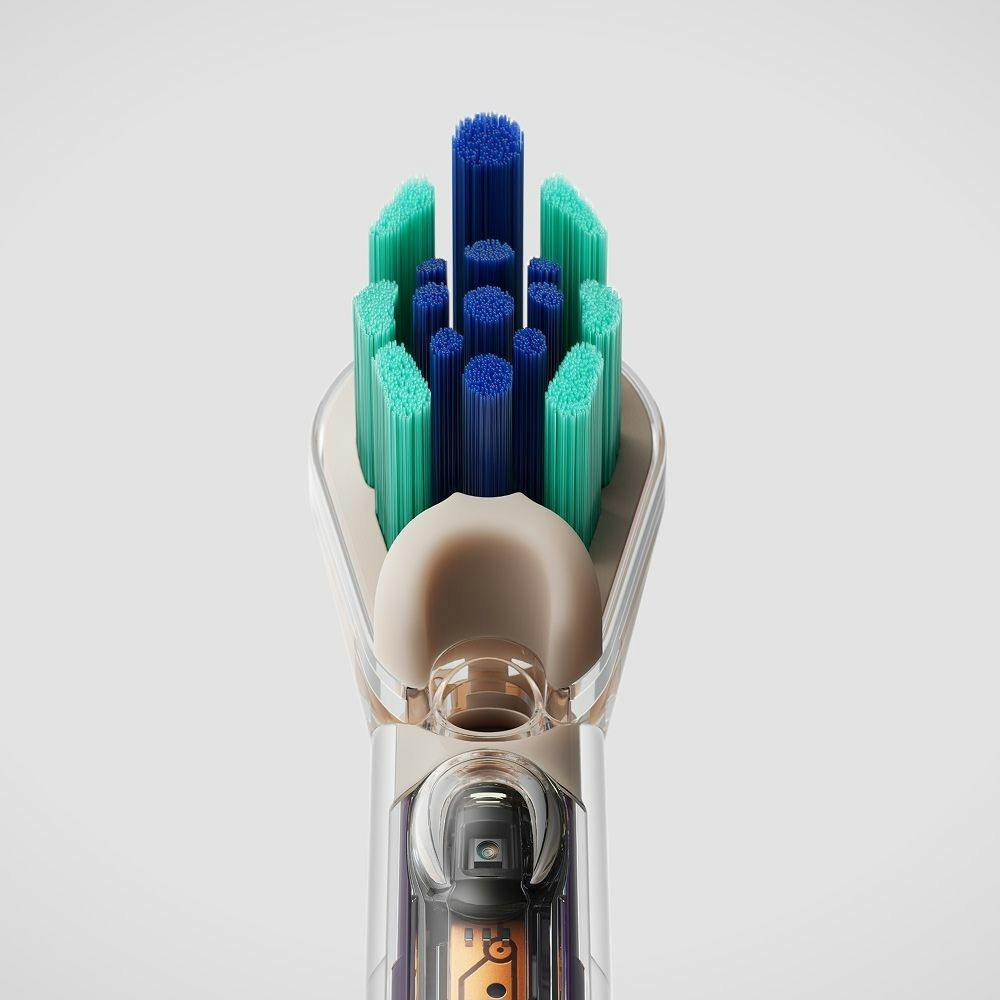
Dyson's CameraJet toothbrush uses a built-in camera and water jets to auto-floss while you brush.
Dyson's CameraJet smart toothbrush integrates a 28fps macro camera into the brush head to detect interdental gaps in real time, then automatically fires conical mouthwash jets to clean them — merging sonic brushing and water flossing into a single step. Led by Jake Dyson, the product leverages Dyson's fluid dynamics expertise and edge AI to tackle the universal problem of flossing avoidance, though questions remain about clinical efficacy, intraoral reliability, and pricing.
Dyson Crosses Boundaries Again: CameraJet Disrupts Oral Care
Dyson has once again brought its expertise in fluid dynamics and precision engineering into an entirely new domain — oral care. Dyson's deep roots in fluid dynamics trace back to founder James Dyson's invention of Cyclone Separation technology, which later expanded into the Air Multiplier bladeless fan, the Supersonic hair dryer (powered by a V9 digital motor spinning at up to 110,000 RPM), and the Airwrap styler that leverages the Coanda effect. The common technological foundation across all these products is the precise control of micro-scale airflow and liquid flow — and CameraJet takes that capability and miniaturizes it further to the oral-cavity scale.
Recently, Dyson launched a smart toothbrush called CameraJet on Product Hunt. It earned 90 upvotes and landed at #13 on the leaderboard, categorized under Health & Fitness and Hardware. The product is led by none other than Jake Dyson, son of the company's founder. Jake established his own lighting company in 2004, specializing in ultra-long-life LED fixtures using heat pipe cooling technology. After the company was folded into the Dyson Group in 2015, he gradually took on broader R&D management responsibilities. His leadership of the CameraJet project reflects the Dyson family's legacy of cross-category innovation — transferring engineering advantages from one domain to seemingly unrelated new ones.
The product's core philosophy is captured in its tagline: "Precision-floss between teeth while you brush." It aims to solve a persistent oral care pain point — many people brush diligently but can't be bothered to floss, yet interdental spaces are hotspots for plaque buildup and periodontal issues. The oral cavity harbors over 700 species of microorganisms, and because toothbrush bristles can't reach between teeth, these gaps are where plaque biofilms most readily accumulate. According to the American Academy of Periodontology, approximately 70% of cavities and early-stage periodontal disease originate in interproximal areas. If plaque isn't removed promptly, it can mineralize into tarite within 48–72 hours, leading to gingivitis and periodontitis. WHO data shows that approximately 3.5 billion people worldwide suffer from oral diseases — a backdrop that underscores the critical importance of interdental cleaning.
Camera + Water Flosser: A Deep Dive into CameraJet's Core Technology
28fps Intraoral Macro Camera for Real-Time Gap Detection
CameraJet's most striking innovation is integrating a macro camera directly into the brush head. This camera captures images at 28 frames per second (28fps) in real time, detecting interdental gaps.
In other words, this is no longer a toothbrush that operates "blind" — it's a smart device that can actually "see" the internal structure of your mouth. When the camera identifies an interdental gap, the device automatically triggers the next action.
From a technical standpoint, 28fps image acquisition means the system must complete 28 full "capture–identify–decide" cycles per second, with per-frame processing latency kept under approximately 35 milliseconds to achieve real-time responsiveness. This requires integrating a dedicated AI inference chip (such as an NPU — Neural Processing Unit) or a highly efficient microcontroller within the extremely limited space of a toothbrush handle. In recent years, as TinyML (Tiny Machine Learning) technology has matured, running lightweight neural networks on microcontrollers consuming only milliwatts of power has become feasible. For example, Google's TensorFlow Lite Micro framework can already run image classification models on ARM Cortex-M series chips, providing the technical feasibility foundation for products like CameraJet.
Automatic Conical Water Jet Replaces Traditional Floss
Upon detecting an interdental gap, CameraJet fires a targeted conical burst of mouthwash directly into the gap, performing a cleaning function similar to a water flosser.
The water flosser was first invented in 1962 by dentist Gerald Moyer and engineer John Mattingly, and was later commercialized under the Waterpik brand. It works by using pulsed water jets (typically pulsing at 1,200–1,700 times per minute at 40–90 PSI) to blast interdental spaces and gum sulci, removing food debris and loose plaque through the shear force and pulsating impact of the water stream. The global water flosser market is currently dominated by brands like Waterpik, Philips Sonicare, and Panasonic, with the market expected to reach approximately $4.5 billion by 2028. However, all existing water flossers are standalone devices that require users to operate them separately from brushing — and this is precisely the usage paradigm CameraJet aims to break.
The brilliance of this design lies in its "automation" and "synchronization":
- Sonic brushing and water flossing combined into one action: In the traditional routine, brushing and using a water flosser or floss are two separate steps. CameraJet merges both into a single brushing session.
- No separate flossing step needed: The product explicitly claims to eliminate the standalone flossing step. Users simply brush normally, and the device intelligently identifies and cleans interdental gaps.
At its core, this is an extension of Dyson's signature "precision airflow control" technology into the oral care arena — from hair dryer and bladeless fan airflow management to conical water jet delivery inside the mouth. The technical lineage is unmistakable.
Why Dyson CameraJet Deserves Attention
Targeting the Behavioral Pain Point: "Nobody Wants to Floss"
Dentists universally recommend daily flossing, but very few people actually stick with it. The reasons are straightforward: flossing is tedious, water flossers are bulky, and the whole thing adds yet another step to an already tiresome routine. CameraJet's product logic zeroes in on this behavioral economics pain point — if something requires extra steps and willpower, most people simply won't do it.
Behavioral economics, pioneered by scholars like Daniel Kahneman and Amos Tversky, reveals systematic biases in human decision-making. In the domain of health behaviors, "Status Quo Bias" and "Present Bias" are two key barriers — people tend to maintain existing habits and value immediate comfort over long-term health benefits. Richard Thaler's "Nudge Theory" offers a solution framework: by altering the choice architecture, people can be guided toward better decisions without restricting their freedom. CameraJet's design is a textbook example of a "default option nudge" — making interdental cleaning a default byproduct of brushing, rather than an extra step users must actively choose.
By letting interdental cleaning "happen along the way" during brushing, Dyson is attempting to transform a health habit that requires active commitment into a nearly effortless automated process. This "lower the barrier to action" design philosophy is a hallmark of many successful health hardware products — similar logic appears in the Apple Watch's stand reminders and automatic fall detection features.
Computer Vision Enters Everyday Oral Care for the First Time
From a technology trend perspective, CameraJet represents yet another case of deep integration between computer vision and consumer-grade hardware. Computer vision applications in consumer health are accelerating: the Apple Watch uses optical sensors for heart rate and blood oxygen monitoring, dermatology AI apps use smartphone cameras to identify skin lesions, Dental Monitoring uses smartphone cameras to track orthodontic treatment progress, and Kolibree (now under Colgate) has released smart toothbrushes with built-in sensors to analyze brushing coverage. But what sets CameraJet apart is that it creates a closed loop between visual recognition and immediate physical action (water jet firing) — a critical leap from the "sense–record–recommend" paradigm to the "sense–decide–act" paradigm. This is a first in consumer-grade oral care products.
Introducing real-time image recognition into the toothbrush — a highly mature product category that seemingly had little room for reinvention — is itself a breakthrough in imagination. The 28fps detection rate means the device must complete the closed loop of image capture, gap identification, and jet firing decision within extremely short timeframes. This poses significant challenges for edge computing, sensor accuracy, and waterproofing engineering — and this is precisely where Dyson's core strengths as a premium hardware brand come into play.
CameraJet's Potential Challenges and Unanswered Questions
While the concept is compelling enough, based on currently available information, several questions are worth watching:
- Can the cleaning effectiveness match traditional floss? Whether the automatically fired conical water jet can truly replace the mechanical scrubbing action of floss still requires clinical data to support. Can water jet impact thoroughly remove soft deposits and plaque between teeth? Traditional floss physically contacts and scrapes biofilm adhering to tooth surfaces through friction, while water jets rely primarily on shear force. For mature plaque that is tightly bonded, removal efficiency may differ. Multiple clinical studies have shown that water flossers are comparable to or even superior to traditional floss in reducing gingival bleeding and gingivitis, but data on interproximal plaque removal rates remain debated.
- Reliability of intraoral recognition: Tooth alignment and gap sizes vary enormously from person to person. Whether the camera can achieve stable recognition in the wet, foam-filled oral environment is the key challenge for real-world deployment. The interior of the mouth is an extremely harsh working environment for electronics: temperatures around 37°C, humidity near 100%, pH fluctuating between 2 and 8 depending on diet, toothpaste foam containing abrasive particles and surfactants, plus enzymes and minerals in saliva that can be mildly corrosive. The lens requires robust anti-fog and hydrophobic coatings (similar to medical endoscope technology), the optical system must achieve sharp imaging at extremely short focal distances (interdental gaps are typically only 0.5–2mm), and the entire electronic assembly must achieve IPX7 or higher waterproof ratings. Additionally, the product must comply with medical device or consumer electronics safety regulations in various countries, including biocompatibility testing and electromagnetic compatibility certification.
- Price and long-term maintenance costs: As a Dyson product, the price tag will almost certainly be steep, and the cleaning and maintenance costs associated with the integrated camera and water delivery system are additional factors consumers will need to weigh.
Currently, the product has only 4 comments on Product Hunt, indicating it's still in the early exposure phase, with market feedback and real user experiences yet to accumulate.
Conclusion: Intelligent Sensing Technology Is Permeating the Most Everyday Life Scenarios
Dyson CameraJet is a quintessential "Dyson-style" innovation — using engineering prowess and cross-disciplinary technology to redefine the product experience in a mature category. It packs a camera, computer vision, and precision fluid control into a toothbrush, attempting to solve the age-old problem of "nobody wants to floss" in one fell swoop.
Regardless of its ultimate market performance, this product showcases a clear trend: intelligent sensing technology is permeating the most everyday, most overlooked life scenarios. When even your toothbrush starts "seeing" your teeth, we may well be standing at the threshold of fully intelligent personal health hardware. From TinyML enabling AI inference on tiny devices, to behavioral economics nudge design lowering barriers to user action, to precision fluid dynamics control in micro-scale applications — the multiple converging technology and design threads behind CameraJet point toward the next evolutionary direction for consumer health hardware.
Related articles

Workbuddy for Absolute Beginners: How a Desktop AI Agent Fits Into Real Workflows
A beginner's guide to the Workbuddy desktop AI agent: installation, claiming credits, file management, and building automated workflows—compared with CodeX for fit and cost, helping professionals shift from AI question-askers to AI managers.

OpenAI's New Agent Stack: Computer Use, Decisions API, and Ultra-Fast Workflows
OpenAI Dev Day unveiled a new agent stack: Computer Use outperforms humans, Decisions API delivers ultra-low-latency classification via Luna, Agents API opens the same Computer Use capabilities, and GPT-6.1 Sol costs only one-seventh of Astra. Core updates, benchmark data, and developer insights.

Liang Wenfeng Open-Sources DeepInfo Inference Framework, Takes On U.S. Ban
DeepSeek open-sources its DeepInfo inference framework after its models, featuring GPU/CPU cross-pipelining, small-model prediction with large-model verification, and full Huawei Ascend and NVIDIA chip support—facing the U.S. federal ban head-on. This article analyzes its significance for AI deployment and open-source strategy.