E-means: A k-means Algorithm That's 10x Faster at Equal Loss
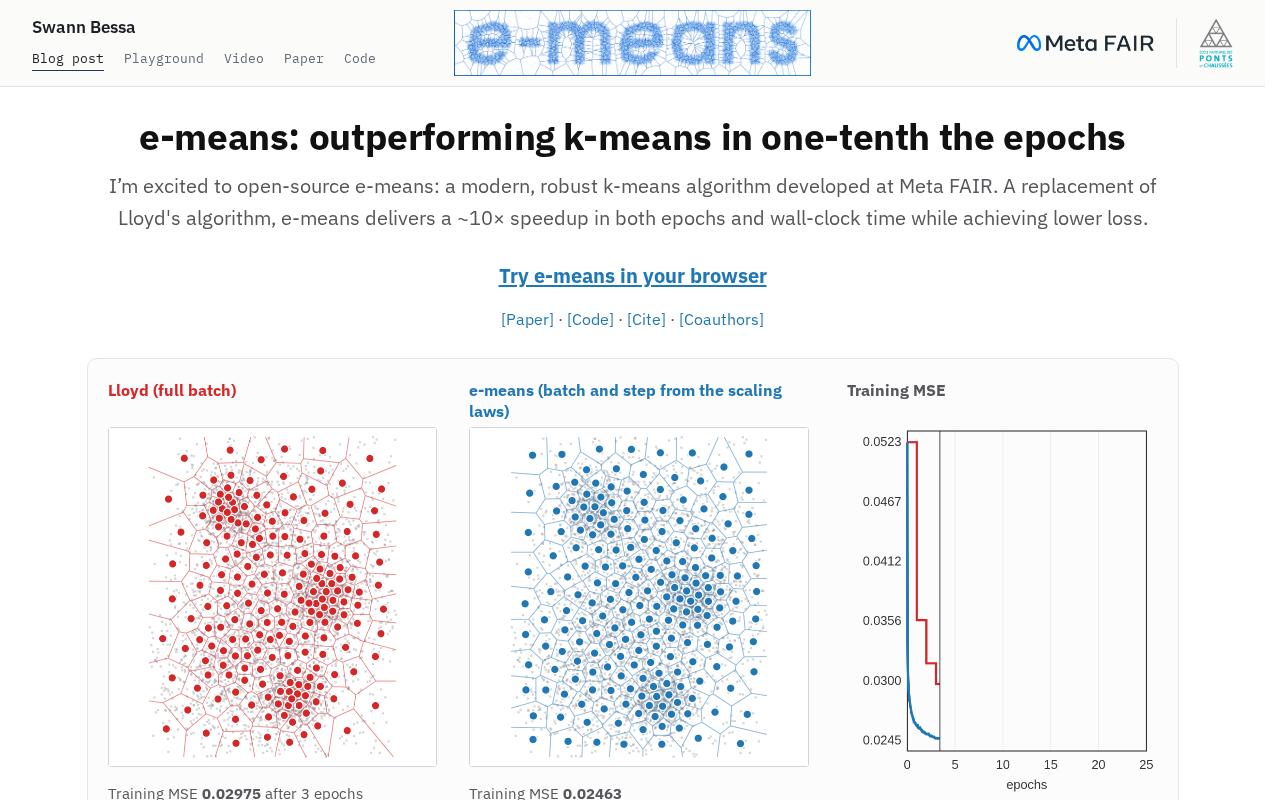
E-means claims 10x k-means speedup at equal loss, but independent reproduction is needed.
The article discusses the E-means project, which claims to achieve 10x k-means speedup under "equal loss" conditions. The author notes that k-means acceleration methods are not scarce—reducing iterations, MiniBatch sampling, and approximate nearest neighbors all sacrifice clustering quality—while "equal loss" is a stricter standard: speedup cannot come from cutting corners. Evaluation must fix random seeds, unify convergence criteria, and cross-validate across multiple datasets. If the speedup holds broadly, pipelines that repeatedly run clustering would benefit. But single-source claims should be independently reproduced, as real-world data characteristics may weaken the effect.
k-means is one of the most classic clustering algorithms in machine learning, but its iterative convergence process can often be time-consuming. The E-means project, recently discussed in the technical community, claims to achieve 10x speedup under "equal loss" conditions. If this claim holds, it would be significant for scenarios relying on large-scale clustering.
What Is E-means
According to the project homepage (e-means.github.io), E-means aims to significantly improve k-means runtime while maintaining clustering quality (i.e., without degrading loss). The project received 231 points and 13 comments on Hacker News, indicating genuine community interest in "lossless speedup" propositions—after all, k-means is used in recommender systems, image segmentation, vector retrieval preprocessing, and many other engineering scenarios, where any constant-factor speedup directly translates into cost savings.
It should be noted that publicly available information mainly comes from the project homepage itself, and technical details in the original discussion thread are limited. Therefore, this article focuses on the engineering value of such acceleration approaches and the validation blind spots to watch for, rather than restating specific implementations.
The k-means loss function typically refers to Within-Cluster Sum of Squares (WCSS), i.e., the sum of squared Euclidean distances from each sample to its assigned cluster center. The algorithm monotonically reduces this loss by alternating between "assigning samples to the nearest cluster center" and "updating cluster centers to the cluster mean," until convergence to a local optimum. Since the objective function is non-convex, the final loss depends heavily on the choice of initial cluster centers (the classic approach being k-means++ initialization), which is why results fluctuate across different random seeds. Understanding this is important: the "equal loss" comparison is not against the global optimum, but rather the local optimum level achieved under the same initialization and convergence conditions.
Why the "Equal Loss" Qualifier Matters
Speedup Is Easy; Not Sacrificing Quality Is Hard
k-means acceleration methods are not scarce: reducing iterations, MiniBatch sampling, approximate nearest neighbor acceleration of distance computation, or simply lowering initialization quality can all make the program run faster. But most of these methods come at the cost of clustering quality—increased loss and degraded cluster structure. By putting "equal loss" in the title, E-means voluntarily accepts a stricter testing standard: speedup cannot be achieved through cutting corners.
This qualifier also determines the evaluation methodology. If only runtime is compared, any approximate method can win; only when wall-clock time is compared at the same loss level does the speedup ratio become meaningful. The common skepticism toward such claims in community discussions precisely centers on how "equal loss" is defined and measured.
MiniBatch k-means is a common acceleration variant: each iteration only samples a small batch from the data to update cluster centers, rather than traversing the full dataset. It can significantly reduce per-iteration overhead, but due to noise in gradient estimation, the converged loss is typically slightly higher than standard k-means, and cluster boundaries may be less precise. Another approach uses approximate nearest neighbors (such as KD trees, ball trees, or approximate indexes like HNSW) to accelerate the "find nearest cluster center for each sample" step, replacing exact distance computation with approximate retrieval—at the cost of potentially assigning samples to suboptimal clusters. These methods are precisely the concrete illustration of "speedup is easy, losslessness is hard"—their acceleration is all built on the premise of relaxing precision.
Measurement Pitfalls in Loss Alignment
In practical validation, "equal loss" involves at least three variables: initialization randomness, convergence criteria (iteration limit vs. loss threshold), and the distribution characteristics of the dataset itself. The final loss of k-means fluctuates across different random seeds; if the baseline is not run sufficiently, acceleration methods can easily "appear" lossless in comparison. Therefore, reproducing such results should fix seeds, unify convergence conditions, and cross-validate across multiple datasets.
The choice of convergence criterion significantly affects the comparability of "equal loss." If a fixed iteration limit is used as the stopping condition, a faster algorithm may complete more iterations within the same wall-clock time, thereby gaining an advantage in loss; if a loss change threshold (e.g., loss difference between consecutive iterations less than 1e-4) is used as the criterion, then what is compared is the actual time required to reach the same precision, which is closer to the intent of "lossless speedup." Additionally, evaluation should report the mean and variance of loss across multiple runs (different random seeds) and use paired comparisons rather than single results—otherwise, one instance of "bad luck" for the baseline is enough to create a spurious speedup ratio.
Potential Impact on Engineering Practice
If E-means' speedup holds on broader datasets, the most direct beneficiaries would be pipelines that repeatedly run clustering: cluster feature generation during feature engineering, coarse clustering of large-scale vector databases, and services requiring online cluster center updates. A 10x magnitude means tasks that originally took hours could be compressed to tens of minutes, thereby changing pipeline design trade-offs—for example, shifting from "offline batch clustering" to "more frequent re-clustering."
However, it must be emphasized that single-source speedup claims should undergo independent reproduction before engineering deployment. Project homepages typically showcase the most favorable benchmark configurations; the long-tail distribution and high-dimensional sparse features of real business data may weaken the speedup effect.
Taking Community Hype Calmly
The 231 points and 13 comments on Hacker News indicate the topic has reach, but the comment count is relatively low compared to upvotes, suggesting limited discussion depth. For algorithm acceleration projects, community hype reflects more "topic attractiveness" than "conclusion reliability." The rational approach is: pay attention to the benchmark setup details on the project homepage, conduct small-scale controlled experiments on your own data, and then decide whether to introduce it into production.
Summary
E-means' claim of "10x speedup at equal loss" is a strong statement with clear testing criteria, and its value lies in bringing the trade-off between speedup and quality to the forefront. For algorithm engineers, such projects are worth following—but even more worth verifying firsthand.
One-line Summary
E-means claims 10x k-means speedup at equal loss, but independent reproduction is needed to verify.
Paragraph Summary
The article discusses the E-means project, which has been hotly debated in the technical community and claims to achieve 10x k-means speedup under "equal loss" conditions. The author notes that k-means acceleration methods are not scarce—reducing iterations, MiniBatch sampling, and approximate nearest neighbors all sacrifice clustering quality—and "equal loss" is a stricter testing standard: speedup cannot come from cutting corners. Therefore, evaluation must fix random seeds, unify convergence criteria, and cross-validate across multiple datasets, being wary of false losslessness caused by insufficient baselines. If the speedup holds on broader data, beneficiaries would be pipelines that repeatedly run clustering, such as feature engineering, vector database coarse clustering, and online cluster center updates. However, single-source claims should be independently reproduced before deployment, as long-tail and high-dimensional sparse features of real business data may weaken the effect. Community hype reflects topic attractiveness rather than conclusion reliability; the rational approach is to conduct small-scale controlled experiments on your own data.
Related articles

Fable 5.2's Self-Improvement Loop Accelerates as Gemini 4 Carbon Closes In
Anthropic Fable 5.2 and Google Gemini 4 Carbon launch together, Remote Labor Index doubles, self-improvement loop accelerates, but benchmark flaws and evaluation awareness persist.

Meta FAIR Releases e-means: A New k-means Alternative That Converges 10x Faster
Meta FAIR releases e-means in FAISS 1.16.0, replacing mini-batch k-means with ~10x fewer epochs, 10-45x GPU speedup, and no new hyperparameters.

AI Is Great at Writing Code, So Why Are Codebases Becoming More Fragile?
AI coding tools boost efficiency but may make codebases fragile. Based on a developer blog and Hacker News discussion, this article analyzes the hidden costs of AI-generated code, community divisions, and practical suggestions for reducing risks.