Echo Agent Deep Dive: A Self-Hosted AI Agent Operating System

Echo Agent is a self-hosted multi-agent AI operating system for private deployment
Echo Agent is an open-source self-hosted Agent operating system that coordinates four specialized roles—Planner, Coder, Researcher, and Operator—to handle complex tasks through division of labor. Its core technical highlights include a four-layer cognitive memory system based on the forgetting curve (surpassing traditional RAG with contradiction detection and dynamic weight management) and an LLM-driven intelligent security approval mechanism, aiming to build a 24/7 AI team residing on your own server.
Overview: When an AI Team Lives on Your Server
In the AI Agent space, most products are either locked into cloud services or too limited in functionality to enable real collaboration. Echo Agent offers a different answer—building a self-hosted Agent operating system that lets a team of specialized AI roles run 24/7 on your own server.
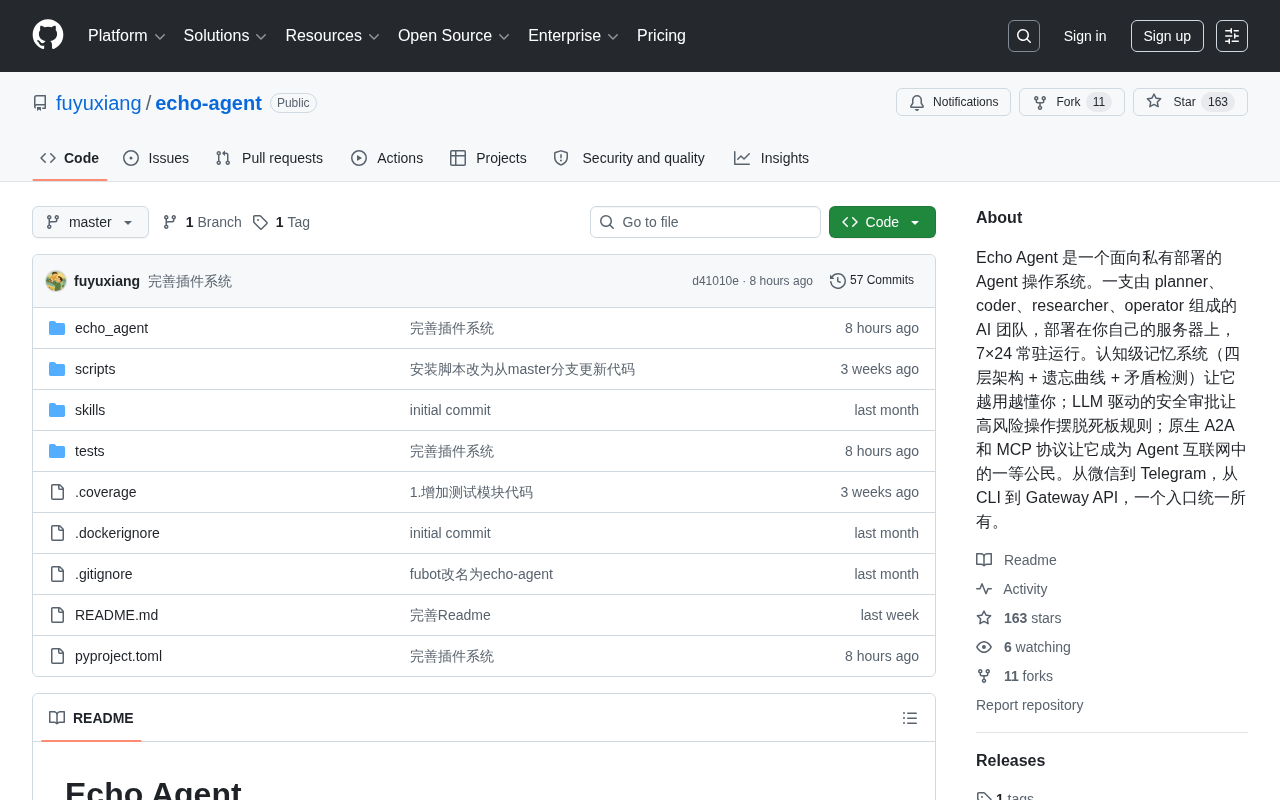
This open-source project (163 GitHub Stars, built with Python) has a clear positioning: it's not a simple chatbot, but a complete Agent operating system equipped with cognitive capabilities, a security approval mechanism, and protocol interoperability.
Four Core Roles: Division of Labor in a Multi-Agent System
Multi-Agent Systems (MAS) are a key branch of distributed artificial intelligence. The core idea is to decompose complex tasks across multiple agents with different specializations working collaboratively. Compared to a single Agent, multi-agent architectures offer stronger fault tolerance, parallel processing capabilities, and deeper specialization. Research on multi-agent collaboration theory dates back to the 1980s in academia, but it wasn't until the emergence of Large Language Models (LLMs) that natural language-based inter-agent collaboration became an engineering reality. The successive appearance of frameworks like AutoGen, CrewAI, and LangGraph marks a pivotal shift from academic research to production-grade implementation.
Echo Agent's architecture revolves around four core roles, each handling distinct responsibilities and collaborating to accomplish complex tasks that a single Agent would struggle with.
Planner — Task Decomposition and Orchestration
The Planner acts as a project manager. When a user presents a complex requirement, the Planner breaks it down into executable subtasks, coordinates other roles to complete them in sequence, and ensures the overall workflow is logical and efficient.
Coder — Code Generation and Execution
The Coder focuses on code-level work: writing scripts, debugging programs, and automating tasks. In a self-hosted deployment, the Coder can directly operate on your code repositories and development environments, truly integrating into daily development workflows.
Researcher — Information Retrieval and Knowledge Synthesis
The Researcher handles web searches, document analysis, and distilling key information to provide data-driven support for team decisions. It serves as the "intelligence officer" of the entire Agent team.
Operator — System Interaction and Operations
The Operator is the execution layer, responsible for interacting with external systems, executing specific commands, and managing operational tasks—turning plans into real-world results.
The core advantage of this multi-role collaboration model lies in specialized division of labor—clear responsibility boundaries deliver far greater collaboration efficiency than the "one Agent does everything" approach.
Cognitive-Level Memory System: The Key Technology That Gets Smarter Over Time
Echo Agent's most technically sophisticated design is its cognitive-level memory system, which employs a four-layer architecture to simulate the hierarchical structure of human cognition.
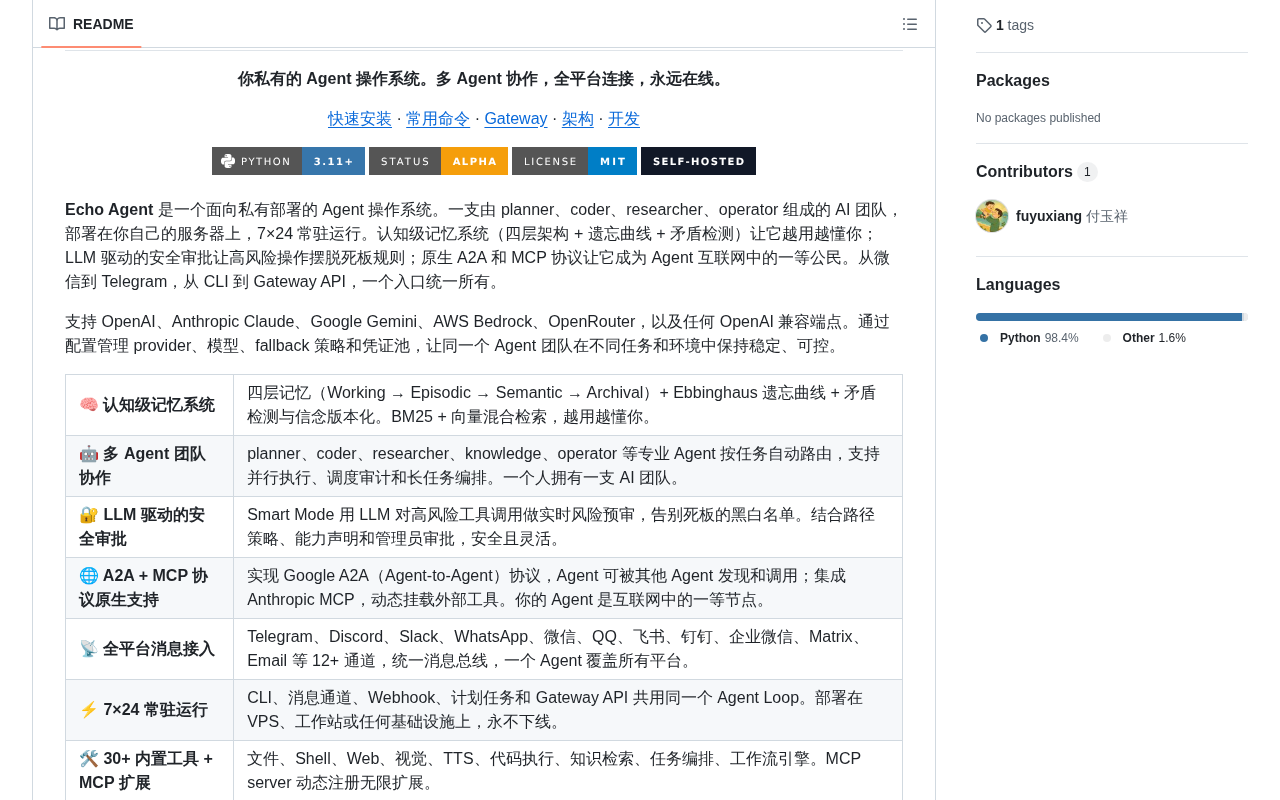
Design Logic of the Four-Layer Memory Architecture
From immediate working memory to long-term knowledge accumulation, each layer serves a distinct purpose. Short-term memory handles the current conversation context, while long-term memory accumulates user preferences, historical decisions, and domain knowledge. This layered design enables the Agent to respond quickly to immediate needs while continuously building its understanding of the user.
Notably, this cognitive-level memory system differs fundamentally from mainstream RAG (Retrieval-Augmented Generation) approaches. RAG's core logic involves chunking documents, vectorizing them for storage, and retrieving relevant segments via semantic similarity during queries to inject into context—this is essentially "searching" rather than "understanding." It doesn't differentiate information timeliness, doesn't handle contradictory information, and doesn't build a user cognitive model. Echo Agent's cognitive memory goes further by introducing dynamic memory weighting, temporal decay, contradiction detection, and proactive update mechanisms. The goal is to enable the Agent to "accumulate understanding of a specific user" like a human would, rather than merely "searching for answers in a knowledge base." This represents a critical architectural distinction in the progression from information retrieval to truly personalized intelligence.
Dynamic Weight Management Based on the Forgetting Curve
Drawing on Ebbinghaus's forgetting curve theory, the system implements dynamic weight management for memories: frequently accessed memories are reinforced, while long-unused memories gradually decay. The Ebbinghaus forgetting curve, proposed by German psychologist Hermann Ebbinghaus in 1885, describes how human memory decays over time—newly learned information is forgotten most rapidly in the first few hours, then gradually stabilizes. This theory has been widely applied in spaced repetition learning systems (such as Anki). Applying it to AI memory management means the system no longer treats all historical information equally, but instead simulates the human cognitive priority mechanism, giving higher retrieval weight to high-frequency, high-value memories. This achieves more efficient knowledge management within limited context windows and storage resources. This mechanism kills two birds with one stone—it improves retrieval efficiency while preventing unlimited storage growth.
Contradiction Detection and Cognitive Updates
When new information conflicts with existing memories, the system can automatically detect contradictions and process them accordingly. For example: if a user previously said "I prefer Python" but later says "use Go from now on," the system identifies this change and updates its cognitive model rather than simply stacking contradictory information.
The design philosophy of this memory system far exceeds traditional vector database retrieval approaches. Its goal is to give the Agent the genuine ability to "understand the user," not just "search for relevant content."
LLM-Driven Security Approval: Smarter Than Rule Engines
In enterprise self-hosted deployment scenarios, security is an unavoidable core concern. Echo Agent takes a bold approach—using LLM-driven security approval to replace traditional rule-based access control.
Traditional approaches rely on hard-coded rule lists to determine whether an operation is permitted. While simple and straightforward, this method tends to be either too permissive or too restrictive when facing complex scenarios, and adjustment costs are high.
Echo Agent lets the LLM assess the risk level and reasonableness of operations, making more flexible approval decisions based on context. For example, deleting a temporary cache file versus deleting a database backup—though both are "delete" operations—carry vastly different risk profiles that an LLM can intelligently differentiate.
Related articles
 Product Reviews
The Programmer's Desk Setup Guide: Building a Workspace That Feels Like Home
Discover how programmers build productive, comfortable workspaces. From multi-monitor setups to ergonomic design, explore the desk philosophy that drives focus and flow.
 Product Reviews
Qoder vs Cursor Real-World Comparison: Which $20/Month AI IDE Is Better?
Hands-on comparison of Qoder vs Cursor AI IDEs: Agent autonomy, human interaction count, and architecture decisions. Qoder needed only 2 interactions vs Cursor's 8.
 Product Reviews
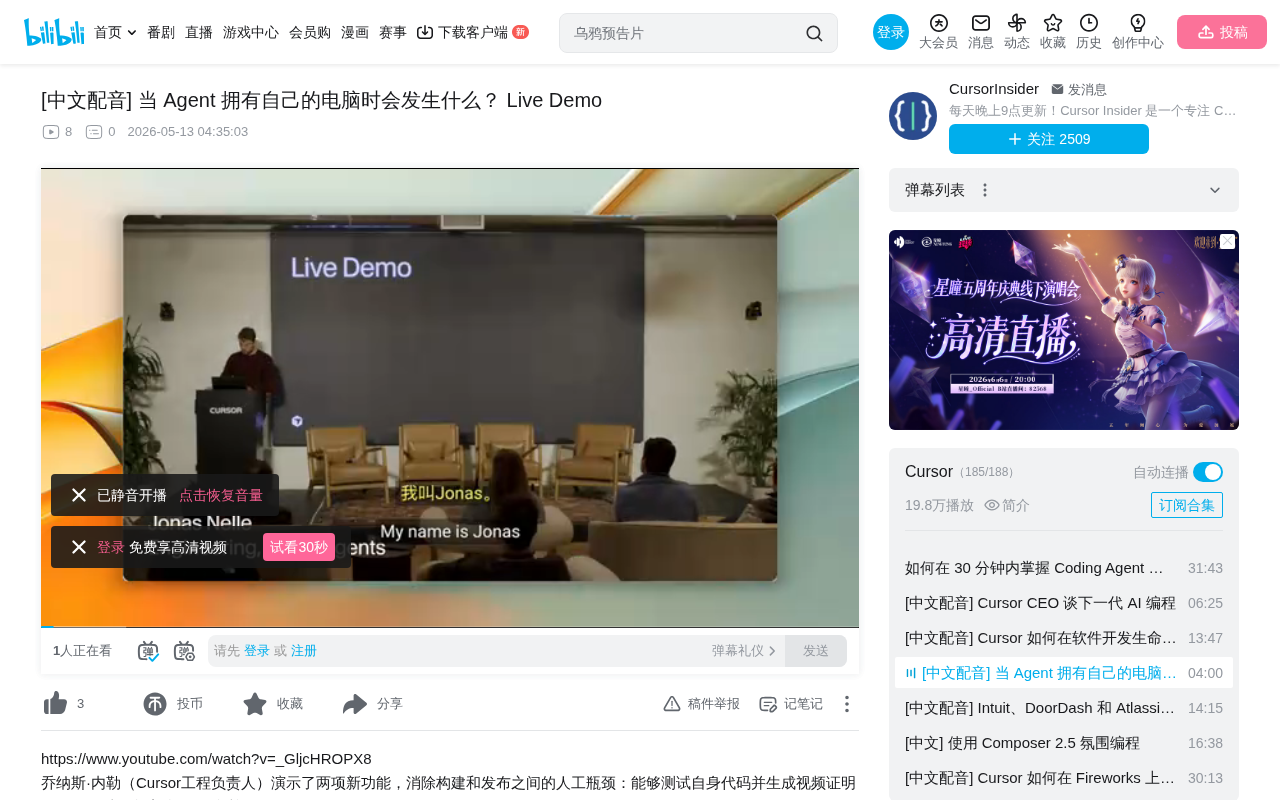
Cursor Cloud Agent Demo: Eliminating Bottlenecks Across the Entire Software Development Lifecycle
Deep analysis of Cursor's Cloud Agent demo showing how cloud VMs, automated test artifacts, and a full-chain control plane systematically eliminate human bottlenecks across the software development lifecycle.