EDG C++ Frontend Goes Open Source: The Hidden Giant of the Compiler World Steps Into the Light

EDG open-sources its battle-tested C++ compiler frontend, offering the industry a rare conformance reference.
EDG (Edison Design Group) is a long-obscured but critical vendor in the C++ compiler frontend space, with companies like Intel licensing its technology. EDG has now published its C++ frontend code on GitHub (edgcpp/compiler), sparking 231 upvotes and extensive discussion on Hacker News. Renowned for the most faithful implementation of the C++ standard — particularly in handling templates, overload resolution, and name lookup — EDG has long served as the industry's invisible conformance benchmark. The release gives researchers and compiler developers a rare look at these implementations and provides a third reference point beyond GCC and Clang/LLVM. However, the absence of a backend limits direct engineering use to static analysis, language research, and education; developers should also review the repository's license carefully.
Who Is EDG? The Invisible Infrastructure of C++ Compilation
Many C++ developers use EDG (Edison Design Group) technology every day without ever knowing the name. EDG has long specialized in building C++ frontends — the core compiler component responsible for parsing, semantic analysis, and language conformance checking. It doesn't generate machine code; instead, it operates as a frontend licensed and integrated into numerous commercial compilers.
Intel's compiler, along with several other long-established C++ toolchain vendors, have incorporated the EDG frontend into their products. The reason is straightforward: C++ is an extraordinarily complex language, and fully implementing its standard correctly — especially the finer points of templates, overload resolution, and name lookup — requires decades of engineering investment. EDG's reputation for strict adherence to the C++ standard and high-fidelity conformance has made it the industry's unofficial benchmark for compiler compliance.
Understanding EDG's role requires grasping the division between a compiler frontend and backend. The frontend transforms source text into a language-semantic intermediate representation, encompassing lexical analysis, parsing, semantic analysis, template instantiation, and name resolution. The backend then converts that intermediate representation into target-platform machine code and applies performance optimizations. C++ demands dedicated frontend specialists because its standard spans over 1,800 pages, with mechanisms like template metaprogramming, SFINAE (Substitution Failure Is Not An Error), and ADL (Argument-Dependent Lookup) presenting countless edge cases that even top-tier compiler vendors struggle to implement correctly. EDG has spent decades focused exclusively on the frontend, accumulating a depth of conformance implementation that far exceeds what most teams can achieve.
What This Open-Source Move Means
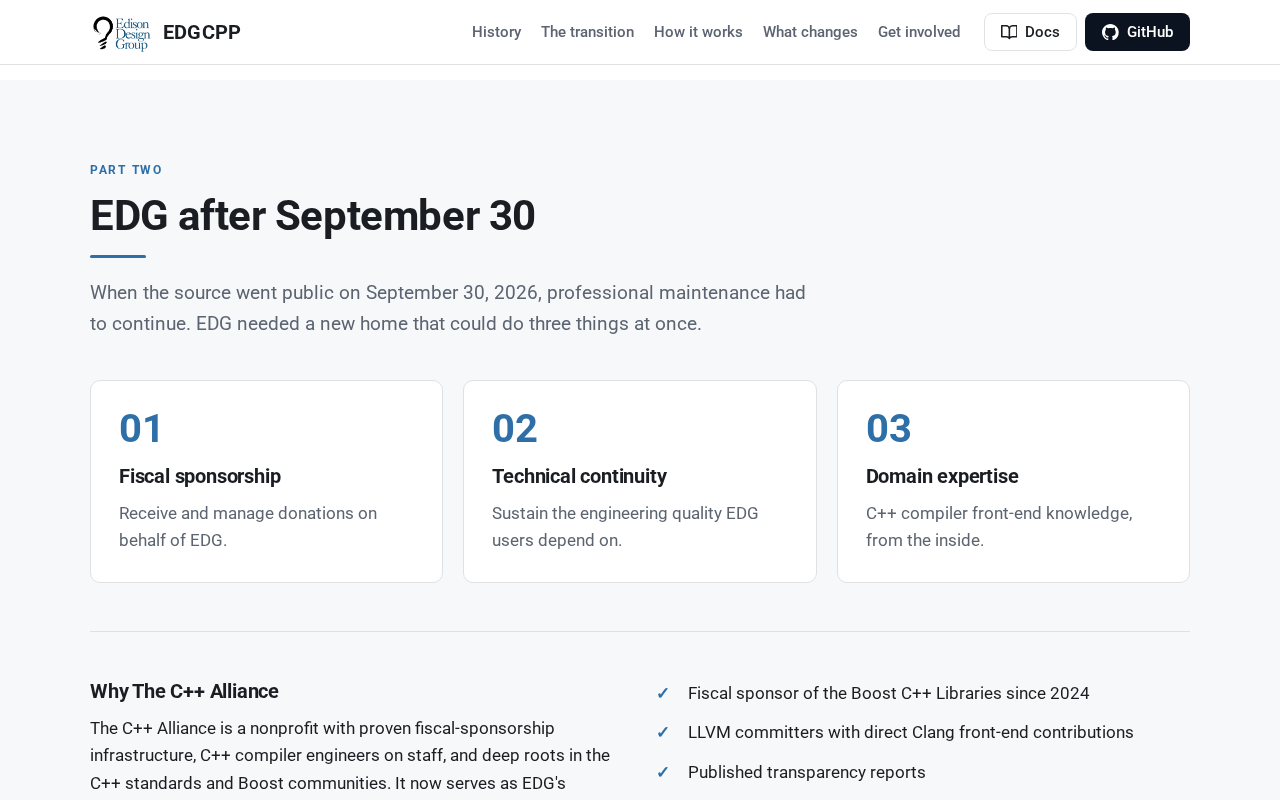
EDG's decision to publish its C++ frontend code on GitHub (edgcpp/compiler) generated significant attention in the compiler community — the topic earned 231 upvotes and hundreds of comments on Hacker News. For a team that has operated under a commercial licensing model with little public code exposure for so long, this represents a symbolically meaningful shift.
From a technical standpoint, the EDG frontend is widely regarded as one of the most standard-faithful C++ codebases in existence. Unlike GCC or Clang, it doesn't shoulder the full responsibility of taking source code to an executable — it concentrates entirely on frontend correctness. This focus means it often handles language edge cases, template instantiation, and diagnostic messages more strictly than mainstream open-source compilers. With the code now public, researchers and compiler developers can finally see exactly how those details are implemented.
Potential Impact on the Compiler Ecosystem
For years, the open-source C++ compiler landscape has been dominated by two camps: GCC and Clang/LLVM. The publication of the EDG frontend introduces a third reference point — not to replace existing tools, but to serve as a "standard conformance reference."
For compiler research, EDG's implementation approach can shed light on how the most obscure corners of the C++ standard are handled correctly. For education and academic work, it represents a rare high-quality engineering specimen — demonstrating the engineering trade-offs a mature C++ frontend makes when confronting the full complexity of the language. It's worth noting that code availability does not imply unrestricted commercial use; developers should carefully review the license terms in the repository.
A brief comparison of GCC and Clang/LLVM is helpful here. GCC (GNU Compiler Collection) is the longest-standing open-source compiler, with tightly coupled frontend and backend components, and has been the backbone of the Linux toolchain for decades. Clang is a frontend built on the LLVM architecture, known for its modular design, developer-friendly diagnostics, and embeddability — it has become the preferred choice at Apple, Google, and others, and serves as the foundation for many static analysis tools and language servers. Both have undergone extensive engineering optimization for code generation and runtime performance, which has sometimes meant that strict language standard conformance takes a back seat to practical engineering concerns. This is precisely where EDG's reference value lies: without the burden of a backend, it can devote all its attention to the question of how the language should be correctly understood.
Community Reaction and Open Questions
The lively Hacker News discussion reflects developers' complex feelings about this event. On one hand, many expressed excitement at being able to read this "industry benchmark" codebase; on the other, discussion touched on the motivations behind the release, the maintainability of the code, and whether it can be effectively utilized in real-world engineering.
A C++ frontend without an accompanying backend (code generation and optimization) has a relatively limited scope for direct use — it's better suited to static analysis tools, language servers, education, and compiler research. EDG's historical business model of licensing its frontend to other vendors who supply the backend itself illustrates the technical positioning of a frontend as a standalone module.
Conclusion: An Important Piece Now Made Public
The open-sourcing of the EDG C++ frontend is a noteworthy event in the compiler infrastructure world. It brings a technical component that long operated invisibly behind commercial licensing agreements into public view, offering rare first-hand insight into what "correctness" looks like in C++ language implementation. Regardless of how widely it ultimately gets adopted, the reference value of this codebase — for anyone who cares about compilers and the inner workings of C++ — cannot be overlooked.
Related articles

Understanding DeepSeek in 3 Minutes: The Rise from a Quant Hedge Fund to an Open-Source AI Leader
DeepSeek's history in 3 minutes: from High-Flyer Quant's compute build-up to V2's MLA inference cost cuts, V3's $5.576M training bill, R1's open-source global shock, and V4 with a $7B Series A.

Local Creative Writing Model Showdown: Fine-tuned Qwen3.8 27B Wins, DeepSeek v4.1 Underwhelms
Bilibili creator tests seven local creative writing models: Hemingway and HumanLike Chat based on Qwen3.8 27B perform best, DeepSeek v4.1 is plain, Dongfang Shuo ranks last with confused characters. Includes three test prompts, scores, and usage advice.

Liang Wenfeng's Three Big Bets: Why Did DeepSeek Open-Source Its 82% Gross Margin?
Why did DeepSeek open-source DeepInfer, its 82% gross margin inference framework, and then launch a hundred-billion funding round? An analysis of Liang Wenfeng's three big bets and the open-source strategy.