Edge AI in Practice: Why a 3B Small Model Can Beat a 70B Large Model

Edge AI's value isn't in shrinking cloud models, but in deploying 3B small models for narrow tasks and winning through scope discipline.
The article argues that edge AI is a different product category from cloud large models, driven by rigid constraints of latency, privacy, and connectivity rather than cost. 3B-class small models are sufficient for classification, extraction, routing, and structured output but cannot handle open-ended reasoning or long-tail knowledge; the core principle is 'one thing per deployment.' In practice, one must avoid being misled by development laptops, validate latency on real SoCs, and verify post-quantization accuracy with business labels rather than generic benchmarks. Teacher-student distillation combined with hybrid routing—high-confidence local execution, low-confidence to the cloud—is the most pragmatic architecture today. The article also emphasizes the operational cost of security, monitoring, power, and continuous on-site labeling, concluding that the ROI of edge AI comes from scope discipline rather than parameter count.
Cloud large models keep getting bigger, but the real business value often hides in scenarios that don't need a "big brain": a warehouse barcode scanner needs to determine cargo damage type within 200 milliseconds in a no-network environment, and a factory production line can't let quality inspection photos leave the premises. The answer for these tasks is clear—small models on the edge, 3B beats 70B.
This is not the story of a "shrunken cloud model," but an entirely different product category.
Why Edge Scenarios Are Naturally Suited to Small Models
The core advantage of edge computing is not "cheapness," but the rigid constraints of latency, privacy, and connectivity. The original text draws a clear line: when a task is narrow enough, latency-sensitive, involves private data, or operates under poor network conditions, edge inference is the only reasonable choice.
Specifically, the target latency for on-device inference on interactive devices is typically within 300 milliseconds, and cloud round-trips can hardly compete within this budget. Offline is not a "degraded fallback"—it is itself a product feature.
But small models have clear capability boundaries. Models at the 3B level excel at classification, information extraction, routing, and structured output (such as JSON schema, enum values, selection lists), but once open-ended reasoning or rare long-tail knowledge is involved, they fall short. So the question is never "can a small model work," but "is your task narrow enough."
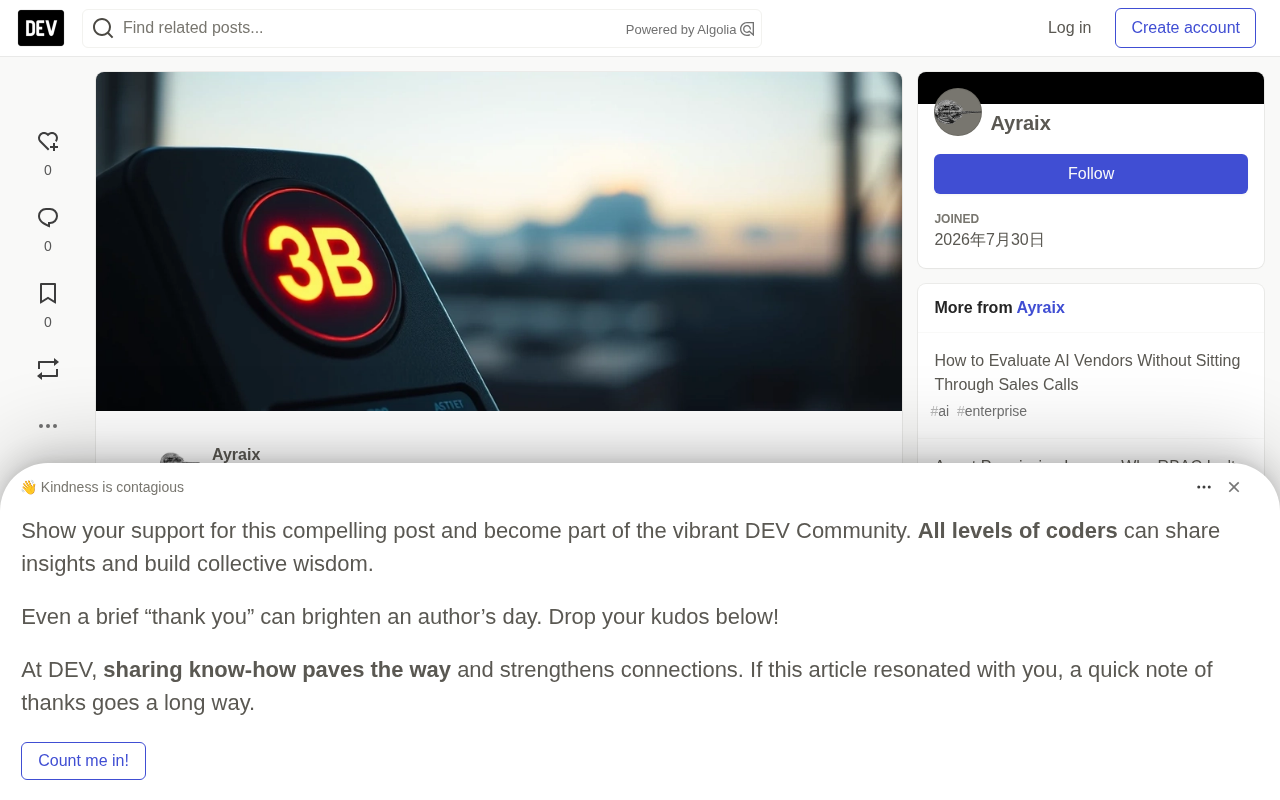
What a 3B model means. Here the "B" refers to the model parameter unit "Billion." 3B means approximately 3 billion parameters, one to two orders of magnitude smaller than the common cloud models of 70B (70 billion) and 405B (405 billion). Parameter count directly determines two things: how much knowledge the model can compress, and how many matrix operations are needed during inference. After INT4 quantization, a 3B model typically occupies only about 2GB of storage and similar memory at runtime, giving it a chance to fit into barcode scanners, industrial PCs, or Jetson-class devices with limited memory and compute. The cost is a significant reduction in long-tail knowledge and multi-step reasoning ability, so it is suited for "narrow and deep" tasks rather than general-purpose Q&A.
Quantization and Q4, Q8. Quantization is the process of compressing model weights from high-precision floating point (e.g., FP16, 2 bytes per parameter) into lower-bitwidth integer representations to reduce memory footprint and accelerate inference. Q4 means 4-bit quantization; an FP16 3B model is about 6GB, and after Q4 it can be compressed to about 2GB; Q8 is 8-bit, with less precision loss but greater size and compute overhead. Quantization introduces numerical errors, and the finer-grained the task (such as distinguishing similar dent types), the more likely precision degradation will surface. This is why the original text emphasizes that after quantization, validation must be done with real business labels—generic benchmark scores cannot reflect the degree of degradation on a specific task.
The Hardware Reality of Edge Deployment
Development laptops lie. This sentence is the most expensive lesson in edge AI deployment.
Edge devices face thermal throttling, memory bandwidth shared with cameras, and batteries that hate continuous inference. The latency budget you measured on an M3 Max may completely collapse in a warehouse at noon in July. Performance profiling must be done on actual SoCs—ARM NPUs, Jetson, industrial PCs—not on a development machine where you think everything is fine because it runs.
Quantization is standard practice for edge deployment, but precision validation after quantization must use real business labels, not MMLU scores. If a Q4-quantized 3B model can't distinguish dent types, then returning a result within 300 milliseconds is meaningless. Sometimes Q8 or a slightly larger model is the correct operational decision.
The hardware-level engineering checklist includes several key items: OTA-signed model packages with rollback mechanisms, offline-first UX design (queue and sync rather than blocking on the cloud), sensor fusion (camera combined with weight, barcode, RFID), and on-site error log collection with privacy filtering.
Edge AI failures happen in the field, not in the notebook—go test where the forklifts are.
Teacher-Student Pipelines and Hybrid Routing
Using a small model for edge inference does not mean abandoning the capabilities of large models. The teacher-student distillation pipeline is currently the most pragmatic approach: use a cloud large model to label edge cases, then distill into an on-device small model. Human review the samples where the two disagree—this is precisely the highest-value training set.
The iteration cycle should be monthly. Once product SKUs change, the edge model's accuracy will age.
Hybrid routing borrows the design philosophy of data center waterfall patterns, just with a different power budget. High-confidence predictions execute directly on-device, low-confidence ones queue for the cloud, and when network is lost, they are delayed or routed to human labeling. This logic is in line with The Waterfall Router Pattern.
Knowledge distillation. Teacher-student distillation is a transfer learning paradigm: let a capable "teacher" large model produce outputs (including soft labels or reasoning results) for a large number of samples, then have a "student" small model fit these outputs, thereby compressing part of the large model's capability into the small model. Compared with directly training a small model on a small set of human labels, distillation can leverage nearly unlimited unlabeled data to "carry" the large model's knowledge to the edge. The key risk of distillation is that the teacher also makes mistakes, especially on long-tail categories, and its errors are inherited verbatim by the student, which is why the original text emphasizes human review of samples where the two disagree.
Hybrid routing and waterfall. Hybrid routing means splitting the same set of inference requests by confidence: high-confidence ones close the loop locally on-device, low-confidence ones are uploaded to the cloud for the large model to handle. This idea originates from the data center's "waterfall" pattern—requests escalate through increasingly stronger models until quality requirements are met. Edge scenarios add power, bandwidth, and network outages as extra constraints: during outages, queue low-confidence samples rather than returning errors directly. It allows limited local compute to be spent only on the most certain parts while retaining the cloud's ability to handle hard cases.
Security, Monitoring, and Power Constraints in the Field
Edge devices get stolen, reflashed, and probed. Models must be signed, weights must be encrypted at rest, and keys must be rotated. A small model installed on a security facility camera is also an attack surface—firmware and model packages must be treated as confidential. Threat modeling for physical access must be done separately from the cloud.
On the monitoring side, edge devices cannot phone home for every metric. Upload telemetry in batches when connected, and use local counters to record latency and error rates when offline. Design dashboards to tolerate offline gaps while avoiding blind spots. Devices report health summaries, not raw inference logs—a win for both bandwidth and privacy.
Battery-powered devices especially need to watch power consumption. Always-on visual inference drains battery quickly; use wake words or button triggers for inference, limiting inference to a few seconds per event rather than continuous streaming.
The attack surface of edge devices. Edge devices are deployed in the physical world and can be stolen, disassembled, or physically reflashed, which is fundamentally different from cloud models that only expose APIs. Once an attacker obtains the device, they can read stored weights, firmware, and keys, or even replace them with a malicious model. Therefore, model packages and firmware must be digitally signed with rollback support, weights must be encrypted at rest, and keys must be rotated regularly to prevent extraction for imitation or poisoning. Threat modeling must also be done separately: the cloud focuses on network and account security, while the edge must additionally consider physical contact, side channels, and supply chain tampering.
OTA and offline-first. OTA (Over-The-Air) refers to remotely delivering firmware or model updates over the network. Networks in edge scenarios are unreliable, so OTA must have signature verification, resumable transfer, and failure rollback; otherwise, a failed update could brick an entire batch of devices. Offline-first is a product design principle: assume no network by default, treat synchronization as a background queued task rather than making users wait on a cloud response. It makes "usable when disconnected" a design premise rather than an afterthought.
Labeling Economics: The Underestimated Operational Cost
The deployment cost of edge models is not just the time of ML engineers; an operational budget must also be reserved for on-site labeling. Labels generated by the teacher model will drift on long-tail categories if they are not human-reviewed.
Monthly label review should focus on edge misclassification samples. When SKUs change faster than the retraining cycle, the small model will "rot." This is a pit many teams don't encounter during the POC stage but inevitably step into at scale.
Define the Task First, Then the Model
All the failure modes in the original text—thermal throttling, post-quantization misclassification, model aging between SKU changes—point to the same root cause: someone tried to make a 3B model do more than one thing.
A 3B model for a narrow task in a harsh environment beats a 70B model you can't run offline. The ROI of edge AI comes from scope discipline, not parameter count—protecting that discipline takes more effort than protecting the weights.
The enemy of edge AI is not model size, it's scope creep. Do one thing per deployment.
The economics of small models in edge scenarios flip fundamentally: a one-time silicon cost replaces a per-token API bill. Privacy protection is just a side effect, not the selling point.
Action items: This week, find one inference task in your pipeline that doesn't need a model larger than 70B—classification, extraction, or formatting. Constrain it to a 3B model, run it locally, and measure latency, accuracy, and cost. The gap will be smaller than you think, and the improvement in operational simplicity will be larger than you think.
One-line Summary
Edge AI's value is not in shrinking cloud models, but in deploying 3B small models for narrow tasks and winning through scope discipline.
Paragraph Summary
The article points out that edge AI is a different product category from cloud large models, driven by the rigid constraints of latency, privacy, and connectivity rather than cost. 3B-class small models are sufficiently capable for classification, information extraction, routing, and structured output, but cannot handle open-ended reasoning and long-tail knowledge; the core principle is "do one thing per deployment." In practice, one must be wary of the misleading development notebook, validate latency on real SoCs, and test post-quantization accuracy with business labels rather than generic benchmarks. Teacher-student distillation combined with hybrid routing—high-confidence local execution, low-confidence to the cloud—is currently the most pragmatic architecture. The article also emphasizes security, monitoring, power, and the operational cost of continuous on-site labeling, concluding that the return on edge AI comes from scope discipline rather than parameter count.
Related articles

How Big Can Stars Really Get? The Physical Limits of the Largest Stars
Red supergiants are the largest stars by volume, with radii up to 2,000 times the Sun, engulfing the inner solar system. But there is no precise upper limit on stellar size—models predict up to 15,000 solar radii. The most massive blue stars are far smaller than red supergiants—biggest and heaviest are two different things.

Apple HomeView Smart Display Full Feature Breakdown: Wall-Mount or Desktop, $299
Apple launches HomeView, a $299 smart display with wall-mount and desktop options, 12MP camera for facial recognition, smart home control, music playback, and recipe step-by-step cooking. Full breakdown of watch faces, apps, privacy, and cooking integration.

Where Did the Promised New Studio Go? Craft Computing Answers After Five Years
Craft Computing's host responds to viewer questions: the new studio promised five years ago was shelved as construction costs soared from $30,000 to $75,000, and was replaced by a 168-square-foot garage conversion.