Edgemetry: A Zero-Cost, Self-Hosted Web Analytics Tool — Privacy-First with Cloudflare Free Tier Deployment

Edgemetry offers free, privacy-first web analytics via Cloudflare's edge infrastructure.
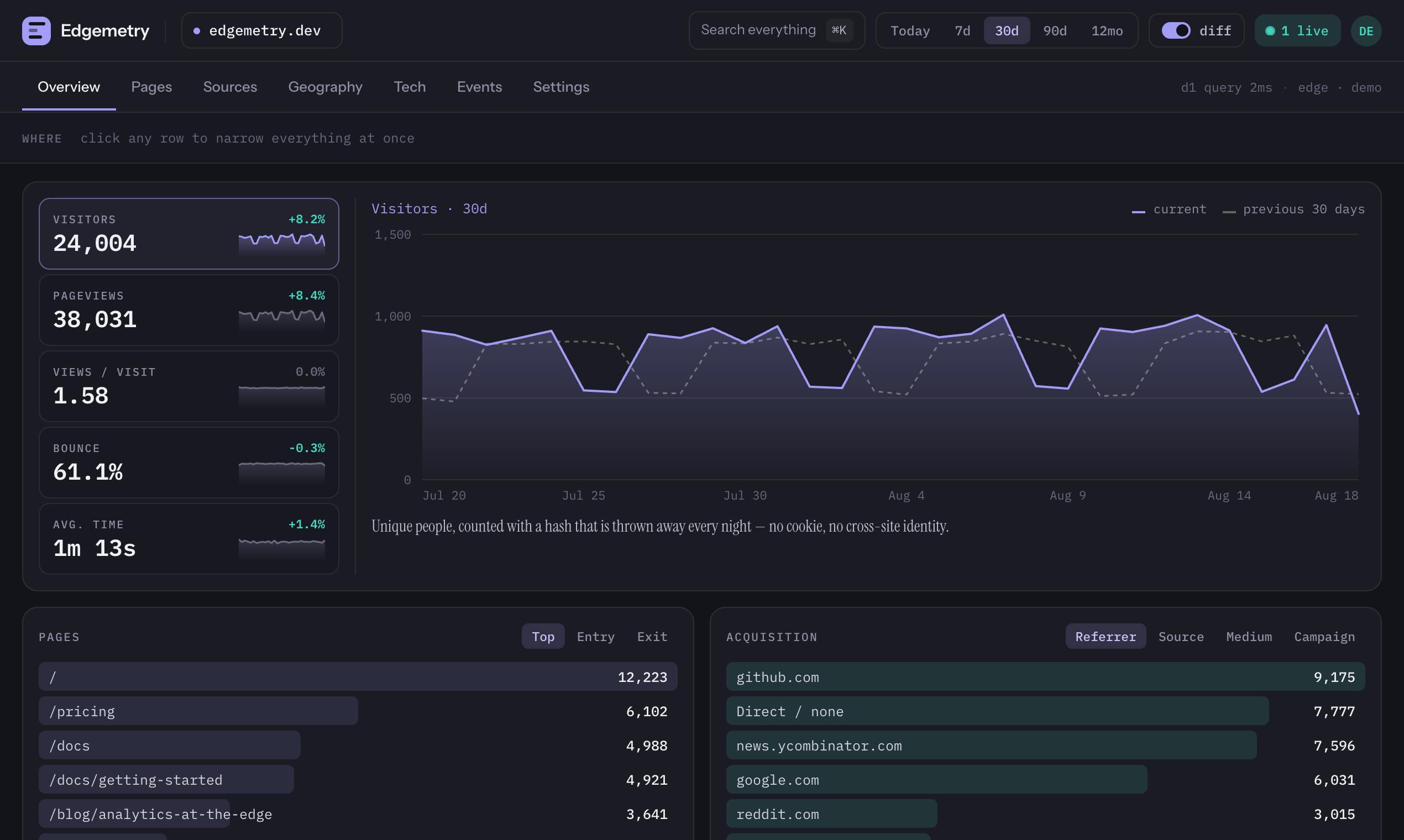
Edgemetry is a self-hosted web analytics tool built entirely on Cloudflare's free tier using Workers and D1 database. It features no cookies, no consent banners, and a 2.1KB lightweight script, supporting ~20,000 daily visits with unlimited data retention at zero cost. Designed for privacy-conscious developers, it represents the growing trend of edge-based, self-hosted alternatives to Google Analytics.
Edgemetry: A Privacy-First, Self-Hosted Web Analytics Tool
In a world where Google Analytics has become the de facto industry standard, a growing number of developers and website operators are seeking alternatives that balance privacy compliance with cost efficiency. Edgemetry, which recently debuted on Product Hunt, is exactly that kind of product — it champions a "privacy-first" approach and is built entirely on Cloudflare's free tier. It has already garnered 89 upvotes, ranking 11th on the day it launched.
Unlike traditional SaaS analytics services, Edgemetry's core philosophy is self-hosted: you run your own analytics backend, and the data stays entirely in your hands. Its architecture is remarkably lean — a single Cloudflare Worker plus a D1 database is all it takes to deploy, and the team claims it can be done with "one-click deployment."
In the privacy-first web analytics space, an increasingly vibrant ecosystem has taken shape. Plausible Analytics (open-source, offering both hosted and self-hosted options starting at $9/month) and Fathom Analytics (a commercial product starting at $14/month) are currently the two best-known choices. The open-source camp also includes solutions like Umami and Matomo. Edgemetry differentiates itself by being completely free and built on an edge computing architecture. The rapid growth of this niche market is driven by the global trend of ever-tightening privacy legislation — beyond the EU's GDPR, the US CCPA, Brazil's LGPD, and China's Personal Information Protection Law are all strengthening protections around user data.
Cookie-Free, Consent-Banner-Free Privacy Compliance by Design
Edgemetry's most noteworthy feature is that it sidesteps privacy compliance pain points by design. It uses no cookies and requires no consent banners.
This is especially important for websites serving EU users. The GDPR (General Data Protection Regulation), which took effect in the EU in May 2018, is one of the world's strictest data protection laws. It applies to any organization processing personal data of EU residents, with fines for violations reaching up to 4% of global annual revenue or €20 million. The companion ePrivacy Directive (also known as the Cookie Law) specifically addresses privacy in electronic communications, requiring websites to obtain explicit user consent before setting non-essential cookies. The combined effect of these two regulations has spawned those ubiquitous "Accept All Cookies" pop-ups that degrade user experience and increase legal risk.
Edgemetry bypasses this burden entirely through its cookie-free technical approach — a philosophy shared by next-generation privacy analytics tools like Plausible and Fathom. For website operators, this means cleaner pages, lower compliance costs, and no need to make painful trade-offs between "data insights" and "user privacy."
A 2.1KB Lightweight Script with Excellent Performance
Embedding Edgemetry requires adding just a 2.1 KB script. By comparison, Google Analytics' gtag.js weighs roughly 28KB after compression, and with additional resources it loads, the total payload can exceed 70KB while also generating extra DNS lookups and network requests. A smaller script means faster page loads and less performance overhead.
This is a tangible advantage for modern websites focused on Core Web Vitals. Core Web Vitals are a set of key web experience metrics introduced by Google in 2020, including LCP (Largest Contentful Paint, measuring loading speed), INP (Interaction to Next Paint, measuring interaction responsiveness), and CLS (Cumulative Layout Shift, measuring visual stability). These metrics directly affect Google search rankings, and third-party scripts are a common culprit for dragging them down. A 2.1KB script means the impact on page performance is virtually negligible.
Cloudflare Free Tier Architecture: Running an Analytics System at Zero Cost
Another major selling point of Edgemetry is cost. It runs entirely on Cloudflare's free tier, with the official claim being: unlimited historical data retention, support for approximately 20,000 visits per day, at zero cost.
The technical foundation of this architecture is worth breaking down:
-
Cloudflare Worker: A serverless computing platform built on the V8 engine (the JavaScript engine powering Chrome). Unlike traditional serverless solutions like AWS Lambda, it runs on Cloudflare's edge nodes spanning over 300 cities worldwide, rather than centralized data centers. This means code runs physically closer to users, with cold start times typically under 5 milliseconds — far better than the hundreds of milliseconds typical of traditional serverless functions. The Worker free tier provides 100,000 requests per day, a quite generous quota for analytics use cases.
-
D1 Database: An edge-native relational database launched by Cloudflare in 2022, built on SQLite — the world's most widely deployed database engine. Unlike traditional centralized databases, D1 stores data in Cloudflare's edge network, where read operations can be completed locally while writes are coordinated through a primary node for consistency. The free tier offers 5GB of storage, 5 million row reads per day, and 100,000 row writes per day. SQLite's lightweight nature makes it ideal for embedded and edge scenarios, and D1 adds enterprise-grade capabilities like automatic backups and point-in-time recovery on top of that.
For most personal blogs, indie developer projects, and small to medium-sized websites, the 20,000 daily visits quota is more than sufficient. And "unlimited historical data retention" addresses a common pain point where many free analytics tools only keep a few months of data.
Data Sovereignty Through Self-Hosting
The deeper value of the self-hosted model lies in data sovereignty. When you use a third-party SaaS analytics service, visitor data actually flows to the service provider's servers. Edgemetry stores all data in a D1 database under your own Cloudflare account, fundamentally eliminating the possibility of your data being aggregated, analyzed, or monetized by third parties.
This model also reduces the risk of vendor lock-in and gives operators full control over their data. It's worth noting that while data is stored on Cloudflare's infrastructure, the D1 database belongs entirely to the user's own account. Cloudflare explicitly states in its terms of service that it will not access or use data stored by users in D1 — a fundamental distinction from handing data over to a third-party analytics provider.
Edge Computing Architecture: Why It's Perfect for Web Analytics
To understand Edgemetry's technical advantages, it helps to grasp the architectural differences between traditional cloud computing and edge computing. Traditional cloud computing concentrates compute and storage in a handful of large data centers (such as AWS's us-east-1 region), where user requests may need to travel thousands of kilometers to reach a server. Edge computing pushes computational power to network edge nodes close to users, and Cloudflare's edge network spans over 120 countries worldwide.
For latency-sensitive but computationally lightweight scenarios like web analytics, an edge architecture is particularly well-suited — analytics requests can be processed at the nearest edge node, reducing both latency and backbone network bandwidth consumption. This architectural pattern is expanding from CDN acceleration into an increasing number of application scenarios and is widely regarded as the next evolution of cloud computing. Edgemetry is a concrete manifestation of this trend in the web analytics domain.
Who Is Edgemetry For?
From a product positioning perspective, Edgemetry is clearly aimed at technical users — developers who are familiar with the Cloudflare ecosystem and willing to deploy and maintain their own infrastructure. While the team emphasizes "one-click deployment," self-hosted solutions still require a certain level of technical proficiency for initial setup and ongoing maintenance compared to turnkey SaaS products.
Its target audience roughly includes:
- Indie developers who prioritize privacy and GDPR compliance
- Small teams looking to reduce web analytics costs
- Users already invested in the Cloudflare tech stack
- Webmasters seeking a lightweight alternative to Google Analytics
It's important to note that as a newly launched open-source project, Edgemetry may not match the feature richness, visualization capabilities, or ecosystem maturity of established commercial analytics platforms in the short term. For example, advanced features offered by Google Analytics 4 — such as event tracking, conversion attribution, audience segmentation, and machine learning insights — are typically absent from lightweight tools like Edgemetry. Its core competitive advantage lies in the combination of privacy, cost, and data sovereignty, rather than an all-encompassing feature set.
Conclusion: A New Trend in Web Analytics Driven by Edge Computing
Edgemetry represents an increasingly clear trend in web analytics: a shift from centralized third-party tracking toward lightweight, privacy-first, self-hostable edge solutions. By leveraging Cloudflare Worker + D1's free edge infrastructure, it makes "running your own analytics system at zero cost" a reality.
The underlying driving forces behind this trend converge from three directions: the continued tightening of global privacy regulations, the maturation and falling costs of edge computing infrastructure, and the developer community's growing awareness of data sovereignty. It's foreseeable that as edge platforms like Cloudflare, Vercel, and Deno continue expanding their free tiers, "zero-cost self-hosted" tools like Edgemetry will increasingly appear across various domains.
For technical users who care about privacy compliance, pursue peak performance, and are unwilling to pay for analytics, Edgemetry offers a compelling option. It may not be for everyone, but in an era where privacy is increasingly becoming a central concern, the value of self-hosted analytics tools like this will only continue to grow.
Related articles

Chain of Thought Isn't Just for AI: How Humans Can Use CoT to Improve Thinking Quality
Chain of Thought isn't just a prompt trick for large models. Starting from a Hacker News discussion, this article analyzes why CoT works for human thinking too, breaks down actionable ways to transfer it, and highlights the key differences between human CoT and machine CoT.
Cloudflare Teams Up with OpenAI: Closi…
Cloudflare Teams Up with OpenAI: Closing the Loop from Vulnerability Discovery to Defense with AI
Cloudflare uses OpenAI Daybreak to investigate security vulnerabilities and generate reviewable remediation plans, while developers use Codex to boost coding efficiency and quality.

Orca Multi-Agent Orchestration in Practice: A Guide to Parallel Collaboration with Claude and Codex
Orca is Stable AI's free open-source agent workbench supporting 34 agents like Claude Code and Codex in parallel. Learn its Git worktree isolation, multi-model orchestration, and mobile management.