EduBehaviors Framework: Making AI Annotation of Educational Dialogue Auditable

EduBehaviors introduces a two-stage observable-behavior pipeline for auditable LLM annotation of educational dialogue.
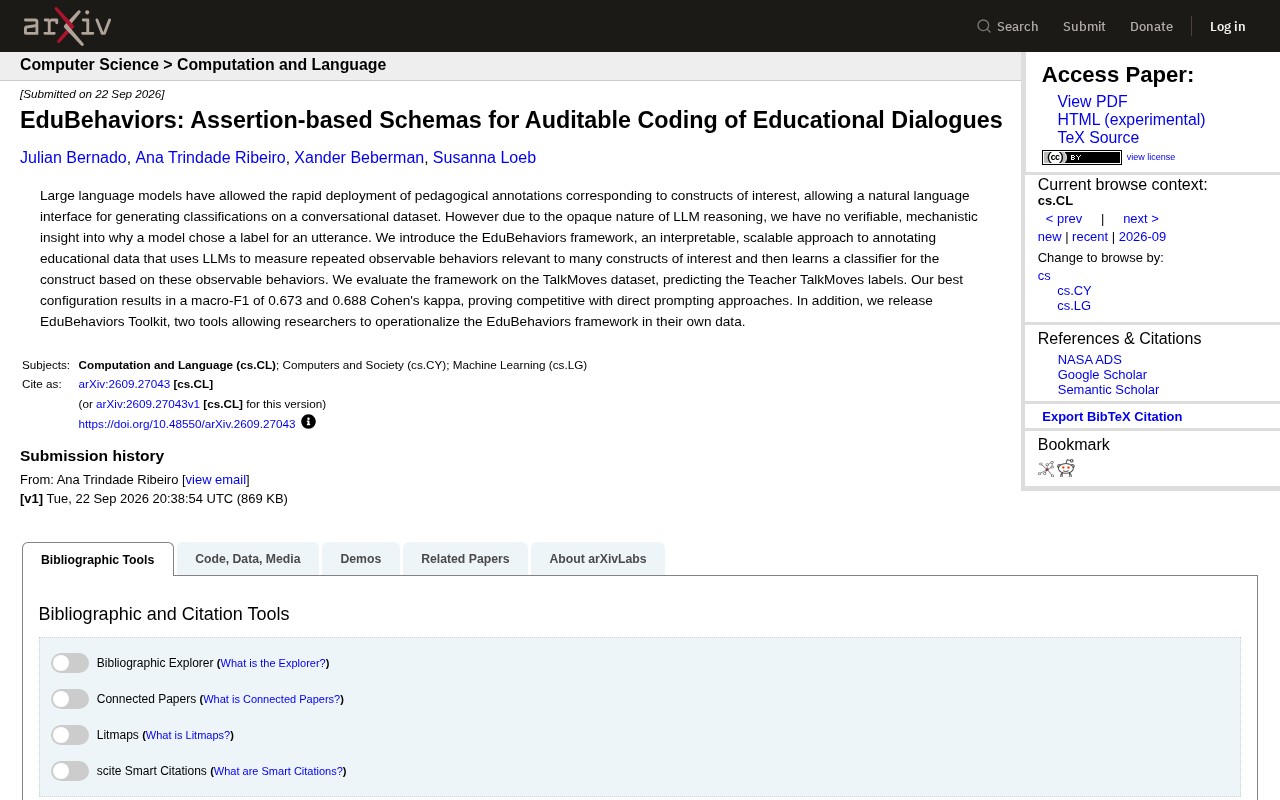
EduBehaviors is a framework proposed in a new arXiv paper that splits LLM annotation into two stages: first having the model identify concrete observable teaching behaviors, then training a classifier on those behaviors to predict abstract teaching constructs. This assertion-based schema decomposes opaque holistic judgments into verifiable intermediate steps, enabling auditable coding. On the TalkMoves classroom discourse dataset, the framework achieves a macro F1 of 0.673 and Cohen's kappa of 0.688, matching direct prompting while significantly improving interpretability. The authors also release the EduBehaviors Toolkit to lower adoption barriers, and the approach has broader relevance for high-stakes annotation in medical, legal, and other domains.
The Pain Points of LLM-Based Educational Data Annotation
The rise of large language models has enabled researchers to rapidly annotate educational dialogue data through natural language interfaces. Want to measure a specific teaching construct? Simply describe it clearly, and the model can classify an entire conversation sentence by sentence. This capability dramatically lowers the cost of manual coding in educational research.
The problem is that LLM reasoning is opaque. When a model assigns a label to a sentence, there is no verifiable, mechanistic explanation available — what exactly drove that decision? In educational research, where the rigor of conclusions is paramount, this "black box" nature becomes a serious obstacle. Researchers need more than a classification result; they need a reasoning path that can be reviewed and audited.
The Core Idea Behind EduBehaviors
To address this pain point, a new paper on arXiv proposes the EduBehaviors framework, centered on an "interpretable and scalable" approach to educational data annotation.
Its key design splits annotation into two stages. In the first stage, rather than asking the LLM to directly judge abstract teaching constructs, the framework asks it to measure recurring, observable behaviors. These behaviors tend to be relevant across multiple constructs and are inherently more concrete and verifiable. In the second stage, a classifier is trained on top of these observable behaviors to predict the target constructs.
The advantages of this assertion-based schema are clear: every step of the model's judgment is grounded in concrete, checkable behavioral evidence, rather than producing a hard-to-trace verdict in one shot. When auditing a particular label, researchers can trace back through the behavioral layer step by step — enabling auditable coding.
A teaching construct is a theoretical concept in educational research used to describe and measure instructional quality or the learning process — for example, "depth of teacher follow-up questioning," "student cognitive engagement," or "the dialogic quality of classroom talk." These constructs typically derive from educational theory, are abstractly defined, and difficult to observe directly. Traditional manual coding relies on trained coders reading large volumes of transcripts and annotating them sentence by sentence or segment by segment against a coding manual — a time-consuming and expensive process. The gap between constructs and observable behaviors is the root cause of LLM errors and opaque outputs in educational data annotation tasks: models lack a mechanism for stably mapping abstract definitions onto concrete linguistic features. EduBehaviors attempts to bridge this gap by introducing observable behaviors as an intermediate layer.
Performance on the TalkMoves Dataset
The paper validates the framework on the TalkMoves dataset, with the task of predicting teacher Talk Moves labels — a coding system for teacher classroom discourse behaviors.
Under the optimal configuration, the framework achieves a macro F1 of 0.673 and a Cohen's kappa of 0.688. Both metrics represent a competitive level for educational discourse annotation — Cohen's kappa measures annotation agreement, and 0.688 indicates substantial agreement with human annotations.
More importantly, the paper emphasizes that these results are competitive with direct prompting approaches. In other words, EduBehaviors trades for interpretability and auditability without meaningfully sacrificing accuracy. This is critical for wider adoption: if the cost of transparency is a dramatic drop in performance, the approach will be difficult to accept in practice.
TalkMoves is an important benchmark dataset in educational discourse research, sourced from real-world transcriptions of K-12 mathematics classrooms in the United States. The concept of "Talk Moves" was introduced by education researchers Michaels and O'Connor to describe a set of discourse strategies teachers use during classroom discussions to advance student thinking — such as "revoicing a student's contribution," "pressing for reasoning," or "inviting additions or challenges." These discourse behaviors are considered directly linked to students' development of mathematical reasoning, making them a central coding target in classroom discourse analysis. The annotation difficulty is high because a single utterance may simultaneously satisfy multiple Talk Move definitions, and inter-annotator agreement among human coders is itself hard to achieve at high levels. A Cohen's kappa above 0.6 is generally considered an acceptable baseline for this task.
The Practical Value of the Open-Source Toolkit
Beyond the methodology itself, the authors also release the EduBehaviors Toolkit, comprising two tools that help researchers apply this framework to their own data.
For the educational research community, this "framework + toolkit" combination is more meaningful than publishing a method alone. Educational dialogue data spans a wide variety of constructs, and different studies focus on different teaching behaviors. A general annotation pipeline mediated by observable behaviors could theoretically transfer to coding tasks across multiple constructs, and the accompanying toolkit lowers the barrier to making that transfer.
Implications and Reflections
EduBehaviors represents a direction worth watching: rather than trying to make LLMs smarter, it restructures the collaboration between humans and models — breaking down opaque holistic judgments into verifiable intermediate steps.
This kind of thinking is not limited to education. Any scenario that requires LLMs to perform high-stakes annotation with a need for traceable conclusions — medical record coding, legal document analysis, content moderation — faces a similar "black box" dilemma. Using observable behavioral assertions as an intermediate layer, then building a classifier on top, may be a general-purpose path that balances scalability with interpretability.
Of course, as a newly released preprint, its conclusions still require validation across more datasets and independent replications. A macro F1 of 0.673 also indicates there is room for improvement on the task itself. But the "auditable annotation" problem it raises genuinely touches on a core anxiety in applying LLMs to serious research.
Related articles

No Code Required: Using AI to Plan Production-Grade Application Architecture
No code, no problem: how to use AI to plan production-grade application architecture — database modeling, agent endpoint design, chat storage, and layered memory.

AI Writes Code, Will Programmers Lose Their Jobs? The Truth About Devin's Autonomous Programming
Devin and other autonomous AI coding agents are changing software development: from Copilot-assisted coding to fully automated engineering agents, the programmer's role shifts from writing code to system design and oversight. This article analyzes the impact of AI programming on employment, code security, and junior developer training, as well as the real direction of programmer demand under the efficiency paradox.

Citigroup's 14,000 Engineers Use Devin, Slashing Tech Outsourcing Bill by 30%
Citigroup's 14,000 engineers used AI coding agent Devin to cut its tech vendor bill by 30% and speed releases 30-40%, while JPMorgan says AI gains aren't in earnings yet.