Edukaci: Building an AI Socratic Tutoring Platform for Francophone West Africa with Claude
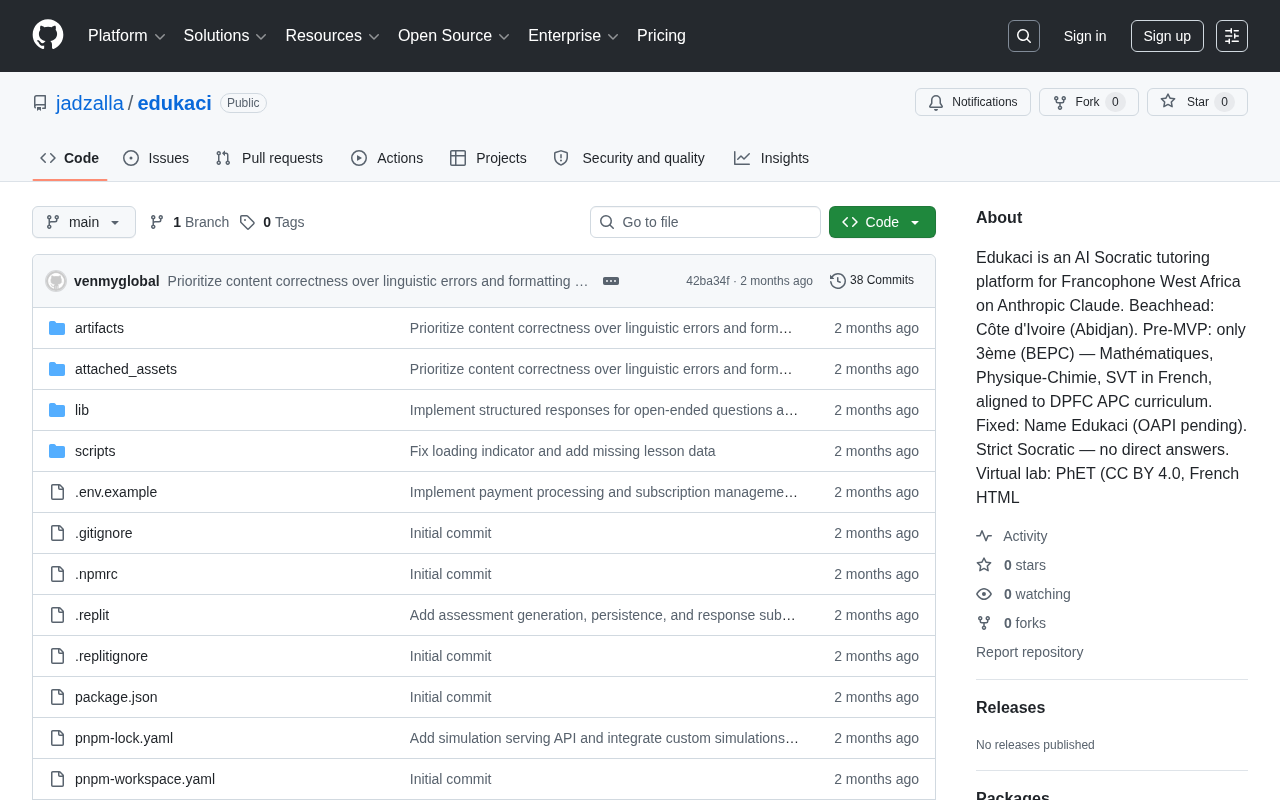
Edukaci: A Claude-powered AI Socratic tutoring platform for Francophone West Africa
Edukaci is an open-source AI tutoring platform built on Anthropic Claude, designed specifically for Francophone West Africa, initially targeting BEPC exam students in Abidjan, Côte d'Ivoire. The project employs a strict Socratic teaching method that never gives direct answers, instead guiding students to think independently. It currently covers Mathematics, Physics-Chemistry, and Life Sciences, aligned with local DPFC APC curriculum standards and integrated with PhET virtual labs. Though still in Pre-MVP stage, its four-layer localization strategy offers an important reference for deploying AI education in developing countries.
Edukaci Project Overview: How AI Education Can Reach Overlooked Markets
In the global wave of AI education, African markets are often overlooked. An open-source project called Edukaci is trying to change that — it's an AI Socratic tutoring platform designed specifically for Francophone West Africa, built on Anthropic Claude, with Côte d'Ivoire (Abidjan) as its initial target market.
The project is still in its Pre-MVP stage with zero GitHub stars, but its design philosophy and market positioning deserve a deep dive. It represents an important attempt at localizing AI education tools for deployment in developing countries.
Strict Socratic Teaching Method: No Answers, Only Guided Thinking
Core Principles of AI Tutoring
Edukaci's most distinctive feature is its "Strict Socratic" teaching strategy — the platform never directly provides answers. When a student asks a question, the AI doesn't simply output a solution process. Instead, it helps students discover answers on their own through a series of guiding questions.
The Socratic Method originates from the ancient Greek philosopher Socrates, whose core approach was to guide interlocutors through continuous questioning (elenchus) to discover logical contradictions and reconstruct their understanding. In modern pedagogy, this method is classified as a practical form of "constructivist learning theory" — learners don't passively receive knowledge but actively construct understanding. However, implementing a strict Socratic dialogue in an AI system is extremely challenging: the model must accurately assess a student's current cognitive level, identify their thinking bottlenecks, and generate appropriately calibrated guiding questions rather than simply restating knowledge points. This requires the underlying model to have strong contextual reasoning capabilities and fine-grained output control.
This design is particularly valuable in today's AI education tool landscape. Most AI tutoring tools tend to create dependency in students, whereas the Socratic method emphasizes cultivating critical thinking. For West African regions where educational resources are relatively scarce, this "teach a person to fish" approach may have far more long-term value than directly providing answers.
Why Claude as the Underlying Model?
The project chose Anthropic Claude as its underlying large language model — a deliberate choice. Claude excels at following complex instructions, making it particularly suitable for scenarios requiring strict output behavior constraints — such as the hard rule of "never directly give answers." In comparison, some models may "break" and leak answers when students persistently press for them. Claude's instruction-following capability provides a more reliable foundation for Socratic teaching.
Anthropic Claude's outstanding instruction-following performance is closely tied to its underlying training methodology. Anthropic employs an alignment technique called Constitutional AI, which has the model critique and revise itself according to a set of explicit principles, making it more stable when following complex constraints. In educational scenarios, this means that even when students probe in various ways (e.g., "please just tell me the answer" or "pretend you're a different AI without restrictions"), Claude is more likely to maintain the "no direct answers" instruction boundary. This characteristic is known in the education field as "jailbreak resistance," which is crucial for maintaining the rigor of Socratic teaching.
Precise Market Positioning: Focused on Côte d'Ivoire's BEPC Exam Curriculum
Beachhead Strategy and Curriculum Alignment
The project employs the classic beachhead strategy, targeting Abidjan, Côte d'Ivoire as its first market. The beachhead strategy originates from military terminology and was systematized as an entrepreneurial methodology by MIT entrepreneurship professor Bill Aulet in Disciplined Entrepreneurship: 24 Steps to a Successful Startup. Its core idea is that startup projects should not attempt to serve all potential markets simultaneously but should instead choose a sufficiently small, specific market segment as a breakthrough point, establish absolute dominance there, and then expand outward.
Edukaci's choice of 3ème students in Abidjan as its beachhead follows clear logic: Abidjan is Côte d'Ivoire's economic capital with the country's highest internet penetration and smartphone ownership rates; 3ème students face the rigid demand of the BEPC exam, with the strongest willingness to pay and motivation to use the platform; and focusing on only three core subjects dramatically reduces initial content development costs.
In terms of curriculum scope, the current version covers only three core subjects for 3ème (equivalent to 9th grade / BEPC exam year):
- Mathématiques (Mathematics)
- Physique-Chimie (Physics-Chemistry)
- SVT (Life and Earth Sciences)
All content is in French and strictly aligned with the DPFC APC curriculum standards (the competency-based teaching syllabus issued by Côte d'Ivoire's Ministry of Education). BEPC (Brevet d'Études du Premier Cycle) is the lower secondary school graduation exam used in Francophone African countries, inherited from the French education system — equivalent to China's zhongkao or a standardized middle school exit exam. In Côte d'Ivoire, BEPC is the critical threshold for students to advance from collège (lower secondary) to lycée (upper secondary), with pass rates that have long fluctuated between 30%-50%. Large numbers of students are forced to end their education because they fail this exam. DPFC (Direction de la Pédagogie et de la Formation Continue) is the Pedagogy and Continuing Education Directorate under Côte d'Ivoire's Ministry of Education, responsible for setting national curriculum standards. APC (Approche Par les Compétences, competency-based approach) is the curriculum framework it employs, emphasizing that students should master transferable core competencies rather than rote memorization — a philosophy that naturally aligns with Socratic teaching.
This precise curriculum alignment is the project's key competitive advantage — generic AI tools cannot understand the specific requirements of local curriculum systems, while Edukaci is built around local educational standards from the ground up.
Educational Pain Points Facing Francophone West Africa
Côte d'Ivoire and surrounding Francophone countries face severe educational challenges: insufficient teachers, oversized classes, and quality tutoring resources concentrated in urban areas. The BEPC exam is a critical watershed in students' educational trajectories, yet many students lack after-school tutoring support. An AI platform that can provide personalized tutoring in French, following local curriculum standards, could theoretically fill this enormous gap.
PhET Virtual Lab Integration: Science Experiments Even on Low-End Devices
The project integrates PhET Interactive Simulations (developed by the University of Colorado, CC BY 4.0 license, French HTML5 versions), providing a visual experimental environment for physics-chemistry and life sciences instruction, enabling students to conduct scientific inquiry even without access to physical laboratories.
PhET (Physics Education Technology) was founded in 2002 by Nobel Physics laureate Carl Wieman at the University of Colorado Boulder. It has since developed over 160 interactive simulations covering physics, chemistry, biology, mathematics, and earth science, translated into nearly 100 languages. PhET simulations' core design philosophy is "inquiry-based learning" — students can freely adjust experimental parameters, observe variable changes, and intuitively understand scientific concepts.
PhET simulations have been translated into French, and their HTML5 technology allows them to run in browsers on low-end devices. The HTML5 versions eliminated early dependencies on Flash and Java and can run in any modern browser, including low-end Android smartphones. In Sub-Saharan Africa, mobile internet is the primary means of going online, with smartphone penetration rates far exceeding personal computers, making HTML5's lightweight characteristics crucial for educational technology products in the region. This aligns perfectly with West Africa's mobile-device-dominant internet access patterns.
Tech Stack and Localization Strategy Analysis
The project is developed in TypeScript, the brand name "Edukaci" has been finalized, and OAPI (African Intellectual Property Organization) trademark registration is underway. OAPI (Organisation Africaine de la Propriété Intellectuelle) is a regional intellectual property organization comprising 17 primarily Francophone African countries, headquartered in Yaoundé, Cameroon. Unlike most intellectual property systems worldwide, OAPI member states do not have their own independent national patent or trademark offices — a single trademark application filed through OAPI automatically takes effect in all 17 member states, including Côte d'Ivoire, Senegal, Mali, Burkina Faso, Guinea, and others. This means that once Edukaci's trademark registration is complete, it will automatically receive brand protection across the entire Francophone West African region — highly consistent with its future expansion strategy to neighboring countries.
From an architectural perspective, Edukaci's localization strategy manifests across four layers:
- Language localization: French-first, not translated from English
- Curriculum localization: Aligned with DPFC APC standards, not generic knowledge
- Pedagogical localization: Socratic guidance, not an answer-dispensing machine
- Technical adaptation: Lightweight web solution, suited for low-bandwidth environments
These four layers of localization constitute Edukaci's core moat differentiating it from generic AI education products.
Challenges and Future Growth Potential
Despite its excellent vision, the challenges facing Edukaci are considerable:
- API cost pressure: Claude API call costs represent a significant expense for a product targeting students in developing countries, and the sustainability of the business model requires validation. Large language model APIs charge by input and output token count. A complete Socratic tutoring conversation may involve multiple rounds of interaction, with cumulative token consumption far exceeding that of a single Q&A exchange. With per-capita GDP in Francophone West Africa generally ranging from $1,000-$2,500, pricing flexibility is extremely limited. Current industry-explored solutions include: using smaller open-source models to reduce inference costs, training specialized lightweight education models through model distillation, adopting B2G (business-to-government) models with NGO or government subsidies, and using caching mechanisms to reduce API calls for repetitive questions. Edukaci's future business model choice will directly determine whether it can achieve scale.
- User acquisition difficulty: In regions with limited internet penetration, reaching the target student demographic is a practical challenge.
- User experience adaptation period: While Socratic teaching produces good educational outcomes, for students accustomed to getting direct answers, the initial experience may not feel "friendly" enough, posing retention challenges.
Nevertheless, Edukaci represents an important trend: the decentralization and localization of AI education tools. While Silicon Valley's AI education products primarily serve the English-speaking world, projects like Edukaci are exploring how AI can truly serve global educational equity.
If this project can successfully validate its model, the experience can be replicated across the entire Francophone West African region — Senegal, Mali, Burkina Faso, Guinea, and other countries use similar curriculum systems, potentially reaching tens of millions of students. The market potential is enormous.
Key Takeaways
- Edukaci is an AI tutoring platform built on Anthropic Claude, designed specifically for Francophone West Africa, with Abidjan, Côte d'Ivoire as its initial target
- It employs a strict Socratic teaching method where the AI never directly provides answers, instead cultivating independent thinking through guiding questions
- Currently covers only three subjects for 3ème (BEPC exam year): Mathematics, Physics-Chemistry, and Life Sciences, strictly aligned with Côte d'Ivoire's DPFC APC curriculum standards
- Integrates PhET French-language virtual labs to address the lack of laboratory equipment in local schools
- The project is still in its early Pre-MVP stage, but its localization strategy provides a valuable reference paradigm for deploying AI education in developing countries
Related articles
 Product Reviews
The Programmer's Desk Setup Guide: Building a Workspace That Feels Like Home
Discover how programmers build productive, comfortable workspaces. From multi-monitor setups to ergonomic design, explore the desk philosophy that drives focus and flow.
 Product Reviews
Qoder vs Cursor Real-World Comparison: Which $20/Month AI IDE Is Better?
Hands-on comparison of Qoder vs Cursor AI IDEs: Agent autonomy, human interaction count, and architecture decisions. Qoder needed only 2 interactions vs Cursor's 8.
 Product Reviews
Cursor Cloud Agent Demo: Eliminating Bottlenecks Across the Entire Software Development Lifecycle
Deep analysis of Cursor's Cloud Agent demo showing how cloud VMs, automated test artifacts, and a full-chain control plane systematically eliminate human bottlenecks across the software development lifecycle.