Effect-TS: Building Production-Grade TypeScript Applications with Functional Thinking

Effect-TS unifies error handling, concurrency, and DI under a single type-safe functional abstraction for TypeScript.
Effect-TS is a TypeScript framework built on functional programming, where the core `Effect<A, E, R>` abstraction encodes success value, error type, and dependency environment directly in the type signature — catching at compile time what traditional code only surfaces at runtime. It integrates type-safe error handling (distinguishing expected errors from defects), Fiber-based structured concurrency with automatic resource management via Scope, and decoupled dependency injection through Context and Layer, with observability (logging, tracing, metrics) built into the core design. With 16,832 GitHub stars and 466 added in a single week, it reflects growing community demand for maintainability and reliability in large-scale TypeScript projects.
Effect-TS: Building Production-Grade TypeScript Applications with Functional Thinking
In the TypeScript ecosystem, error handling, async control flow, dependency injection, and concurrency management have long been scattered, unsolved challenges. Developers often cobble together try/catch, Promises, and third-party libraries just to piece together a somewhat reliable architecture. Effect-TS aims to bring all of these concerns under a single, unified, type-safe framework and a coherent mental model. The project has accumulated 16,832 stars on GitHub, gaining 466 in a single week, with 814 forks — and momentum continues to build.
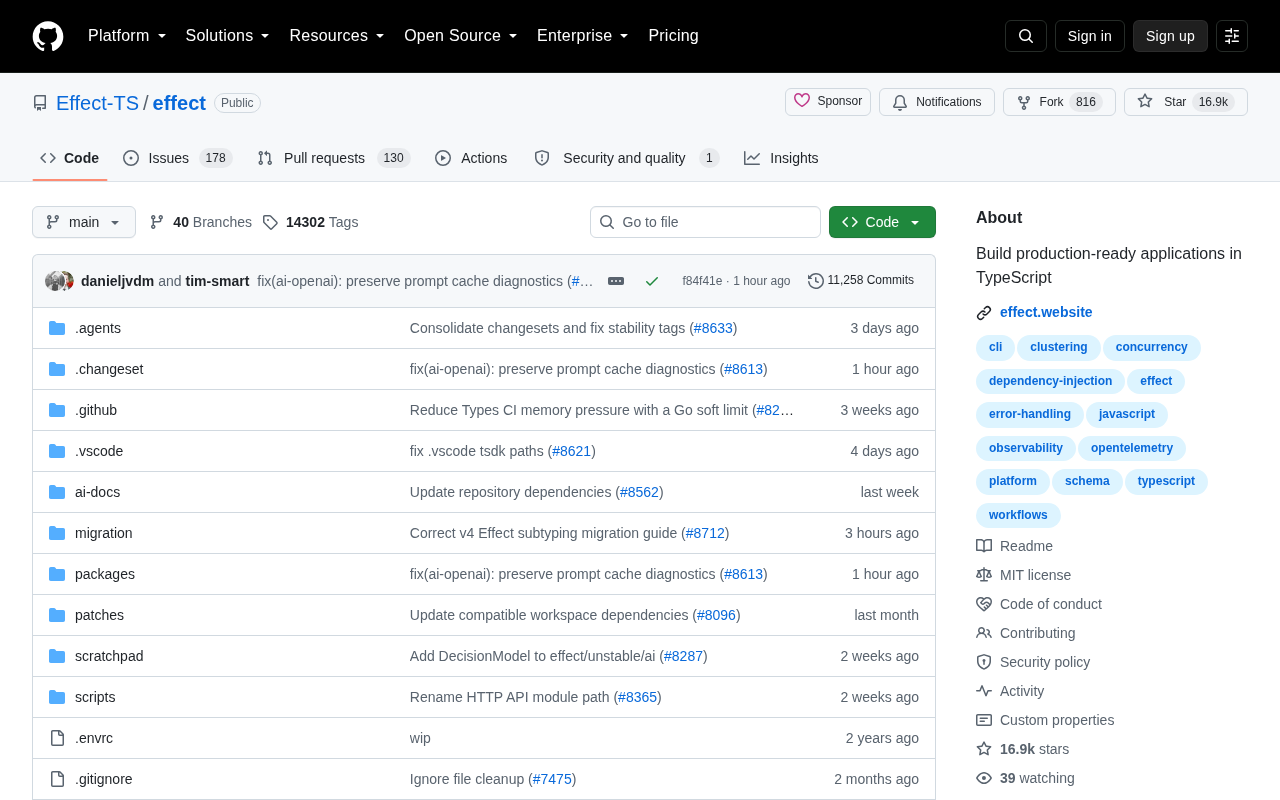
What Problem Does Effect-TS Actually Solve
Effect-TS positions itself as a framework for "building production-grade applications in TypeScript." It's not just another utility library — it's a full runtime and type system built on a functional programming foundation. Its key abstraction is the Effect type: a value that describes a computation that may succeed, may fail, and may require certain dependencies.
In traditional TypeScript, an async function's signature typically only tells you the return type; error types and dependencies are hidden in the implementation. Effect encodes all three into the type signature — success value, error type, and dependency environment — all at a glance. This means the compiler can catch unhandled error cases at build time, rather than letting them surface as runtime crashes in production.
This design draws inspiration from functional frameworks like Scala's ZIO, but has been adapted to TypeScript's language characteristics, allowing frontend and Node.js developers accustomed to imperative style to migrate incrementally.
Core Capabilities It Brings
Effect-TS consolidates scenarios that previously required multiple libraries into a single, coherent system:
Type-Safe Error Handling
Errors are no longer surprises exposed at runtime — they become first-class citizens in the type system. You can precisely distinguish between recoverable errors and defects, and explicitly catch, retry, or transform them using combinators, eliminating deeply nested try/catch blocks.
Effect's error handling distinguishes two categories of failure at the type level: Expected Errors (predictable errors encoded in the E parameter of Effect<A, E, R>) and Defects (unexpected exceptions, analogous to traditional uncaught exceptions). The former are part of normal business flow and require explicit handling; the latter are caught by the Effect runtime as a safety net, preventing the entire program from crashing. This is fundamentally different from traditional TypeScript, where all exceptions flow through the same catch channel. Common combinators include Effect.catchAll (catch all expected errors), Effect.retry (retry with scheduling strategies), and Effect.mapError (transform error types) — all fully type-safe, with the compiler ensuring every error branch is explicitly handled or propagated.
Structured Concurrency and Resource Management
Effect has a built-in Fiber (lightweight coroutine) model that supports cancellable concurrent tasks, timeouts, racing, and other patterns. Combined with the Scope mechanism, resources such as database connections and file handles are acquired and released automatically, preventing resource leaks.
Fibers are the fundamental unit of Effect-TS's concurrency model — think of them as green threads far lighter than OS threads, scheduled by the Effect runtime on JavaScript's single-threaded event loop. Each Fiber can be interrupted, enabling timeouts, racing (Effect.race), and structured concurrency (Effect.all parallel execution) to cancel safely — unlike Promises, which continue running in the background and consuming resources even after you've stopped waiting for them. The Scope mechanism binds resource lifecycle to Fiber lifecycle: regardless of whether a Fiber completes normally, errors out, or is interrupted, acquired resources are released in reverse order. This fundamentally eliminates the resource leak problem common in async code. This design philosophy draws from Kotlin's Structured Concurrency and ZIO's Scope — a systematic answer to the longstanding pain point of Promise chains having no awareness of cancellation.
Dependency Injection and Testability
Through Context and Layer, Effect provides a type-safe dependency injection solution. Business logic is decoupled from concrete implementations, making it easy to swap in mock implementations during testing — no additional DI framework required.
Effect's dependency injection system is built around three concepts: Context (a type-safe service container, similar to a Map keyed by type), Tag (a unique identifier for a service, used to look up its implementation from a Context), and Layer (a blueprint describing how to construct one or more services, with support for automatic dependency graph composition and lazy loading). Layer's design allows you to declare the entire application's dependency graph as a pure value, assembled at the program's entry point — tests simply swap in alternative Layer implementations, with no need for mock framework magic or reflection. Compared to popular decorator-based DI frameworks like tsyringe and inversify, Effect's approach operates entirely within the type system, with no runtime metadata dependencies and no need for experimental TypeScript decorator features.
Why It's Gaining Momentum Now
A growth rate of 466 stars in a single week reflects a rising community demand for "TypeScript reliability engineering." As TypeScript projects grow in scale, teams increasingly require maintainability, observability, and predictable error behavior.
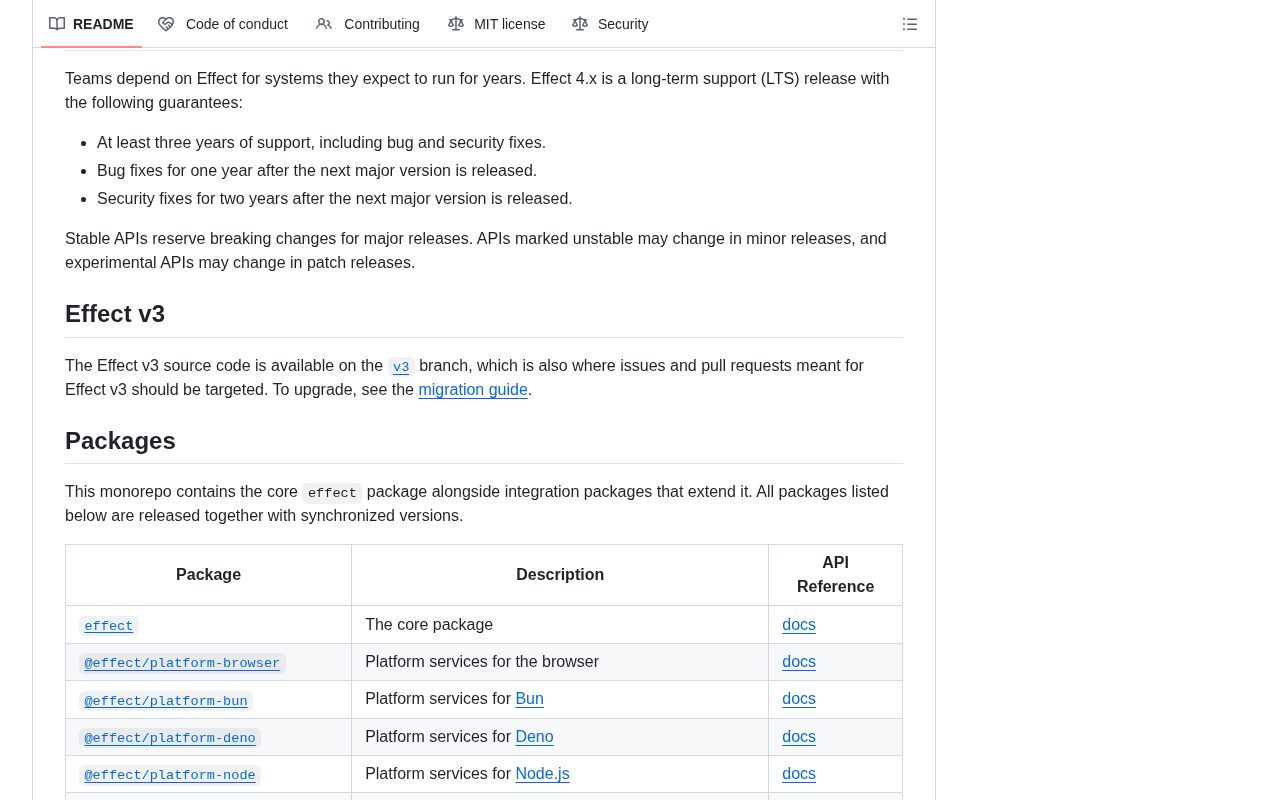
Effect-TS incorporates observability (tracing, logging, metrics) into the framework's core design rather than treating it as an afterthought. For teams building microservices, backend APIs, or complex frontend state management, this "production-first" philosophy is highly appealing.
Effect is also not an all-or-nothing proposition. It supports gradual adoption — you can introduce Effect in isolated modules and expand usage over time, lowering the migration barrier for large existing projects.
Learning Curve and Practical Considerations
To be objective, Effect-TS has a non-trivial learning cost. The combinator-heavy functional programming style and deep reliance on the type system present a real hurdle for developers used to traditional patterns. On first encounter, complex type signatures and a large API surface of combinators can create significant cognitive overhead.
That said, these constraints are precisely where the value lies: shifting more errors from runtime to compile time, and making architectural decisions explicit. For medium-to-large teams prioritizing long-term maintainability, this learning investment typically pays off. For smaller projects optimizing for rapid prototyping and development speed, however, Effect may feel like overkill.
Summary
Effect-TS represents one direction in which the TypeScript ecosystem is evolving toward "reliability engineering." By using the unified Effect abstraction to integrate error handling, concurrency, dependency injection, and observability, it provides a more solid type-safe foundation for building production-grade applications. Its 16,832 stars and sustained growth signal that an increasing number of developers are willing to invest in the learning curve in exchange for greater robustness. It may not be the right fit for every project, but it's worth understanding for any developer who takes TypeScript engineering quality seriously.
Related articles

Felix Rieseberg Personal Homepage
Felix Rieseberg's personal homepage sparks attention on Hacker News. This article covers the Slack engineer's technical background, the rise and fall of nativefier, and the value of a developer homepage as a tech calling card.

@ai-sdk/vue 3.0.306 Patch Release Syncs with [email protected] Update
@ai-sdk/vue 3.0.306 released, synced with [email protected]. A routine patch release for the Vercel AI SDK ecosystem with no public API changes; the Vue adapter layer stays version-aligned with the core package.

Gemini 4 Argon API Launches: The Era of Million-Token Output Begins
Google launches Gemini 4 Argon with sparse MoE architecture, up to 1M output tokens, and a 68.90% Vals Index score, available across API, AI Studio, and the Gemini app.