Eight States Sue OpenAI: Is ChatGPT Safe for Children?

Eight states sue OpenAI, sparking fierce Reddit debate: who is responsible for AI child safety?
Eight state attorneys general have jointly sued OpenAI, alleging ChatGPT poses a safety hazard to minors, signaling a shift from观望 to action by regulators. Reddit reactions are polarized: one side blames parental negligence and calls for stronger guardianship rather than platform accountability; the other argues digital tools are now educational infrastructure, making simple bans impractical. The debate also touches on generational differences in risk and claims that the lawsuit stems from anti-AI sentiment. The core issue is the blurred boundary between platform and parental responsibility, which no single party can resolve alone.
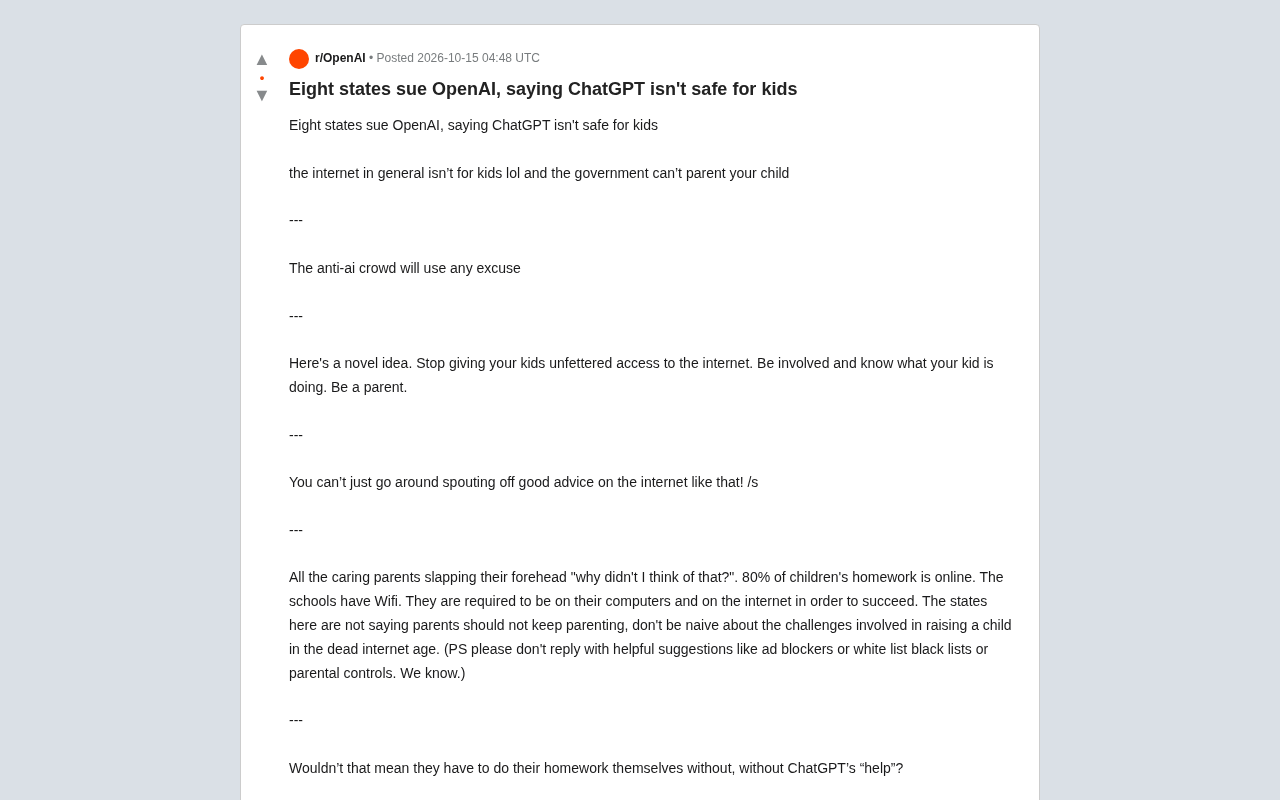
Eight states have joined forces to sue OpenAI, alleging that ChatGPT poses a safety hazard to minors. The lawsuit once again thrusts the issue of child protection in AI products into the spotlight—but on Reddit, the community's reaction is far more complicated than the lawsuit itself. The core debate isn't "whether AI is risky," but "who should be held responsible."
The Core Dispute Behind the Lawsuit
According to Reddit discussion threads, the attorneys general of eight states have jointly filed a lawsuit against OpenAI, with the central claim being that ChatGPT has failed to effectively protect underage users. This isn't the first time an AI company has faced such legal challenges, but the multi-state joint action carries stronger signal value: regulators are shifting from "wait and see" to "taking action."
The specific demands of the lawsuit have not been detailed in the discussions, but based on community reactions, the controversy centers on the boundary between platform responsibility and parental responsibility. This is precisely the most thorny gray area in current AI governance.
State attorneys general (AG) are the highest law enforcement officials in each state, with the independent power to file civil lawsuits, investigate corporate wrongdoing, and seek damages on behalf of state residents. In multi-state joint lawsuits, one or two states typically lead, with the rest joining as co-plaintiffs, and the outcome often sets a precedent for the entire industry. This kind of joint action differs from federal-level regulation (such as the FTC) in that it bypasses federal legislative gridlock and applies pressure directly at the state law level. Historically, multi-state AG joint lawsuits against tobacco companies, pharmaceutical firms, and social media platforms have all driven substantive changes in industry rules. Therefore, the signal value of eight states suing OpenAI lies in this: AI governance is shifting from industry self-regulation and federal观望 (wait-and-see) to the actual implementation of state-level enforcement actions, which may pave the way for more states to join or for follow-up legislation.
Community Perspectives: Parental Responsibility vs. Platform Responsibility
Reddit discussions show a stark polarization.
One camp argues this is fundamentally a matter of parental negligence. A top-voted comment states bluntly: "Don't give your kids unrestricted internet access, be involved in their lives, know what they're doing," and asks, "Who is letting their kids chat with ChatGPT? Don't do that." This view holds that the government cannot replace parents in exercising guardianship duties, and shifting responsibility to AI companies is targeting the wrong party.
The other camp points out that this "manage your kids" advice is overly naive. A heavily endorsed comment rebuts: "80% of children's homework is done online, schools have WiFi, and they must use computers and the internet to complete their studies." This commenter emphasizes that raising children in the "dead internet era" presents challenges far beyond imagination, and simple blacklists or parental controls cannot solve structural problems.
This debate reveals a deep-seated contradiction: when digital tools have become the infrastructure of education, "choosing not to use them" simply isn't a realistic option.
The so-called "Dead Internet Theory" was originally an online conspiracy theory holding that most content on today's internet is automatically generated by bots and AI, with genuine human activity accounting for an extremely low proportion. While its extreme version lacks evidence, the phenomenon it describes—platform content being flooded by algorithms and automated content, with real human interaction diluted—is real. In the parenting context, this concept is used to emphasize: contemporary parents aren't facing an internet where they can simply block a few bad websites, but an environment where content is difficult to distinguish as true or false, recommendation algorithms actively push content, and AI generates conversations at any moment. Traditional parental control tools (such as whitelists and time limits) target "which websites are accessed," but struggle to address "what content AI actively generates in conversation." This is precisely the technical background behind the commenter's view that parental controls cannot solve structural problems.
Generational Perspective: From Free-Range to Surveillance
An interesting entry point in the discussion is generational difference. One commenter noted: "Do you know what this sounds like to Gen X? We were exposed to the entire real world unsupervised back in our day."
This comparison isn't simply "things were better back then" nostalgia. It raises a real question: the digital survival environment of contemporary children and the physical world exploration of the previous generation have fundamentally different risk natures. Physical world risks are typically visible, localized, and buffered by community; AI conversation risks are hidden, scalable, and lack social intermediaries.
But conversely, using "how things were in our day" to dismiss contemporary parents' anxieties is equally a form of cognitive laziness.
The Social Amplification of Risk theory was proposed by sociologist Kasperson and others, arguing that the impact of risk events depends not only on their objective harm but also on how media, the public, and institutions transmit and interpret them. On the issue of AI child safety, this theory helps explain why the same technology triggers vastly different reactions among different groups: parent groups may amplify anxiety due to media coverage, while tech communities may underestimate risks due to familiarity with the technology. The theory also points out that risk amplification often leads to a "ripple effect"—a lawsuit or scandal can affect the entire industry, prompting regulators to take actions beyond the scope of the original event. The eight-state lawsuit against OpenAI may produce precisely such an amplification effect; even if the lawsuit itself targets specific allegations, its chain reactions could reshape the entire AI industry's minor protection standards.
Confusion Between Anti-AI Sentiment and Genuine Concerns
Another noteworthy thread in the discussion: some commenters believe this lawsuit is merely "another excuse found by the anti-AI crowd."
This suspicion isn't entirely unfounded. Public discourse around AI is indeed filled with voices of mixed motivations. But categorizing all concerns about AI child safety as "anti-AI" is equally a simplification. The question raised by the lawsuit—what standards should AI products meet for minor protection—is real and urgent.
As one comment sarcastically pointed out: "Claiming it's unsafe for children isn't safe for children either." The subtext of this statement is: excessive panic narratives themselves harm the public's rational understanding of AI.
Who Defines "Safety"?
Where this lawsuit ultimately leads remains unknown, but it forces all stakeholders to answer a fundamental question: who should set the "child safety" standards for AI products, and how should they be enforced?
Platforms can strengthen age verification, content filtering, and usage time limits; parents can manage devices and provide guidance through communication; schools can establish AI usage guidelines. But no single entity can solve this problem independently. The lawsuit may push legislative progress, but if it ultimately just shifts responsibility from one entity to another, the problem itself won't disappear.
The chaos and division in the Reddit discussion are precisely a reflection of the true complexity of this issue.
One-line Summary
Eight states sue OpenAI, sparking fierce Reddit debate: who should be responsible for AI child safety?
Paragraph Summary
Eight state attorneys general have jointly sued OpenAI, alleging that ChatGPT poses a safety hazard to underage users, marking a shift from观望 (wait-and-see) to action by regulators. Reddit community reactions are polarized: one camp believes this is parental negligence and that guardianship should be strengthened rather than holding platforms accountable; the other points out that digital tools are already educational infrastructure, making simple bans unrealistic. The discussion also extends to a generational perspective—the AI risks contemporary children face differ in nature from the physical world risks of the previous generation—and some commenters view the lawsuit as a product of anti-AI sentiment. The core contradiction lies in the blurred boundary between platform responsibility and parental responsibility, which no single entity can resolve independently, and who sets the "child safety" standards and how to enforce them remains a fundamental unresolved question.
Related articles

JobRunner MCP Server: AI Agents Can Now Fix Failed Java Jobs
JobRunner launches an open-source MCP server enabling AI agents to view cluster status, diagnose failures, and recover Java jobs—incident response from any cloud coding environment or existing agent.

MLAI Digital Launches 9 Security Agents: MCP Server Safeguards the Full Lifecycle of Agentic AI
MLAI Digital launches Security MCP Server with nine built-in specialized security agents covering vulnerability discovery, attack simulation, prompt injection detection, API and infrastructure assessment, and accelerated remediation—embedding security validation across the full Agentic AI lifecycle from development to production.

Running Isaac Lab on H100 GPUs: Exploring Better Approaches
Exploring optimization methods for running Isaac Lab on NVIDIA H100 GPUs, including MIG configuration, mixed precision, TensorRT acceleration, and community experience to improve robotics simulation and reinforcement learning efficiency.