EkLine: Helping AI Agents Discover and Recommend Your API

EkLine uses auditing plus PR-based fixes to help API products be correctly understood and recommended in AI answers.
The article introduces EkLine, an early-stage Product Hunt product targeting developers' new procurement path of "ask AI first, then write code," treating "AI visibility" as an auditable, fixable, measurable engineering problem. Its workflow has four steps: AI agents scan websites, docs, GitHub, and community content to find where models misunderstand or cannot implement things; prioritize gaps by business impact; submit code-backed fixes as Pull Requests; and re-test AI responses to measure improvement. The author considers embedding fixes into code review a pragmatic design, but notes the product faces re-testing costs and attribution challenges from model version drift, and PR backlogs can make audit results stale. The product is still early, but its question — "what does your product look like in AI's eyes" — deserves attention from developer tool teams.
When Buyers Ask AI First, Then Write Code
The decision-making path for developers and technical buyers is changing. More and more people no longer start by searching for tools on search engines, but instead directly ask ChatGPT "which API is suitable for this task," then hand the answer to Cursor to implement. EkLine, which emerged on Product Hunt, targets exactly this new funnel: if your API is absent from AI answers, or doesn't work when AI generates code, you've effectively disappeared from the procurement list.
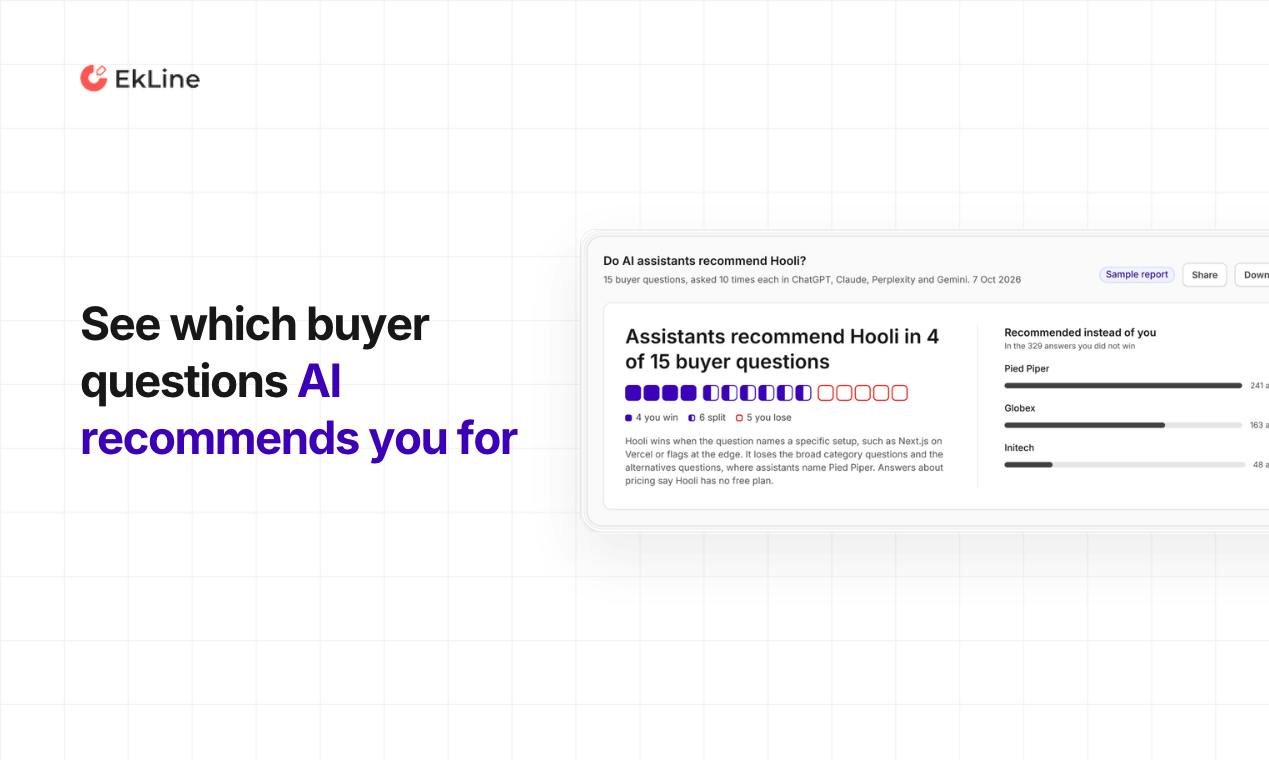
EkLine's positioning isn't yet another SEO tool — it treats "AI visibility" as an engineering problem that can be audited, fixed, and measured. Its product description is blunt: AI agents audit your website, documentation, GitHub, and community content to find where AI misunderstands or cannot implement things, then provide a prioritized gap list, submit code-backed fixes as Pull Requests, and finally re-test AI responses to measure improvement.
The Paradigm Shift from "Being Found" to "Being Recommended"
Traditional SEO cares about keyword rankings and click-through rates, while EkLine cares about an earlier link in the chain: whether AI can correctly understand your product when generating recommendations and code. These two things have completely different technical requirements.
Search engines crawl page text, while AI agents need executable understanding — your API authentication method, parameter constraints, error code meanings, typical call sequences. Any ambiguity can cause generated code to fail. EkLine claims its audit scope covers websites, documentation, GitHub, and community content, essentially piecing together information scattered across multiple touchpoints into a product profile in AI's eyes.
This also explains why it lands fixes as Pull Requests. Compared to giving a report of "suggested copy improvements," directly producing code-level changes is easier for engineering teams to accept and verify — after all, whether example code in documentation actually runs is precisely where AI is most likely to stumble.
GEO (Generative Engine Optimization) is the key background for understanding this shift. Traditional SEO optimizes a webpage's ranking in search result lists, where users see a link and click to judge for themselves; GEO optimizes the probability and accuracy of a brand or product being mentioned, correctly described, and recommended in LLM-generated natural language answers. The levers differ: SEO relies on keywords, backlinks, and page structure, while GEO relies on factual consistency of content, degree of structuring, and coverage density in training/retrieval corpora. Currently, the common industry method for measuring GEO effectiveness is "prompt set testing" — constructing a batch of questions real users might ask, and observing whether the target product appears in answers from different models and versions, and whether descriptions are accurate. EkLine's "re-test" step is essentially the productization of this method.
Product Mechanism: Audit, Prioritize, Fix, Re-test
EkLine's workflow can be broken into four stages, each corresponding to a specific deliverable.
Audit: AI agents scan websites, documentation, GitHub repositories, and community content to locate where AI understanding deviates or cannot implement things. The output of this step is an "issue list in AI's eyes," not a vague content quality score.
Prioritize: After identifying gaps, rank them by priority. For API products, documentation gaps in authentication and core calls are obviously more critical than phrasing issues in edge features — prioritization determines where the team fixes first.
Fix: Submit code-backed changes as Pull Requests for team approval and merging. Putting fixes into the normal code review process is a pragmatic design choice — documentation changes and code changes go through the same review mechanism, avoiding the disconnect between "marketing copy" and "technical documentation."
Re-test: After modifications, re-test AI responses to measure which metrics actually improved. This step turns "AI visibility" into a trackable metric rather than a one-off consulting project.
The article repeatedly mentions "AI-generated code doesn't work," which involves the mechanics of RAG (Retrieval-Augmented Generation) and tool calling. When developers ask ChatGPT or Cursor how to use an API, models typically rely on two types of information: product knowledge memorized from training corpora, and official documentation fragments retrieved in real-time. If documentation lacks executable examples, has vague parameter descriptions, or undefined error codes, the model will "hallucinate" seemingly reasonable but actually incorrect usage — such errors are called hallucinated API calls. For API providers, this means documentation isn't just for humans to read, but also for models: structured parameter tables, complete runnable example code, and clear authentication steps all directly improve the first-pass success rate of AI-generated code.
Who Needs to Care About AI Visibility
Judging from EkLine's categories on Product Hunt — SEO, Developer Tools, Artificial Intelligence — its target customers are API and developer tool teams. This group shares several characteristics: product decisions depend on technical documentation, customer acquisition relies heavily on developer word-of-mouth, and differences in competitors' exposure in AI training corpora directly affect recommendation results.
An easily overlooked point: AI recommendations often carry a "default option" effect. When developers ask "what tool to use for X," the first answer AI gives significantly influences subsequent tool selection, and that answer comes from the model's comprehensive understanding of public content. If your documentation is poorly structured, example code is outdated, and GitHub issues go unanswered, AI will likely give a solution that "looks usable but doesn't actually work" — developers will switch to competitors after one failed attempt.
EkLine attempts to solve exactly this silent churn. It doesn't promise to rank your API first in AI answers, but at least ensures that when AI mentions you, it says the right thing that actually works.
The "default option" effect corresponds in behavioral economics to anchoring and status quo bias: when users face uncertain choices, they tend to adopt the first-appearing or least-effort option. In AI assistant scenarios, this effect is amplified — developers often directly adopt the first answer without cross-verification, because verification costs more than trial-and-error costs. For developer tools, this means ranking position in AI answers has leverage far exceeding the second page of traditional search. At the same time, note that model answers exhibit version drift: the same prompt may yield different recommendations across different model versions and system prompts, so single test results are insufficient as long-term conclusions — you need to establish baselines and periodically regress.
A Few Calm Observations
The opportunities and uncertainties in this space are equally obvious. The opportunity: AI assistants are becoming the entry point for technology selection, yet almost no teams have a dedicated "AI visibility" owner — the need for tooling is real. The uncertainty: AI model answers drift with version updates — responses that pass re-testing today may change next month due to model upgrades. Who bears the ongoing re-testing costs, and how to attribute results, are questions the product needs to answer.
Additionally, writing fixes as Pull Requests, while elegant engineering-wise, means deep dependence on team response speed. If PRs pile up, audit results become stale, and the value of this closed loop diminishes.
EkLine is currently an early-stage product on Product Hunt, with 21 comments and 80 votes — not enough discussion volume to judge market validation. But the question it raises deserves serious attention from all teams building APIs and developer tools: in an era where AI becomes the first filter, what does your product actually look like in AI's eyes?
Related articles

Michael Nielsen Takes Down His Classic Neural Network Textbook, Sparking Community Discussion
Michael Nielsen's classic free textbook Neural Networks and Deep Learning has been taken offline, sparking discussion on Hacker News about the reasons and impact.

Inside the AI Training Data Market: The Trade-off Between Exclusivity and Discounts
G2i founder Gabe Greenberg reveals the dual-track pricing of the AI training data market: labs pay a premium for exclusive data or accept discounts that allow others to buy it.

SessionGraph: Unifying All Coding Agent Sessions in One Interactive Graph
SessionGraph aggregates coding agent sessions into an interactive graph, helping developers review, debug, and manage AI coding workflows across sessions. This article examines its positioning, value, and open questions.